Research notes: A Young Draughtsman in a Broad-Brimmed Hat
These notes set out, subject by subject, what the supplied photographs show, what identified sources report, and what remains an inference or an open question. They accompany the research dossier and do not change its conclusion: the drawing remains unattributed. They are not an attribution, valuation, legal opinion, provenance certificate or conservation report.
Notes 00–14 record the research as it stood on 26 September 2026. Where those notes say that no Ter Borch Strasbourg-lily record had been found, or direct a watermark enquiry only to RP-T-1887-A-1327, that finding is superseded by notes 15 and 16, prepared 5 October 2026. Note 15 is the watermark account. Note 16 is the source list and reading scope. The working name used in the original notes has been replaced here by “the present sheet”. Private correspondence, unsent drafts and internal instructions are not published.
Prepared: 26 September 2026 Purpose: public-facing research notes for a continuing investigation. They organise what is observed in the supplied photographs, what identified sources report, and what remains an inference or an open question. They do not constitute an attribution, valuation, legal opinion, provenance certification, or conservation report.
Status, prepared 5 October 2026. Notes 15 and 16 supersede the active watermark findings in notes 06, 10, 11 and 13. The September statement that no published Ter Borch Strasbourg-lily record had been found was a bounded metadata result. It is not the current finding. The drawing remains unattributed.
How to read these notes
OBSERVED means visible in a specified supplied image, scan, or reproducible comparison. It may still be limited by reproduction quality.
SOURCE-REPORTED means an identified institutional record, catalogue, or scholarly source states it. It applies to that object or record only.
INFERRED marks a reasoned possibility from listed evidence; it is not a source statement.
UNVERIFIED marks a testable question without sufficient evidence.
CONTRADICTED is used only where a stronger identified source conflicts with a specific claim.
The drawing remains unattributed. The present material does not establish a seventeenth-century date, an author, a sitter, a particular ink or paper composition, an authenticated signature, a historic provenance, or a direct copying mechanism.
The public research coverage register linked from the gallery records the treatment of the scientific notes that informed this set, including material retained only as an operational protocol or as a corrected historical claim. Private correspondence, private financial details, addresses, contracts, internal working instructions, and the original presentation files are not visitor content. Public catalogue-acquisition leads are distinguished from private financial information. Supplied extracted images are included with captions identifying what is observed, source-reported, and unverified. Each image retains its actual object-specific rights or permission status; inclusion here does not create a general reuse licence.
OBSERVED. The supplied present-sheet recto is a small digital image of a seated young man wearing a broad-brimmed hat at a table. Its visible marks include a persistent perimeter, brown linear passages, regular hatching in several shadow areas, and local darker reinforcement. These are image observations, not identifications of media, number of hands, or sequence of execution.
SOURCE-REPORTED. A distinct drawing recorded by RKD as Zittende jongeman aan een tafel, no. 116036, is catalogued as an anonymous seventeenth-century Northern Netherlandish work in black and white chalk on blue paper, 352 × 251 mm. Its object record concerns that comparator, not the present sheet. The inspected Sotheby's London catalogue of 6 July 2005, lot 141, describes a drawing of the same candidate as A Young Man in a Hat Seated at a Table, Filling His Pipe, Dutch School, seventeenth century, black and white chalk on blue paper, 352 × 251 mm, with a pencil inscription Terburg.
OBSERVED / INFERRED. The present sheet and the RKD candidate are separate objects, yet their figure arrangements are closer than the available present sheet–Dresden comparison under a documented, manual registration exercise. This warrants testing a design relation. It does not establish the direction of derivation, a common author, a shared sitter, tracing, or a date.
Questions kept open
Question
Current status
What would change it
Is the present sheet seventeenth-century?
UNVERIFIED
Object examination of support, media and documented history.
Is the present sheet by Barent Fabritius, Carel Fabritius, a Ter Borch, Drost, another pupil, or a later copyist?
UNVERIFIED
Controlled comparison with suitable primary controls, object study, and source-specific attribution evidence.
Is the present sheet related to RKD 116036?
INFERRED: design relation worth testing
Rectified images or original access, a blind comparison protocol, and image/object history.
Is the visible mark a complete WR or Strasbourg-lily watermark?
UNVERIFIED
Full-sheet transmitted-light or equivalent documented capture.
Is the sitter Titus van Rijn or another named person?
UNVERIFIED
Object-specific documentation and a stronger, independent constellation of evidence.
Does a named historical sale belong to the present sheet?
UNVERIFIED
Object identity through image, inscription, dimensions, support, collection record, or other traceable link.
Claims that cannot be recovered from photographs
Ordinary colour photographs and derivative scans do not identify iron-gall ink, bistre, fibre species, sizing, mould, ream, pressure, drawing speed, topography, or the number and identity of hands. Apparent dimensions describe a surviving sheet or its reproduction; they do not establish a standard workshop format. A similar watermark motif does not establish common mould, paper stock, date, or ownership.
Correction record
Earlier proposals of a fixed 153 × 206 mm Rembrandt-workshop sheet, a WR paper stock, a material twin, chemically identified media, a Rembrandt correction, and an unbroken provenance from Habich through Feldmann to the present sheet are unsupported by the cited evidence. Identified auction catalogue conflicts are set out in the provenance note. These corrections do not settle an opposite attribution; they keep the investigation attached to evidence that can be checked.
References: project Phase 0 claim ledger and risk review; RKD 116036; Sotheby's London, 6 July 2005, lot 141, printed p. 159; the documented visual-registration review of 20 September 2026. See Sources and next tests.
No institutional record or publication located in this investigation attributes the present sheet to Barent Fabritius, Carel Fabritius, Gerard ter Borch II, Moses ter Borch, Willem Drost, Rembrandt, or another named artist. A comparison can support a question or eliminate an overstatement; it does not transfer an attribution from one sheet to another.
Barent Fabritius
SOURCE-REPORTED. A small institutional and scholarly comparison corpus exists for drawings currently associated with Barent, but its boundaries are unstable and some historical Barent attributions are now rejected or qualified. Identified Barent records show a wider range of mixed media than can be diagnosed from the present sheet's photograph.
INFERRED. The available present-sheet image does not presently show a sufficiently distinctive correspondence with the controlled Barent corpus to support an attribution. This does not exclude Barent: media and sequence in the present sheet remain unexamined, and the secure drawing corpus is limited.
Carel Fabritius and the family boundary
Carel is a necessary near-neighbour control, not a secure negative corpus. The published and institutional boundaries of drawings associated with Carel are themselves qualified. A familiar name, a hat, a youth, paper, or a Rembrandt-school context cannot decide between Carel, Barent, another pupil, or an imitator.
Rembrandt, pupils, and anonymous school
The current evidence remains compatible with several Rembrandt-school possibilities, including an anonymous school or circle hand and a later derivation. It does not support direct Rembrandt intervention. Historical workshop practice provides context for repeated models and copies, but does not supply an object-specific link to the present sheet.
How comparisons should be weighed
Comparison type
What it can contribute
What it cannot contribute alone
Securely catalogued drawing of a named artist
A controlled range of medium, line, date, and working method
Automatic attribution of the present sheet.
Qualified or disputed drawing
A boundary case and alternative hypotheses
A secure corpus anchor.
Same composition or close design
A reason to test derivation or common source
Same hand, direction, or date.
Shared medium, hat, or format
Contextual compatibility
A diagnostic authorship criterion.
Historic inscription or sale heading
Attribution history
Authographic signature or provenance without object verification.
Current conclusion
The defensible public description is “unattributed drawing under comparative research.” The strongest new question concerns the relation of the RKD design to the Ter Borch family/workshop context; this is a research priority about the comparator's design, not a new attribution of the present sheet.
References: Barent corpus report; Carel boundary report; British Museum and Rijksmuseum comparison records; Ter Borch audit; Drost assessment. Full citations are in Sources and next tests.
SOURCE-REPORTED. Sotheby's 2005 lot 141 records a pencil inscription Terburg on the large chalk drawing associated in the current research record with RKD 116036. Sotheby's nevertheless retained the object as Dutch School, seventeenth century; it did not call the mark an authenticated signature or attribute the sheet to Gerard ter Borch.
The inscription therefore provides an object-specific reason to investigate a Ter Borch association and the comparator's attribution history. It does not name the present sheet, prove a hand, or identify a sitter.
Three supplied crops now make the evidentiary position more precise: an RKD monochrome crop (281 × 134 pixels), an RKD colour crop (249 × 135 pixels), and a Sotheby's PDF crop (381 × 208 pixels). OBSERVED: each is a reproductive view of the same reported inscription area, with faint cursive marks, limited tonal separation and reproduction pattern/halftone. They make the reported reading available for scrutiny; they do not authenticate a signature, identify its writer, date the addition, or turn three reproductive witnesses into three independent signatures.
Controls and their qualifiers
Gerard ter Borch II: Boijmans H 223 and Städel 926 carry unqualified institutional names, but do not establish a common author with the present sheet. Cleveland 1941.603 offers a useful black-chalk-and-white comparison and records a verso name; the record does not authenticate that name as a signature.
Qualified Städel group: Städel 924, 2917, and 2916 display Gerard ter Borch the Younger ? and retain Moses ter Borch — by note on mount as an alternative. These qualifiers are part of the evidence, not editorial clutter to omit.
Studio control: Sotheby's 2022 lot 169 is catalogued Studio of Gerard ter Borch II. Its note reports that Kettering placed a related group with an unidentified student, not securely with Gerard or his family. It is a workshop-boundary control.
Moses ter Borch: Rijksmuseum self-portraits provide documented examples of black and white chalk on blue paper. Other Moses controls carry qualifiers. Shared media and youthful figures are useful comparisons, not authorship tests.
Repetition and transfer
SOURCE-REPORTED. Städel 2916 is catalogued as a copy and decalcomania; its German record calls it Rötel (Abklatsch) and presents 2917 as the related reference. The two sheets have close dimensions, while both retain qualified authorship and a Moses alternative.
This documents a particular counterproof/copy relationship in a Ter Borch-associated group. It does not demonstrate that the present sheet is a counterproof of RKD, that their scale relation has the same cause, or that Gerard made either sheet.
Korevaar and Tauber's study of repetition and transfer in documented Ter Borch works gives additional historical context. It does not analyse the present sheet or RKD 116036.
Inscription controls and a language discrepancy
The Rijksmuseum records a Gerard drawing explicitly described as signed by the artist; that is a useful category control, not an authentication of Terburg elsewhere. Other museum fields use terms such as mentioned on object, signature, and annotation, which must not be treated as interchangeable.
Fondation Custodia inv. 5111 preserves a verso v. J. Terburg, but its English and French pages differ over whether the marks are described as pencil or brush. The public conclusion should be confined to a verso inscription, without using the stated medium as technical evidence.
Proper scope of the hypothesis
INFERRED. The available sources justify a focused question about whether the RKD design has a connection within or around the Ter Borch family/workshop. UNVERIFIED: whether the RKD object is by Gerard, Moses, a pupil, another artist, or a later copyist; whether the present sheet shares its author; and whether the inscription predates the drawing's later history.
References: Sotheby's 2005 lot 141, p. 159; Boijmans H 223; Städel 926, 924, 2917, 2916; Sotheby's 2022 lot 169; Cleveland 1941.603; Rijksmuseum controls; Kettering (1988), located but not fully read; Korevaar and Tauber (2014).
RKD 116036, design relation, and reproduction history
RKD 116036 and the present sheet must be kept separate. The RKD record describes another sheet and attaches two distinct image records: a colour reproduction (9141481) and a black-and-white photograph (9158962). The available colour and monochrome files have different framing, margins, lettering, and pixel dimensions. This contradicts only the narrow claim that the monochrome is a simple grayscale conversion of the colour file; it does not prove that the two files are independent captures of the original.
The current 2005 Sotheby's page supplies a documented lot page, subject title, technique, dimensions, and the reported Terburg inscription for a strong object candidate. Three supplied crops of that inscription zone—RKD monochrome, RKD colour, and a Sotheby's PDF reproduction—show faint cursive marks but also limited tonal separation and halftone/reproduction pattern. They are three reproductive witnesses to one reported mark, not independent signatures or proof of an autograph. The catalogue and crops do not, by themselves, identify the immediate source of either RKD image or establish an object history before the sale.
What the visual comparison shows
OBSERVED / INFERRED. A documented registration exercise, based on six manually selected broad landmarks and four retained checks, left lower residuals for present sheet–RKD than for present sheet–Dresden. The exercise makes RKD the priority compositional comparator in the available set.
This is not a line-by-line overlay. The points were selected manually, the images are not orthorectified, and the retained points do not form a blind validation sample. Residual values are descriptive of one configuration, not a probability of copying or a measure of authorship.
Several regional comparisons support questions rather than conclusions:
At the back, the present sheet's boundary appears near an interior route in the RKD design. It is UNVERIFIED whether that route is spine, seam, fold, abandoned contour, or a reproduction artefact.
Trouser and shadow regions preserve related organisation but differ in line and tonal treatment.
the present sheet's stepped horizontal shadow has no equivalently legible sequence in RKD. This weighs against a claim that every line coincides.
What follows from a close design—and what does not
INFERRED. The closeness is sufficiently specific to test direct derivation, an intermediate reproduction, or an earlier common design. It is not enough to choose among them. Same-hand repetition, workshop copying, copying by another hand, and later derivation remain separate possibilities.
Different nominal scale may weigh, after direct measurement and control for trimming, against contact transfer 1:1 between original sheets. It does not weigh against a reduced or enlarged copy, a transfer from a reproduction, or a common antecedent.
Reproduction quality
The 2005 catalogue image is a scan of a printed page, not a native photograph of the drawing. Its effective depiction of the work is comparable in pixel envelope to the available RKD files and retains a visible screen or grid. It improves the documentary history of the published comparator but does not reveal stroke endings, sequence, paper structure, watermark, or medium chemistry.
Next verification: obtain source/acquisition metadata for RKD image assets, a photograph or negative made directly from the drawing if one exists, and a perpendicular, scaled photograph of the present sheet. A comparison of non-iconographic reproduction artefacts may clarify image genealogy; it would still not establish authorship.
References: RKD 116036 and digital objects 9141481/9158962; Sotheby's 2005 lot 141, p. 159; the 20–25 September image-quality and registration audits.
The Dresden drawing C 1421, Junger Mann mit breitkrempigem Hut an einem Pult, is a historical comparator, not an established companion to the present sheet. The relevant institutional and catalogue records give a sheet of 183 × 140 mm and retain qualified institutional language in the Rembrandt-school / Samuel van Hoogstraten orbit. A contradictory 137 × 103 mm figure in a later client presentation is not supported by the SKD/Ketelsen reference and should not be repeated.
Relation to the present sheet
OBSERVED / INFERRED. The present sheet and Dresden share a general young-man-at-desk motif and some visual conventions. The available visual registration makes RKD—not Dresden—the closer compositional comparator under the selected landmarks. This does not prove that Dresden is independent of the present sheet or RKD; it means the current reproductions do not establish the same degree of close correspondence for that pair.
The following possibilities remain open: common model or arrangement, direct derivation, derivation through a reproduction, generic resemblance, or no direct relation. Neither the Dresden record nor its attribution history adds the present sheet or RKD to its documented group.
The Dresden catalogue discussion of particular irregularities, including the relation of the desktop to the figure's overlong thighs, belongs to C 1421. It neither invalidates the separate present sheet–RKD back observation nor proves that the present sheet selectively corrected, ignored, or copied any Dresden feature. Each proposed contour route must be assessed in its own pair and at the available image quality.
Reproduction history
The illustrated literature surrounding C 1421 matters because a later copy can derive from a published image rather than an original sheet. The project has verified that historical references and potential earlier illustrations need separate treatment: an identified bibliography is not evidence that a particular plate was inspected or available to a copyist. The directly checked reproduction history must not be overstated as the first possible publication when earlier references remain uninspected.
Paper and attribution limits
No watermark has been documented in the public record inspected for Dresden. This must not be restated as a demonstrated physical absence on the original, and it does not make a paper relationship impossible. Conversely, no mould, stock, ream, workshop, or date relationship with the present sheet has been demonstrated.
Next verification: inspect C 1421 through an institutional image or object-study route; obtain full paper structure and any technical documentation; and distinguish plates actually consulted from bibliographic citations only. Any comparison should preserve the institutional qualifier separately from scholarly proposals.
References: SKD online record for C 1421; Dittrich and Ketelsen, Rembrandt. Die Dresdener Zeichnungen (2004), cat. 95; C 1421 relation report and reproduction-timeline audit.
Status, prepared 5 October 2026. The active watermark account is research note 15. The September finding below, that no published object-specific Strasbourg-lily record had been located, was a bounded online-metadata result. It is superseded by seven Kettering part I entries. RP-T-1887-A-1327 / M 18 remains a corrected historical lead: a possible lamb fragment in a crowned shield, recorded in the Dutch metadata as Schild met kroon. The text below is kept as the record of that earlier check, not as the current finding.
What is visible
The supplied photographs show laid-paper-like structure and a partial wiremark area. They do not provide a complete, rectified transmitted-light record of the sheet. No reliable reading of WR, a crown, shield, countermark, or complete Strasbourg-lily variant has been established from these images.
What dimensions and motifs can mean
Sheet dimensions are descriptive. They do not establish a workshop standard, a mould, common stock, common ream, sequence in a sketchbook, date, or authorship. A partial lily/crown/letter motif is compatible with multiple paper traditions and copies. A countermark is normally a separate mark on another part of a sheet; an element below a shield should not automatically be relabelled a countermark.
WR must not be expanded into a named paper stock without a source that supports that reading for the object. Watermark literature records WR in more than one family of marks and shows that motifs and initials were copied. Identification requires the entire mark, its relation to chain and laid lines, wire deformations, orientation, and comparison with documented exemplars.
September 2026 Ter Borch watermark check
SOURCE-REPORTED / negative result with limits. A targeted review of accessible institutional records and watermark literature did not locate a published, object-specific Strasbourg-lily record for a drawing institutionally attributed to Gerard ter Borch I/II, Moses, Harmen, or Gesina. This is not proof that none exists: Kettering's two-volume catalogue was not read page by page, and conservation records may not be public.
The review found object-specific PM / letters PM records for individual Gesina and Moses sheets, and an English/Dutch discrepancy in the level of watermark description for another Gesina sheet. It also found a WR-bearing Pieter Lastman drawing that passed through the Ter Borch studio estate. That is a useful warning: a family collection or studio-estate history does not make a watermark evidence for an artist in that family.
The most useful specific lead is Rijksmuseum RP-T-1887-A-1327, Boy Squatting to Relieve Himself beside a Dog, attributed to Moses ter Borch, c. 1656–57. The museum's public JSON-LD records Schild met kroon (shield with crown), and links the sheet to Kettering M18, vol. I, p. 296 (illustrated). This is SOURCE-REPORTED terminology for that object. It does not identify a fleur-de-lis, letters, a Strasbourg-lily variant, a full countermark, or an autograph Moses sheet. It is a defined technical follow-up, not a material match.
Other exact records retain the same limits: Städel 923 Z (Moses, Standing Youth in Naval Uniform) records B mit Krone; Städel 924 Z (Gerard II ?, with a Moses alternative on the mount) records Wappen mit Flügeln [?] und dem Buchstaben B; Rijksmuseum RP-T-1887-A-1260 (Gesina) records PM; and RP-T-1887-A-1125 (Moses mentioned on the object) records letters PM. None is a verified Strasbourg-lily record. Conversely, the apparent Crown with a fleur-de-lis in Rijksmuseum RP-T-1887-A-1174 belongs to a drawing catalogued as school of Rembrandt, even though it came from the Ter Borch estate; it cannot be converted into Ter Borch paper evidence.
The search trail matters. Public Kettering-linked metadata for 1,308 unique records was searched, yielding 13 records containing watermark terms. Those hits include recto/verso records of one sheet and archival material, so they are not 13 independent drawings; none expressly named a Strasbourg lily. This is a bounded metadata search, not a census of every watermark in the Ter Borch corpus. Object JSON does not always carry the technical text visible in a scientific catalogue: RP-T-1887-A-1174 is a concrete counterexample. The printed Kettering catalogue and technical records therefore remain necessary checks.
SOURCE-REPORTED: Rijksmuseum's Watermarks Project began in 2024 and describes low-energy radiography of roughly 4,000 seventeenth-century Dutch drawings, with images shared internally, a preliminary index, and intended future open publication. It does not say that the full dataset is publicly downloadable. The project page identifies Aurora Belli as Research Technician / Junior Paper Conservator. These facts describe a possible research route, not a published present-sheet comparison.
September 25 supplied photographs
Eight supplied JPEGs (IMG_6605.JPG–IMG_6612.JPG) add limited but real clarity. Their primary images are 640 × 480 pixels; embedded HDR gain-map auxiliaries are 320 × 240 pixels and do not measure depth, infrared response, radiography, or paper structure.
OBSERVED: the close view IMG_6608.JPG, with broader views IMG_6605.JPG, IMG_6606.JPG, and IMG_6612.JPG, repeats a marginal group of light, curving, approximately symmetrical lines. In IMG_6608.JPG the visible portion includes a narrow central configuration, rounded paired side contours, an arched or undulating upper sector, and at least two short strokes towards an irregular current edge.
INFERRED: repetition across those views makes it more plausible that a localized structural feature of the support, compatible with a wire element, is being recorded rather than a one-off reflection. The photographs remain oblique, non-coplanar and unregistered; rulers are not a valid physical scale. They do not identify the design as a crown, WR, a Strasbourg lily, Type E, a mill, a mould, or a date. Edge irregularities support recording each edge, but do not prove trimming or loss of a watermark.
WZIS/Piccard and Briquet give comparative historical entries for lily-and-WR families, but neither identifies the present sheet or a Ter Borch drawing. WIRP-style methodology demonstrates why whole-motif and chain-line information are needed before naming a variant.
Material claims not supported
The present files do not identify fibre as flax/hemp, ink as iron gall or bistre, sizing, paper date, mouldmates, same ream, or a material twin. A visually empty online watermark field means “not reported/examined in that record,” not a demonstrated absence on an original sheet.
Next test
Capture the entire present sheet under transmitted light or an appropriate non-invasive equivalent, with scale, orientation, rectification, chain/laid-line intervals, all visible wire features, and full recto/verso context. Compare potential matches against complete, object-specific technical records. A first focused external query, if later authorised, would be RP-T-1887-A-1327 / Kettering M18, vol. I, p. 296: request the full watermark image, variant designation, dimensions, chain-line relation, and countermark information. Even a confirmed watermark would date paper circulation, not necessarily execution of the drawing.
References: paper assessment and non-invasive laboratory brief; WIRP method; WZIS/Piccard; Briquet; Rijksmuseum object records; Kettering, Drawings from the Ter Borch Studio Estate (1988), cited object entries; 25 September new-photographs assessment; and the 26 September Ter Borch watermark synthesis.
The sitter is currently unidentified. Authorship and sitter identity are separate questions: a proposed artist does not identify the figure, and an apparent facial resemblance cannot attribute a drawing.
Titus van Rijn has been proposed as a possibility, but no source located identifies the present sheet or RKD figure as Titus. The comparison portraits themselves require qualification. For example, institutional language concerning a KHM painting differs between English and German versions, while the Boijmans record keeps a possible identification. Such records may provide historically relevant comparators; they are not a chain of identity for another image.
Hair, hat, and facial resemblance
OBSERVED. The present sheet and RKD show elongated, curved locks beneath a brimmed hat. Some Titus comparison portraits show fuller curls or waves. This difference is a limited visual reservation, not an exclusion or identification: view, medium, cropping, and abbreviation differ, and a copied design may carry inherited rather than observed features.
Hats, profile views, youths, desks, and broad clothing folds recur across seventeenth-century Dutch drawings and paintings. They are not individualising evidence. A comparison may be useful to ask whether a particular feature is convention, but it does not convert costume into identity.
The activity at the table
Sotheby's 2005 described the RKD-lot candidate as a young man filling his pipe. This corrects an earlier certainty that the comparator is a draughtsman. The present-sheet image should remain neutrally described as a seated young man working at a table until the small object and action can be resolved. Possibilities include drawing, writing, handling a pipe, or a related activity; none is established as the subject of the present sheet from the present image.
Next test
Priority evidence would be a source that names the sitter or a set of independent object-specific links: a contemporaneous inscription of known status, a documented related work, provenance identifying the model, or a high-quality comparison capable of testing multiple distinctive traits. Hair or a hat alone cannot carry that burden.
References: sitter assessment and protocol; KHM GG 410 and Boijmans Titus records; Sotheby's 2005 lot 141; September 2026 hair/source review.
A provenance link must identify this sheet through a photograph, dimensions plus distinctive features, inscription, collection mark, inventory, invoice, correspondence, or another traceable object-level record. A collector's interest in Fabritius, a sale title, a family collection, or an allegedly related drawing is not enough.
The documented modern custody assertions remain insufficient for a continuous ownership chain. This research therefore records gaps rather than declaring title, restitution status, UNESCO or export compliance.
Corrected auction references
Several proposed links are contradicted by the primary sale catalogues:
C. G. Boerner, 1931, lot 120 is Die Grablegung, 190 × 251 mm, not the present sheet.
Gilhofer & Ranschburg, 1934, lot 143 is Jordaens, Bauer und Satyr, 300 × 372 mm, not the present sheet.
Gilhofer & Ranschburg, 1934, lot 134 is attributed there to Samuel van Hoogstraten as Der Dreikönigstag, 206 × 153 mm. Sharing a reported measurement does not identify it with the present sheet.
The 1892 Habich catalogue concerns paintings and does not create a chain for the drawing. A general Sotheby's 2005 catalogue title mentioning the Feldmann Collection does not show that lot 141 was Feldmann property. No conclusion about title or historical loss follows from these corrections.
The Sotheby's 2005 comparator
The inspected page 159 of Sotheby's London, 6 July 2005, lot 141 is valuable documentary evidence: it publishes an image, subject title, Dutch School attribution, material, sheet dimensions, and a reported Terburg inscription for the candidate associated with RKD 116036. It does not identify the present sheet, document a realised price in the inspected source, prove Feldmann ownership of the lot, or establish the source of RKD's image files.
Reproduction history as an independent question
Close design can arise through original-to-copy transmission, photographs, printed catalogues, or a common source. Image genealogy must be evidenced separately from object provenance. The available RKD records show two image assets but not photographer, negative, printed source, or acquisition history. A visible page margin or screening pattern is compatible with print reproduction; it does not identify a specific publication without matching evidence.
Next test
Obtain object-specific modern documentation where appropriate; inspect the full lot 141 entry and image-credit context; and request RKD image-acquisition metadata or source details. These are research steps, not legal conclusions.
References: provenance event and gap reports; Boerner 1931; Gilhofer & Ranschburg 1934; Habich 1892; Sotheby's 2005 lot 141; RKD image-source audit.
OBSERVED. The present-sheet image contains lighter and darker brown passages, apparent variation in width, persistent contours, and regular hatching. There are diffuse halos near some worked areas. These observations justify a technical examination plan; they do not identify a pen, brush, ink chemistry, pressure, speed, a pentimento, or a sequence of campaigns.
UNVERIFIED. There is no adequate photographic basis to state that a pupil's drawing lies beneath a master's correction, that two people executed the sheet, or that Rembrandt intervened. Image filters based on luminance, including emboss or normal-map-like renderings, derive information from two-dimensional intensity and do not measure surface topography, ink depth, or order of marks.
One hand, multiple campaigns, or multiple hands
All remain open in principle. The currently available evidence is more compatible with one hand, local reinforcement, and self-correction than with a demonstrated second hand, but that is a provisional reading rather than an identification. A persuasive multiple-hands finding would need coherent, repeated differences in graphic system and, where relevant, material or stratigraphic evidence at crossings.
The Drost comparison
British Museum Oo,9.96 is a useful control because its published history includes a qualified Drost attribution and a Rembrandt-school context. The 2010 catalogue calls the Drost attribution plausible and recognises the heterogeneity of the relevant comparison group. It does not attribute the present sheet to Drost, identify a sitter, prove a shared workshop session, or establish identical paper or media.
The object is useful to test particular conventions—broad hat, hatching, and local dark accents—not to turn these broad conventions into a signature. Drost's documented chronology also weakens proposals that treat a narrow Amsterdam sitting in the mid-1650s as settled.
What technical work can answer
Photograph recto and verso perpendicular to the sheet, with scale and colour target.
Use raking light and microscopy at selected crossings to distinguish overlap, abrasion, retouching, and paper texture.
Record transmitted light across the complete support before naming a watermark.
If conservation professionals consider it suitable, use non-invasive spectral or surface methods to test materials and relationships among marks.
Such work may distinguish campaigns or identify material classes. It would not alone identify Rembrandt, Drost, or another artist; connoisseurial and documentary comparison remain necessary.
References: one-hand/execution assessment; Drost controls and Royalton-Kisch (2010); technical examination plan; the September 2026 audit of the presentation claims and image-derived filters.
Status, prepared 5 October 2026. The paper lead below, limited to M 18 / RP-T-1887-A-1327, is superseded. The current request is the seven Kettering objects and part II, pp. 776–802, set out in research note 15. No enquiry has been sent. Part I was consulted for those entries; the part II plates were not.
Principal primary and institutional sources
RKD, Zittende jongeman aan een tafel, no. 116036; its colour-reproduction and black-and-white-photograph assets. Source for comparator catalogue details and image-record distinctions, not an attribution of the present sheet. https://rkd.nl/images/116036
Sotheby's, Old Master Drawings, London, 6 July 2005, lot 141, printed p. 159. Inspected scan: title, Dutch School attribution, medium, dimensions and reported Terburg inscription of the comparator candidate.
Rijksmuseum, named controls in the Barent, Carel, Gerard, Moses, and paper notes. Catalogue wording, measurements, media, annotations, and watermarks are object-specific.
Städel Museum, 926 Z, 924 Z, 2917 Z, and 2916 Z. The question marks, mount-based Moses alternatives, and Abklatsch relation are substantive parts of the records.
Cleveland Museum of Art, 1941.603. A Gerard ter Borch control with CC0 image access; Google Arts & Culture is a discovery/derivative route, not independent attribution evidence. https://clevelandart.org/art/1941.603
Primary auction catalogues: Boerner (1931), Gilhofer & Ranschburg (1934), Habich (1892), and Sotheby's (2005). These are used for precise object corrections, not for inferred present-sheet provenance.
Scholarship and method
Alison McNeil Kettering, Drawings from the Ter Borch Studio Estate in the Rijksmuseum (1988): principal catalogue reference. On 26 September 2026 its bibliographic record and individual object citations were checked, and the two volumes were not fully read. That check named M18, vol. I, p. 296, for Rijksmuseum RP-T-1887-A-1327, whose public metadata records a shield with crown. On 5 October 2026 part I was consulted for seven other watermark entries and for a correction of M 18: Kettering suggests a possible lamb fragment in a crowned shield, not a positive lily. Part II, pp. 776–802, remains unread. See research note 15.
Gerbrand Korevaar and Gwen Tauber, “Gerard ter Borch Repeats” (2014): historical context for repetitions and transfer. It does not study the present sheet or RKD 116036.
Christian Dittrich and Thomas Ketelsen (2004): Dresden C 1421 catalogue.
Martin Royalton-Kisch (2010): British Museum Rembrandt-school and Drost control.
Watermark references including WZIS/Piccard, Briquet, WIRP methodology, and the National Gallery of Victoria discussion: comparison and identification method, not evidence that the present sheet bears a named variant.
Ranked next tests
Priority
Test
Specific question addressed
Limitation retained
1
Perpendicular, high-resolution recto/verso and transmitted-light record of the present sheet
Complete support, wiremark, chain/laid structure, crossings, and reproducible dimensions; improve on the eight 640 × 480 supplied photographs, which show a repeated but incomplete curvilinear feature
Still does not date execution or identify an artist by itself.
2
RKD image-source and object documentation
Is a direct-object image, negative, publication source, or higher-resolution record available? Is lot 141 explicitly linked?
Image genealogy is not authorship.
3
Catalogue and attribution history
What is the date and status of Terburg; how do Kettering entries classify the relevant Ter Borch sheets?
A historical label is not automatically autograph evidence.
4
Controlled comparison against matched media and functions
Do repeated graphic decisions survive across multiple passages and secure controls?
Similarity cannot be converted into numerical attribution probability.
5
Object-specific provenance documentation
Can any historical or modern event be tied to this sheet?
Provenance research does not itself authenticate the drawing.
The Rijksmuseum Watermarks Project is a potential later research route. Its current public description says it has used low-energy radiography on roughly 4,000 seventeenth-century Dutch drawings, with an internal image-sharing workflow, preliminary index and planned future open publication; it identifies Aurora Belli as Research Technician / Junior Paper Conservator. A properly scoped request, if later authorised, could ask for a limited technical index check for the named Ter Borch-family controls and for M18. It should request the inventory number, full image, variant, dimensions, chain lines and countermark rather than presuppose that a shared motif proves a common mould or artist.
Publication and rights boundary
These research notes may cite sources and link to institutional records. Reproduction must follow the object-specific licence or permission. RKD image rights, Sotheby's scans, Boijmans images, Custodia images, and supplied case images must not be treated as public-domain merely because they are accessible online. Publicly supplied extracted images can be included with captions that identify source and uncertainty; their inclusion does not change their underlying rights status.
Reconciliation with the live dossier
The live dossier snapshot of 26 September 2026 already presents the present sheet–RKD viewer, regional back/breeches/shadow observations, the Ter Borch research lead, current source qualifications, and a staged examination plan. These notes consolidate the research record behind that public material. They should be integrated as supporting notes or linked sections, rather than duplicating it. Where a source audit identifies a documented correction, integrate it transparently and record the revision; preserve the distinction between observed contour routes and an unproven individual-stroke or mechanical-tracing claim.
Status, prepared 5 October 2026. The Kettering rows below recorded the September reading scope. Part I has since been consulted for the seven watermark entries and for the correction of M 18 in research note 15. Part II, pp. 776–802, has not been read. Those September sentences are not the current watermark finding.
This guide identifies the substantive public records and publications used in the dossier. Read means the named pages, entry, or specified passage was inspected during this research; it never means an entire multi-volume publication was read unless stated. Located, not fully read means it is a useful locator only. A source about a comparator or a historical practice does not attribute the present sheet.
Read: public record and its colour-reproduction / black-and-white-photograph image entries, accessed September 2026.
SOURCE-REPORTED: a seventeenth-century anonymous Northern Netherlandish drawing on blue paper with black and white chalk. It is the closest documented compositional comparator in the material examined. It does not identify the present sheet, its sitter, authorship, the direct image source, or a transfer mechanism.
Sotheby's, Old Master Drawings, London, 6 July 2005, lot 141, printed p. 159.
Read: supplied scan of the printed catalogue page.
SOURCE-REPORTED: the printed Dutch-School lot title, technique, dimensions and a reported Terburg inscription. The inscription is a catalogue report, not a published authentication of an artist's signature. The catalogue page does not establish the source or date of the RKD images.
Christian Dittrich and Thomas Ketelsen (eds.), Rembrandt. Die Dresdener Zeichnungen (Dresden: Staatliche Kunstsammlungen Dresden, 2004), cat. 95, pp. 170–171, notes p. 213; current SKD record C 1421, https://skd-online-collection.skd.museum/Details/Index/931916.
Read: specified catalogue entry / notes and current institutional record.
SOURCE-REPORTED: a qualified attributional and sitter history for C 1421, including the historical Titus proposal. The catalogue's comparison group and workshop-session discussion concern its own objects; they do not name the present sheet or RKD 116036. Its reported C 1421 dimensions (183 × 140 mm) contradict the unrelated 13.7 × 10.3 cm figure in a supplied slide.
Authorship, workshop, and sitter controls
Reference
Status
Proper use
Jochem van Eijsden, “Samuel van Hoogstraten as Rembrandt's teaching assistant,” Kroniek van het Rembrandthuis 2024/25, pp. 7–21, DOI https://doi.org/10.48296/KvhR2024.02.
Read: article/PDF and indicated pages.
A recent scholarly proposal concerning Samuel and Barent in the Rembrandt environment. It is not an institutional reattribution of the present sheet, C 1421, or RKD 116036.
A crucial qualified Carel control: the article stresses the insecure basis of much of the proposed Carel drawing corpus. It prevents treating Carel as either a secure authorial corpus or an automatic exclusion.
Its possible Titus identification is deliberately qualified. It is a contextual sitter control, not a facial identification of any drawing in this dossier. Any reproduction retains the object-specific rights status recorded in the package manifest.
Kunsthistorisches Museum, Titus van Rijn, der Sohn des Künstlers, lesend, GG 410, c. 1658.
Read: current record.
A firm institutional Titus control for an adolescent sitter, while its own description qualifies the work as an intimate scene rather than a portrait in the strict sense. The record must not be merged with the differing 1656/57, inv. 411 and size details reported in an older C 1421 note.
Wallace Collection, Titus, the Artist's Son, P29, c. 1657; Louvre, Portrait de Titus, RF 1948 34, c. 1662.
Read: current records.
Useful comparison controls with different levels of institutional confidence. They do not establish a profile match or transfer Titus to the present sheet, RKD or C 1421.
Holm Bevers, Lee Hendrix, William W. Robinson and Peter Schatborn, Drawings by Rembrandt and His Pupils: Telling the Difference, exh. cat. (Los Angeles: J. Paul Getty Museum, 2010), 304 pp.; Getty online exhibition, “Rembrandt's Workshop Drawing,” 2009–10.
Read: the online exhibition page; located, not fully read: the catalogue.
The exhibition documents a c. 1641 landscape-drawing practice in which master and pupils made nearby views. It establishes a general precedent, not a particular shared session, date or sitter for the three case drawings.
Ter Borch records and literature
Reference
Status
Proper use
Alison McNeil Kettering, Drawings from the Ter Borch Studio Estate in the Rijksmuseum, 2 vols. (The Hague: Staatsuitgeverij, 1988), 896 pp.; Rijksmuseum publication record https://id.rijksmuseum.nl/30038077.
September 2026: bibliographic metadata and object-level citations; both volumes not fully read. 5 October 2026: part I consulted for GSr 62, GJr 12, GJr 50, GJr 93, H 17, H 19, M 46 and the correction of M 18. Not read: part II, pp. 776–802.
Principal catalogue. The September limit no longer means that the part I watermark entries are unquoted. The missing plates are still not images already inspected.
Rijksmuseum, RP-T-1887-A-1327, Boy Squatting to Relieve Himself beside a Dog, attributed to Moses ter Borch, c. 1656–57.
Read: public metadata, and Kettering part I, p. 296, on 5 October 2026.
SOURCE-REPORTED: Dutch metadata Schild met kroon. Kettering suggests a possible lamb fragment in a crowned shield, with Moses, Gesina and Harmen alternatives. Not a positive lily example, and not the lead for the present comparison.
Rijksmuseum, RP-T-1887-A-1174, Elijah Visited by an Angel in the Desert, school of Rembrandt; Kettering FC47, p. 733; Schatborn 1985, no. 78.
Read: record and online scholarly catalogue.
The record's Crown with a fleur-de-lis is a methodological warning: the drawing is not catalogued as Ter Borch merely because it came from the Ter Borch estate. It is not a material match for the present sheet.
Städel, 923 Z, Moses, Standing Youth in Naval Uniform; 924 Z, Gerard II ?, Moses alternative by mount; 2916 Z/2917 Z, the copied Abklatsch pair.
Read: current records.
Exact qualifiers, watermarks (B with crown; shield with wings [?] and B) and the pair-specific copy/decalcomania description should be retained. The 2916/2917 relationship does not establish the present sheet–RKD mechanism.
Gerbrand Korevaar and Gwen Tauber, “Gerard ter Borch Repeats: On Autograph Portrait Copies in the Work of Ter Borch (1617–1681),” The Rijksmuseum Bulletin 62, no. 4 (2014): 348–381, DOI https://doi.org/10.52476/trb.9852, p. 360, fig. 8.
Read: text, pagination and identified figure.
Documents variable underdrawing and reinforcement in particular Ter Borch cases. It does not examine the present sheet, RKD 116036 or the 2005 lot; it cannot establish a general mechanical-copy rule.
The museum attributes the drawing to Gerard ter Borch and transcribes Gérard Terburg on the verso in graphite plus a separate printed label. Those are documented marks, not a museum-certified autograph signature.
A family-attribution history and reverse inscription are useful controls. The language versions differ on the reported medium of v. J. Terburg; the inscription should therefore be cited as an inscription, without asserting its medium.
John Smith, Supplement to the Catalogue Raisonné, part IX (London, 1842), pp. 529–537; Émile Michel, Gérard Terburg (Ter Borch) et sa famille (Paris, 1887), selected pp. 5–6, 21–22, 25–26, 31, 35, 41, 54, 57, 68–70.
Read: stated selected passages only.
Historical evidence of catalogue instability, family albums, repetitions and false or disputed labels. Neither source gives an object-specific link to the present sheet, RKD 116036 or lot 141.
Reports a 2024 project using low-energy radiography for roughly 4,000 seventeenth-century Dutch drawings, an internal/preliminary index and future open publication; it identifies Aurora Belli as Research Technician / Junior Paper Conservator. This is a route for a future limited enquiry, not a public present-sheet match database.
Explains that watermark and countermark may appear in different portions of a sheet and that variants require full structural comparison. It does not document Ter Borch or present-sheet paper.
WZIS/Piccard, Briquet, and WIRP methodology.
Located / used as comparison method; no single present-sheet match verified.
Appropriate for a full transmitted-light record with chain lines, laid lines, orientation, dimensions and wire deformations. Motif resemblance or initials alone do not establish a mould, a ream, a workshop or an author.
Earlier C 1421 reproduction locators
Reference
Status
Proper use
Kurt Freise, Karl Lilienfeld and Heinrich Wichmann (eds.), Rembrandts Handzeichnungen, vol. III (Parchim: Hermann Freise's Verlag, 1925), p. 16, no. 50.
Located; plate not inspected.
An earlier C 1421 illustration locator reported in the Ketelsen bibliography. It corrects an incomplete later reproduction chronology, but does not yet establish first publication or image genealogy.
Walther Scheidig, Rembrandt als Zeichner (Leipzig: E. A. Seemann, 1962), p. 60, fig. 130.
Located; figure not inspected.
The same limited value: a documented bibliographic lead, pending review of the physical/digital figure.
Citation rule for this dossier
Institutional attributions, object measurements, techniques, inscriptions and watermark phrases should be cited to the specific object record. Historical and scholarly sources should retain their stated qualification. Repeated web reproductions, general books on the artist, or a shared sitter/subject may generate a testable question; they do not supply independent corroboration of the present sheet's authorship, provenance, dating or transfer history.
Two focused next steps: paper records and the complete 2005 sale catalogue
Status, prepared 5 October 2026. The Aurora Belli request below, aimed at RP-T-1887-A-1327, is superseded. The current proposal asks about A-1211, A-788, A-1134, RP-T-1888-A-1797, A-949, A-911 and A-1095, and about Kettering part II, pp. 776–802, as set out in research note 15. No enquiry has been sent. Nothing has been ordered. The paragraph below is kept as the history of the earlier request.
Ask Aurora Belli about object-specific paper documentation — superseded request, retained as history
SOURCE-REPORTED. The Rijksmuseum identifies Aurora Belli as Research Technician / Junior Paper Conservator on The Watermarks Project. Its technical imaging programme makes a limited enquiry worthwhile: are full watermark records available for named Ter Borch-family drawings, especially RP-T-1887-A-1327, attributed to Moses ter Borch, Kettering M18, vol. I, p. 296?
That object's public metadata says Schild met kroon (shield with crown). It does not identify a Strasbourg lily. Ask for the full image, recorded variant, dimensions, chain-line relationship, countermark and any conservation qualification. A response that the mark has not been imaged or classified would also be useful. No enquiry has yet been sent as part of this update.
INFERRED research value. An object-specific technical record could close a precise information gap left by public catalogue metadata. Evidence against treating this as an attribution route is substantial: the present sheet's mark remains incomplete and unclassified, and even a motif match would not establish a mould, shared paper stock, execution date or authorship. This recommendation is a documentation request, not a predicted match.
Recover the remaining lots of the Sotheby's sale
The supplied PDF contains only the front cover and lot 141. Obtain or consult the complete Sotheby's, London, 6 July 2005, Old Master Drawings including Property from the Arthur Feldmann Collection, to inspect the other lots and the catalogue's preliminary matter. A library copy or a full scan may answer this documentary question before purchase of a physical copy is necessary.
SOURCE-REPORTED commercial lead, checked 26 September 2026.The Catalog Star, stock 14449 lists the correct London sale, 243 lots, at £29, with two copies shown in stock at the time of checking. Shipping is not included in that quoted price and availability may change. The dealer also advertises scans of the complete catalogue or selected lots; the scan fee was not established. These are seller statements, not an order or a guarantee of fulfilment.
The AbeBooks copy previously supplied by the dossier editor had been located at approximately US$60–65 (reported as US$63), from the UK. That earlier quotation has not been reconfirmed for current availability or shipping. It is reasonable to retain it as a historical acquisition lead, but not as a current guaranteed price.
INFERRED research value. Compare how other lot entries describe inscriptions and former attributions; look for any reproductions of comparable handwriting, borders, mounts or collector's marks; and check whether the catalogue explicitly groups lot 141 with an identified consignor or provenance. Record positive and negative results against individual lot numbers and pages. This can help place the reported Terburg inscription in its documentary setting and may generate better defined comparisons.
Limits and counterevidence. Being sold in the same auction is not evidence of shared authorship or provenance. The Feldmann name on the cover does not establish that lot 141 belonged to that collection. A physical catalogue still reproduces a printed image: it may improve legibility over a weak scan, but will not necessarily recover drawing detail lost in the original halftone reproduction. A direct-object photograph or source negative remains preferable for individual-stroke analysis.
Three supplied crops of the reported inscription
OBSERVED. The editor supplied three crops of the lower-left inscription area: RKD monochrome (281 × 134 pixels), RKD colour (249 × 135 pixels), and the Sotheby's PDF reproduction (381 × 208 pixels). The public gallery preserves their full captured dimensions. Faint cursive marks are visible, with a reproduction pattern and limited tonal separation. Enlargement can make these marks easier to inspect but cannot restore missing detail.
SOURCE-REPORTED. Sotheby's calls the mark a pencil inscription Terburg. The three crops are reproductive views of the same drawing, not three independently signed works. They support examination of the reported reading; they do not authenticate a signature, identify its writer, date the inscription, or distinguish Gerard from Moses or another later annotator. Retain the Ter Borch family as a documented research lead, with autograph status UNVERIFIED.
Verification addendum: public sources checked on 26 September 2026
This note was added when the dossier was updated. It records public sources read on 26 September 2026 and states, for each, what the source supports and where its limit lies. No enquiry was sent and nothing was purchased while it was prepared.
Sotheby's lot 141: the catalogue note
SOURCE-REPORTED. Sotheby's online catalogue keeps a page for lot 141 of Old Master Drawings, London, 6 July 2005, sale L05040. It repeats the printed description: Dutch School, 17th Century, a young man in a hat seated at a table, filling his pipe; "bears pencil inscription, lower left: Terburg"; black and white chalk on blue paper.
The printed page 159, in the supplied PDF, and the online page carry the same catalogue note:
One can easily imagine finding a figure based on this study from life in a painting by one of the Bamboccianti. Little is, however, known of the figure drawing style of most of those artists, so until this figure is actually found in a painting, this highly accomplished study must remain unattributed. The clue to its authorship may perhaps lie in the fact that although the figure type and approach to lighting seem strongly Italianate, there is also a certain stylistic affinity with figure drawings by Rembrandt school artists such as Backer and Flinck.
The printed page gives an estimate of £5,000–7,000 (€7,300–10,200; US$9,200–12,900). Neither the page nor the online entry records a result.
What this changes. The 2005 cataloguer recorded the "Terburg" inscription but did not discuss it. The stylistic suggestion pointed instead to the Bamboccianti, painters of Roman street life, and to Rembrandt-school figure drawings by Jacob Backer and Govert Flinck. That is a 2005 opinion about lot 141, not evidence of authorship, and it concerns the present sheet only through the shared composition. It should be read beside the Ter Borch lead, not beneath it.
Provenance fields for lot 141
SOURCE-REPORTED. The online entry for lot 141 has no provenance section. Feldmann property in the same sale is identified explicitly: lot 33, for example, records Arthur Feldmann, Brno; seizure by the Gestapo; the Moravian museum in Brno; and restitution to Feldmann's heirs in 2003. A contemporary ARTnews report of 19 July 2005 described the Feldmann group as 55 drawings in a sale of 244 lots; dealers list the catalogue as 243 lots. RKD 116036, last updated on 9 April 2024, lists as provenance only this sale: Sotheby's, London, 6 July 2005, lot 141. It records no literature or exhibitions.
Limit. A lot printed without provenance has an undocumented earlier history, not a known one. Neither Sotheby's nor RKD supplies a Feldmann provenance for lot 141, so statements that the RKD sheet came from the Feldmann collection remain unsupported. Neither source says anything about the present sheet.
Backer and Flinck: the comparison the catalogue named
SOURCE-REPORTED. Museum records document figure studies in black and white chalk on blue paper by both artists named in the note:
Albertina, Vienna, inv. 10212: Jacob Adriaensz. Backer, Knee-length figure of a man with hat and cloak, seated before a table, black and white chalk on blue paper, 27.4 × 21.5 cm; formerly attributed to Jürgen Ovens; Sumowski I, no. 64x.
Rijksmuseum RP-T-1977-40: Govert Flinck, Seated old man with a cloth over his lap, 1657–59, black and white chalk on blue paper, 230 × 213 mm. The record lists Backer as a rejected attribution.
Ackland Art Museum 2017.1.1: Jacob Adriaensz. Backer, Study of a Seated Boy, Gazing Downward, c. 1640–50, black and white chalk on blue-grey paper, 29.3 × 22.6 cm.
Limit. These records show that the medium and the seated figure study were current in Backer's and Flinck's circle, and the Rijksmuseum record shows how readily attributions move between the two. The medium does not identify an artist. Ter Borch family drawings in black and white chalk on blue paper are also documented, for example Rijksmuseum RP-T-1887-A-1048(R) and RP-T-1887-A-1046. None of the three records mentions RKD 116036 or the present sheet. They are cited without images, and no comparison of hands is claimed. At 352 × 251 mm, lot 141 is larger than all three sheets.
Watermark records re-read
Status, prepared 5 October 2026. The A-1327 note below records the public metadata as read on 26 September 2026, including Schild met kroon. Kettering part I, p. 296, consulted later, treats that mark as a possible lamb fragment in a crowned shield. It is not the current lily lead. See research note 15.
SOURCE-REPORTED.Rijksmuseum RP-T-1887-A-1327, Boy squatting to relieve himself beside a dog, attributed to Moses ter Borch, c. 1656–57. Pen in brown, 93 × 158 mm. The Dutch object page gives "watermerk, gedrukt: Schild met kroon"; the English page says only "watermark". It cites Kettering M 18, vol. I, p. 296 (illustrated), and places the sheet in a group, M 8–M 20, attributed to Moses. It is a small pen drawing, so it is a lead for paper documentation, not a stylistic comparison.
SOURCE-REPORTED.Rijksmuseum RP-T-1887-A-1174, school of Rembrandt, which descended through the Ter Borch family. "Crown with a fleur-de-lis" appears in the technical notes of the online scientific catalogue entry (Schatborn 2018), not in the object metadata. This confirms that a metadata search can miss recorded watermarks.
SOURCE-REPORTED.Städel 923 Z, Moses ter Borch, records the watermark "B mit Krone".
SOURCE-REPORTED.The Watermarks Project began in 2024. It plans to radiograph about 4,000 drawings over two years and compiles a preliminary index, and it intends to make results freely available online in due course.
The complete 2005 catalogue
SOURCE-REPORTED, checked 26 September 2026. The AbeBooks listing 30474485400 is live at US$64.58, condition Good. The seller is thecatalogstarcom Ltd, Westbury, United Kingdom, and the listing quotes free shipping to the USA in 14–21 business days, dispatched from the seller's depot in India. This is the same dealer as The Catalog Star, stock 14449, which lists £29, two in stock, 243 lots, 253 pages and 1,070 g. The two listings are one seller, not two independent copies.
SOURCE-REPORTED, checked 26 September 2026.Klondyke, book no. 408436-LB7, a Dutch bookseller, lists the same title at €15.00: paperback, 278 pages, condition Good, shipping extra.
UNVERIFIED. The page count differs: 253 in the dealer's listing, 278 in the library and Klondyke records. The difference may lie in how preliminary pages were counted.
INFERRED research value. A copy with the price list could show whether lot 141 sold in 2005, and at what price. Consulting a library copy would answer that before any purchase. None of these listings has been ordered.
A dated Moses ter Borch portrait with a broad-brimmed hat
SOURCE-REPORTED, checked 26 September 2026.Rijksmuseum RP-T-1887-A-1042, Moses ter Borch, Portrait of Gerard ter Borch the Elder. Black chalk heightened with white chalk, some black brush, on blue paper, 287 × 230 mm; made in Zwolle. The recto inscription, in pen and brown ink and recorded as the father's handwriting, reads "Mosus ter Borch. nae het leven getijckent den 23. Januarij 1660". The museum cites Kettering M 54, vol. I, pp. 316–317 (illustrated), and gives the work as public domain. The image was downloaded from the museum at the dossier editor's request.
INFERRED comparison. The hat has a very broad brim and a raised, round-topped crown, with hair below the brim and parallel hatching on the brim, as on the present sheet. The medium matches the RKD catalogue description of RKD 116036. Subject, view and medium differ from the present sheet. The drawing dates one example of this hat type to January 1660; an elderly sitter may keep an older fashion, so it does not date the present sheet, and a hat type is not a criterion of hand. The father's pen annotation is not a model for the pencil "Terburg" reported on lot 141.
Gerard ter Borch the Elder, Girl Reading
SOURCE-REPORTED, checked 26 September 2026.Rijksmuseum RP-T-1887-A-764, Gerard ter Borch (I), Girl Reading or Portrait of a Girl Reading a Book, c. 1630–1635, made in Zwolle. Pen in brown, brush in brown and grey, red chalk, 97 × 88 mm. The museum records the inscription "Ger Sr; G Ter Borch Sr" and describes the sheet as signed by the artist; it cites Kettering GSr 107, vol. I, pp. 78–79 (illustrated). The Wikimedia Commons file suggested by the dossier editor names the girl as probably the artist's eldest daughter Anna; the current museum record does not. The museum's higher-resolution image is used.
INFERRED comparison. An absorbed figure, head bowed and eyes lowered to the hands, in brown pen with brush. In the reproduction the washes stay within the figure on an untouched ground, a parallel inside the Ter Borch family to the local, contour-bound wash of the present sheet. The modelling is carried by wash, not serial hatching. One small sheet, a generation or more earlier and by the father; it does not narrow the hand or identify the sitter.
Korevaar and Tauber 2014, read in full
SOURCE-REPORTED. Gerbrand Korevaar and Gwen Tauber, "Gerard ter Borch Repeats: On Autograph Portrait Copies in the Work of Ter Borch (1617-1681)", The Rijksmuseum Bulletin 62/4 (2014), pp. 348–381, doi:10.52476/trb.9852. It was read in full from a copy supplied by the dossier editor. The article is cited, not republished.
The subject is two pairs of painted portraits: Godard van Reede (Rijksmuseum; Slot Zuylen) and Jacob de Graeff (Rijksmuseum; Saint Louis Art Museum). The authors conclude that Ter Borch painted both versions of each pair (pp. 349, 376–377). No drawing comparable to the present sheet or RKD 116036 is studied.
Ordering criterion. The Oud-Zuilen portrait follows the final painted hairline of the Rijksmuseum portrait and lacks its single pentimento (p. 361). The corrected eye position of the Amsterdam De Graeff was copied to Saint Louis (p. 376).
Transfer evidence. Short, faint parallel lines shifted by 2–3 mm are read as the double register of a mechanical transfer (p. 362). Note 11 (p. 378) defines tracing through a blackened or whitened verso, pouncing through pinpricks, and the counterproof, a mirror image. Blackened versos survive in the Ter Borch family drawings (pp. 352–353, fig. 3). Free-hand copying at a larger or smaller size, with the parts kept in proportion, is documented for Gerard II (p. 353, fig. 4).
Handling. The Saint Louis portrait is freer to the point that "one might suspect another hand"; shared pentimenti and construction keep it with Ter Borch, and it also has minor pentimenti of its own (p. 376).
Pupils. Note 4 (p. 377) lists Caspar Netscher, Antoni Jordens and Bartholt Berentsen as documented pupils in Deventer, with Pieter van Anraedt and Roelof Koets accepted as working in the studio. The authors write that no artist in the immediate circle equalled the master (p. 349).
INFERRED application. The present sheet and RKD 116036 face the same way in the superposition, so a counterproof is not their direct relation. Their reported sheet sizes differ (about 206 × 153 mm and 352 × 251 mm); the figures have not been measured. If the figures differ in size as the sheets do, none of the three same-size transfer methods linked them directly. The ordering criterion cannot yet be applied: the multiple RKD back boundaries and the possible first placement at the hat crown of the present sheet are not resolved in the available reproductions. Four physical checks are added to the conservation session: the verso for blackening or chalk rubbing, raking light for stylus indentation, transmitted light for pinpricks, and magnification for doubled lines. A negative result would not exclude free-hand copying.
Photograph orientation
OBSERVED. Several custodian photographs were published sideways or reversed. They are now shown with the sitter's head up, each change recorded in its caption. IMG_6606, IMG_6608 and IMG_6612 were turned a quarter turn clockwise, and IMG_6609, IMG_6610 and IMG_6611 a quarter turn anticlockwise. IMG_6605 showed the drawing upside down and reversed, probably because it was taken through the back of the sheet; it is flipped to read as the front. The close view of the wire shape and the in-situ view of the watermark were turned a quarter turn clockwise, and the hand-held support view was mirrored. Turned upright, the in-situ view shows the partial wire figure at the left edge, beside the sitter's back, lying on its side. The earlier description, "lower edge … under the seat", was an effect of the sideways display and has been corrected.
References: the online pages linked above, read on 26 September 2026; Sotheby's, London, 6 July 2005, lot 141, printed page 159, from the supplied PDF; Korevaar and Tauber 2014, as cited above.
Watermark research update, prepared 5 October 2026
This note is the preparation text for the watermark increment. It is not an attribution, a mould identification, or a publication date. The drawing remains unattributed. The custodian is named by first name on the dossier; the surname used in the research file is not repeated here.
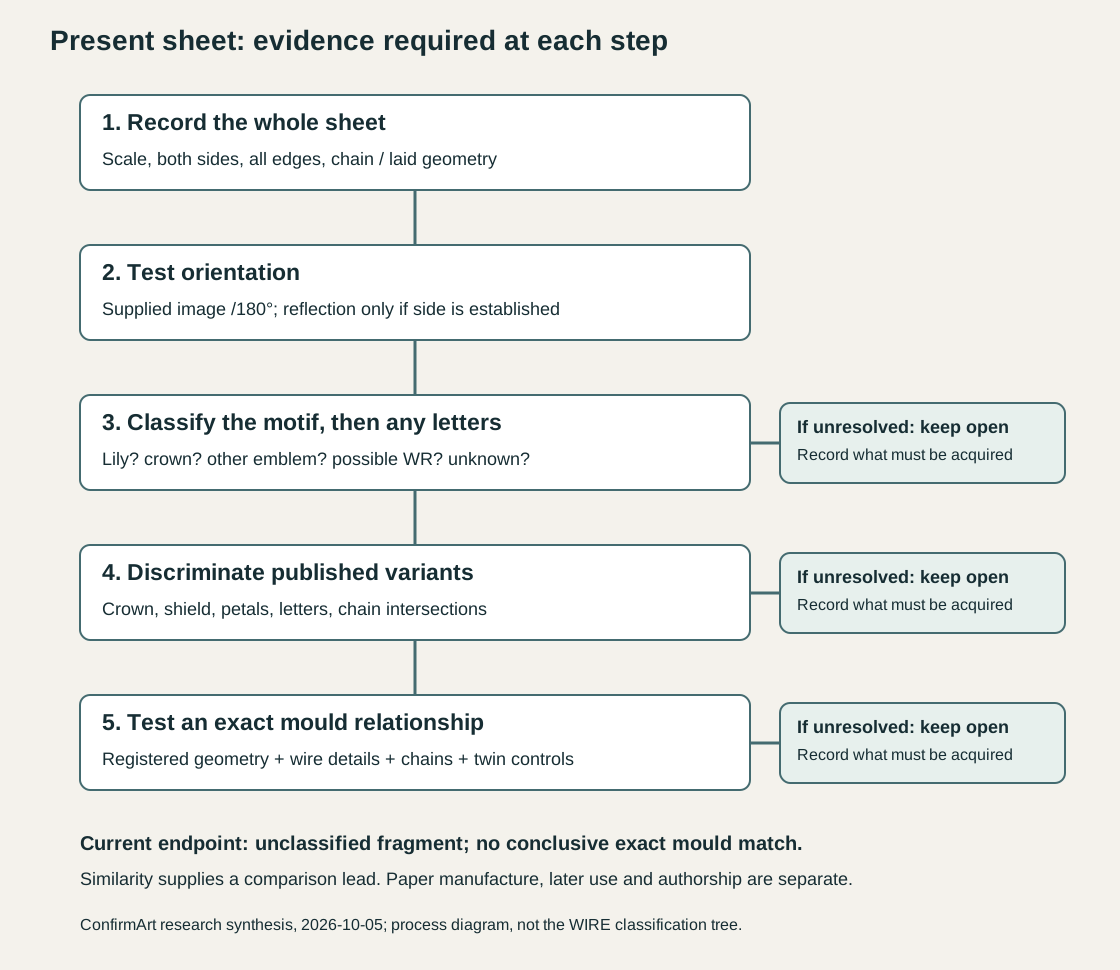
No conclusive exact mould match has been established. The photographed fragment shows features compatible with published lily-related designs and a possible WR reading, providing useful comparison leads. Its complete motif, letters, variant and relationship to any particular mould remain unresolved. This is a comparison programme, not a dated paper identification.
What the photographs support
The supplied transmitted-light photographs show a marginal group of bright, curved and lobed lines against the paper’s closely spaced linear structure. The fragment recurs in several views. A structural wiremark interpretation is reasonable, but a photograph can contain lighting effects and overlapping drawing media: only continuously visible segments should be recorded. The recent images improve documentation; they do not supply an orthogonal, calibrated map of the complete sheet.
The owner’s annotated photograph labels two features W and R. Those annotations record a proposed reading, not letters established by this study. If eventually confirmed, WR would be part of the wire design impressed into the paper during manufacture, not an artist’s written signature. BM as an artist’s initials is not supported either. The alternatives should not be decided by turning an ambiguous image until it resembles preferred letters.
The owner now reports 10 laid lines per centimetre, chain intervals 25–25–30 mm, and a sheet 203 × 153 mm. Earlier case material used approximately 206 × 153 mm and other laid-line counts. These are reports from different measurements, not a new calibrated measurement by this study. Their differences must remain visible until the sheet is measured consistently. Similar chain spacings in historical paper are compatible but are not enough to identify a mould, ream or workshop.
Why show the fragment upside down as well?
In the supplied photograph, the lobed fragment appears inverted relative to the conventional orientation of the lower lily inside the shield in the published comparison examples. A 180-degree rotation is therefore useful as a viewing test. It supports examining a lower-lily-in-shield hypothesis alongside the earlier crown/ornamental interpretation. It does not establish the original orientation of the sheet, the identity of the signs, or which missing elements existed.
The gallery shows the untouched photograph and its exact 180-degree rotation side by side. They are two presentations of one capture. Rotation and reflection are different operations: a photograph taken through the opposite side can reverse a wiremark laterally, whereas a rotation turns it upside down. Simulated reflections in the research archive are controlled viewing experiments, not captured verso photographs and not signs of authenticity. Imaging side and wire side must be recorded independently. NGV database, orientation and classification context.
The Worcester Cathedral Library’s A124i, 1616, figure 11 provides a photographic control for the arrangement of lily, crowned shield and lower 4/WR. It helps locate the relevant parts of a design. It has not been aligned at physical scale to the present sheet, and no shared wire geometry has been measured. Library publication and image.
Comparative watermark studies
These publications classify or illustrate lily and WR designs in other bodies of paper. They are not pages for single museum objects. Those object pages are in the section “Artwork records that report a watermark”, after the Ter Borch catalogue. The labels below must remain attached to the publications that use them. Fleur-de-lys II in the Viola da Gamba Society appendix and STRASBOURG LILY 2 in Rasch are descriptive classifications in those sources. They have not been mapped here to a specific Hinterding variant such as B.y, A.4WR.c.a, E’.a.a or D’.a. A Strasbourg bend is also a different design family from a lily in a shield, even though WR can occur with different emblems.
Published comparison
What it contributes
What it cannot establish for the present sheet
VDGS, Fleur-de-lys II, pp. 272–273
Six subdivisions, II/1/a–b, II/2/a–b, II/3/a–b, with paired forms and measured structure. The scheme on p. 272 shows WR below a crowned shield without an intermediate 4 represented.
A type scheme is not a radiograph. Absence of 4 in the present sheet would not by itself prove that a 4 was cut off. The terminology is not automatically a Rembrandt-watermark code.
Och 1185, II/1/a and /b
Upper and lower segments recorded on different leaves of an oblong quarto; the /a example uses ff. 9 and 10, the paired /b example ff. [76] and [75].
Historical precedent for divided marks, not proof of the present sheet’s original sheet format.
Ob MS Mus. Sch. E.406, II/2/a and /b
Segments on ff. 3/4 and 10/13, with chains around 29.5–31.5 mm.
Broad spacing similarity is not a distinctive mould identity.
Och 373, II/3/a and /b
Segments on ff. [17]/[16] and [18]/[19]; the /a lower segment has chains 23.5/25/25 mm, while the /b upper segment has 27.5/23.5/25.5 mm.
The different intervals and geometry must be tested, not collapsed into a generic 25 mm “match”.
Rasch, Geminiani, entry 1B1a, p. 8
A 1719 Walsh–Hare impression on paper described as STRASBOURG LILY 2 with 4/WR, an IV countermark, and 26 mm vertical chains.
A later documented use warns against dating by motif. The title’s 1716 is not the impression’s date or a date of paper manufacture.
Maas 2023, fig. 12, p. 234
A manually traced crowned-shield lily, 4 and WR from a Cape document dated 8 May 1686, reported as 55 × 105 mm.
It is a tracing, not diagnostic radiography; the date is the document’s use, not the mould’s manufacture.
Hinterding, in Rembrandt Now (2022), pp. 109–110
Strasbourg Lily D’.a is listed among impressions of Jan Six. The chapter asks whether watermark evidence should redate impressions.
It does not identify the NGV impression’s paper, and a plate date of 1647 does not date that impression. The rest of the volume was not read.
WR is historically associated with Wendelin Richel/Rihel, but the motif and monogram circulated more widely. It cannot identify a single active papermaker, artist or date. Object records that leave WR attached to a hunting horn, rather than to a lily, are kept with the artwork records below.
Published examples in the Ter Borch family corpus
The earlier search of online metadata found no explicit object-specific Strasbourg-lily description. That bounded result is superseded by the subsequently consulted printed catalogue, which supplies seven pertinent entries. They demonstrate that lily/WR-related papers occur in the family corpus; they do not show that the present sheet shares a mould or came from the family’s supplies.
Kettering 1988, part I
Object
Source-reported paper details
GSr 62, p. 52; PDF 90
A-1211, Gerard I, Two horses playing
Lower half of fleur-de-lis with WR; horizontal chains 24–26 mm; Piccard XIII, 1297 ff., Strasbourg c. 1600.
GJr 12, p. 98; PDF 136
A-788, Four views of a horse-drawn sleigh, 29 January 1631
Fleur-de-lis in crowned shield with WR below; horizontal chains 22 mm.
GJr 50, p. 122; PDF 160
A-1134, Vegetable market in the evening, 1634
Upper half of crowned-shield fleur-de-lis; vertical chains 24–26 mm; Heitz 293, Heawood 1766 and Piccard 1316 comparisons.
GJr 93, p. 154; PDF 192
RP-T-1888-A-1797, landscape sketchbook
Crowned lily/WR on specified leaves; vertical chains 22–24 mm; folio 36 dated 1633. Other leaves have different paper marks.
4 and WR, possibly belonging to a fleur-de-lis; vertical chains 25 mm.
M 46, p. 312; PDF 350
A-1095, Moses mentioned on object; copy after Testa, 1659
Crowned-shield fleur-de-lis, 4, WR, IHS countermark; vertical chains 26 mm; similar to Heawood 1785, recorded in 1670.
The catalogue’s terms “same”, “similar” and “possibly” are different evidentiary grades. Comparative watermark dates such as 1652 or 1670 are not automatic earliest dates for the drawings. The absence of technical images prevents us from checking the cited comparisons independently. M 18 / A-1327, p. 296, is not a positive lily example: Kettering suggests a possible lamb fragment in a crowned shield and leaves Moses/Gesina/Harmen alternatives. It should no longer lead the lily comparison request.
Only part I of Kettering has been supplied and consulted. The watermark plates, pp. 776–802 in part II, remain to be recovered. The part-I catalogue text is positive bibliographic evidence; the missing plates are not images already inspected. Rijksmuseum publication record. The accompanying reference file supplies links to each object and page locators.
Artwork records that report a watermark
These are pages for individual works. Each reports a watermark on that object. They are not the research articles or the comparative studies above. A mark reported on another sheet is not a mould match for the present sheet.
The proposed NGV comparator is the specific Jan Six impression work 23466 / accession 1242-5. Its record reports the partial variant B.y and chains of 27–28 mm. An exact institutional master was not downloaded. The custodian’s screenshot is not an independently verified master, and a plate dated 1647 does not date that impression’s paper. Hinterding’s 2022 chapter, in the comparative studies above, also lists Strasbourg Lily D’.a in impressions of Jan Six. That is a reason to identify this impression, not a reason to change the gallery’s label. NGV object record.
Ackland Art Museum 2017.1.86, Esaias van de Velde, A Cluster of Trees near a Ruin, is catalogued about 1620–25. The record reports a partial lower Strasbourg lily, 4/WR and vertical chains of 24–26 mm. It is a non-Rembrandt comparison request. No technical image of its mark was inspected here. Ackland record.
Two further object records are warnings, not lily candidates. The Glasgow Whistler catalogue leaves a partial WR open between a hunting horn in a shield and a Strasbourg lily. Getty entry 82, Jacques de Gheyn II, documents a hunting horn above WR. That passage was read in an indexed extract, and a usable full PDF was not retrieved. Glasgow object record, Getty catalogue, entry 82.
Exact-match method: three JHNA articles
Three articles in the Journal of Historians of Netherlandish Art set out how a watermark in Rembrandt’s etchings is classified and then tested for an exact mould match. None of them examines the present sheet, and none reports a result for it. The pictures that bear on this case are named below. Each link opens that picture on the article. The plates are not copied here. The articles are CC BY-NC 4.0, and some 2020 photographs are credited to Sound and Vision Publishers BV.
Decision trees, 2020
C. Richard Johnson Jr., “Decision Trees for Watermark Identification in Rembrandt’s Etchings,” JHNA 12, no. 2 (2020), DOI 10.5092/jhna.12.2.5. The article covers the WIRE project’s decision trees: a sequence of visible features that takes a watermark type to a variant and a subvariant, then a check against a radiograph and the chain-line spacing. It is demonstrated on seven prints in the Frick Collection. The part that applies to a lily in a shield is printed pp. 37–39. There the article treats Strasbourg Lily as frequent in Rembrandt’s etchings and counts sixteen variants.
Figure 51 is a labelled sketch of a complete Strasbourg Lily, drawn by Margaret N. Canfield at Cornell. It is the picture used here to name the parts a full mark would have: crown, shield, petals, the 4 and letters below, and the chain line. Only the parts actually in the present photograph can be compared. Crown bands and jewels, shield sides, petal-to-shield contact, the presence and placement of 4 and letters, and the relation to chain lines are presently unknown.
Figure 52 is the WIRE decision tree from type to subvariant for Strasbourg Lily in Rembrandt’s etchings, drawn by Isabella M. Dobson at Cornell. It is the picture that lists the questions. A feature outside the photograph, or hidden by the drawing, is not an observed absence, so no terminal branch is selected by answering “no” to what cannot be seen. Note 39, on printed p. 54, adds a separate limit: the presence of initials is not a feature suited to separating Strasbourg Lily variants, because variant A has subvariants with initials and subvariants without them. A possible WR reading, even if it were confirmed, would not by itself choose a branch.
Figures 53, 54 and 55 are a finished identification, not comparators for this sheet. They identify Strasbourg Lily E’.a.a on the Frick Landscape with Three Gabled Cottages (1916.3.30). Figure 53 sets the watermark under investigation beside the published E’.a.a; the right-hand photograph is credited to Sound and Vision. Figure 54 is the branch that reaches variant E’.a. The article says that five questions in figure 52 identify the mark in figure 53, and that the “P” side of the shield overlapping the chain line identifies subvariant E’.a.a. The apostrophe means a chain line down the centre. Figure 55 aligns the chain spaces; the upper image is Sound and Vision, and the overlay is by Canfield. Hinterding’s date of about 1652 belongs to that identified watermark on that print. It is not a date for the present sheet. The article’s other plates — Foolscap, Paschal Lamb, IHS, and The Flight into Egypt — are other watermark types. They are not pictures of this fragment.
The pictures that apply to a cut sheet are the second case study, figures 11–17. They compare a full Foolscap with Five-Pointed Collar with a fragment of that type, and the overlay includes the chain lines beside the mark. That is why the present fragment is not automatically unusable, and also why it is not yet matched. The article says its decision tree is for full watermarks, because the distinguishing features are spread through the design. A fragment still has to be shown to agree with one candidate and to disagree with the near alternatives. Those pictures are Foolscap watermarks, not a lily in a shield, so they are not comparators for this sheet. The skipped-point rule there is a numbering rule for a missing collar intersection on a Foolscap. It is not a licence to score an unseen feature on this sheet as a difference.
Figures 2–10 are a Strasbourg Bend case. Figure 8 is that type’s decision tree, and figure 10 is the overlay that separates the twins D’.a.a and D’.a.b. A Strasbourg bend is a different design family from a lily in a shield, even where WR occurs with both. Those pictures are named so that the distinction stays visible. They are not candidates for the present fragment.
As the article uses Briquet, an exact match between a watermark on a sheet of interest and one on a dated sheet can support assigning that date, and the wires of a watermark remained undamaged on the mould for about two years for popular paper sizes. That implies about a two-year maximum gap in manufacture between identical marks. Twin moulds, used in rotation, carry nearly identical marks and are not the same mould. The article then adds a further period for storage and distribution between manufacture and use, and gives four years as an example of that further period (note 22). It tests a proposed match with an overlay, not with a similar motif. The two-year figure is not a universal life for every wire, and it is not a date for this drawing. The article reports no result for this sheet.
Figures 1 and 2 are photographs of a modern laid mould and of how a watermark wire is fastened to it. They show the object an exact mould match would have to agree with. They are not a picture of this fragment. Figures 4 and 5 show a point-marked Foolscap with Five-Pointed Collar and an overlay against a second image of that type. Figure 8 is Rembrandt’s The Flute Player, the print whose paper supplies one of those Foolscap examples. These are illustrations of the method on another watermark family. They are not placed beside the present fragment.
The custodian’s side-by-side comparison and apparent 3D screenshot are preserved as proposals. Neither supplies a registered wire-for-wire overlay at common physical scale, an instrument record, a calibrated height axis or raw topographic data. The drawing’s inked forms remain prominent in the apparent relief. An intensity-to-height visualization can make a photograph look three-dimensional, but its height would encode brightness rather than paper thickness. Without a documented procedure we cannot identify the software or affirm that this was the method used. It does not demonstrate removal of surface ink or a “felt-side authenticity effect”. ImageJ’s explanation of intensity-based surface plots.
The accompanying process diagram shows this study’s actual route: acquire the sheet, test orientation, classify motif and letters, discriminate variants, then test mould geometry. It is not figure 52, not a replacement WIRE tree, and it assigns the present sheet no WIRE code. watermark-decision-path.svg.
Evidence for the lead, evidence limiting it, and the next test
Support: a repeatedly photographed structural-looking fragment; a lobed shape worth testing against lily geometry; published lily/WR designs in several relevant corpora; documented divided watermark examples; and concrete Ter Borch object/page references.
Limits and alternatives: unresolved letters and complete motif; missing crown/shield diagnostics; uncalibrated and oblique captures; non-exclusive spacing; competing WR-bearing emblems; later documented uses; and no verified, registered comparison demonstrating diagnostic wire correspondence. Old paper carrying a later drawing remains possible even if a historic paper type is eventually identified. The present limitation is not a completed negative test excluding every candidate.
The most useful next step is a paper conservator-led full-sheet structural record, with scale, sides, all edges, chain/laid geometry and documented imaging settings. Begin with controlled transmitted light where it resolves the structure. If media conceal it, the conservator should choose an appropriate method, such as low-energy X-radiography, after assessing the sheet’s condition. Beta/electron radiography has particular handling/contact requirements and is not interchangeable with a photographic filter. Rijksmuseum project, Bunting’s first-hand account.
A focused enquiry to Aurora Belli is proposed to ask about existing radiographs and further references for the seven Kettering objects, together with the part-II plates. No enquiry has been sent and no availability or acceptance of a private object is assumed. Comparison should include alternatives and twin moulds, preserve the registration and residuals, and state which diagnostic features agree, disagree or remain unreadable. Authorship remains a separate question.
Decision path
This is the study’s evidence-acquisition sequence, not an extracted branch of WIRE and not a classification result. The diagram is published with the dossier as watermark-decision-path.svg. It is an acquisition sequence, not a WIRE tree. The WIRE Strasbourg-lily tree is Johnson 2020, figure 52, discussed with the other two JHNA articles above.
Acquire: complete, scaled sheet, both sides, all edges, documented chain and laid lines. Current outcome: insufficient for calibrated comparison.
Orient: test 0° and 180° against emblem geometry. Record camera side/wire side separately. Current outcome: 180° useful under the lower-lily-in-shield interpretation; conditional.
Classify: identify surviving motif, then read any wire letters. Current outcome: lily-related lead; WR unconfirmed. Retain crown/other ornamental or emblem possibilities.
Discriminate: use crown bands, jewels, shield curves, petal contacts, initials and chain intersections. Current outcome: too many unknowns to choose a WIRE variant.
Test mould: compare identified technical masters, global registration, diagnostic wire deformations and complete neighbouring chain geometry; include twins and alternative candidates. Current outcome: no conclusive exact match established.
Interpret dates separately: manufacture/use date of comparator, possible storage or later reuse, date of the mark on the present sheet, and authorship are separate findings.
At any step UNKNOWN is a valid endpoint. It is not NO and not an invitation to reconstruct missing features. Do not display a highlighted path to B.y/E’.a.a/D’.a or any other terminal class for the present sheet.
Examination plan
The immediate question is the paper’s structural mark, not the artist’s identity. Ask a paper conservator to assess the sheet before selecting acquisition or handling methods. The research files do not replace that assessment.
Priority
Record needed
Purpose and interpretive boundary
1
Complete recto/verso, orthogonal, in-plane millimetre scale; maximum/minimum dimensions; all four edges
Resolve 203 versus 206 mm and coordinate orientation. No inference of quarto format or chronology from dimensions alone.
2
Whole-sheet transmitted-light master where safe and effective; RAW/16-bit archival files; unedited acquisition settings
Record continuously visible wire segments, distances to edges, laid density in several fields, and the complete chain sequence. Do not fill gaps concealed by the drawing.
3
If the medium obscures structure, conservator-selected technical imaging, potentially low-energy X-radiography
Acquire structure independently of surface brightness. Beta/electron techniques may involve contact, pressure or vacuum and require a separate suitability assessment. No domestic handling prescription.
4
Verified comparator masters with accession, technical-image ID, camera/radiograph side, physical scale and capture method
Retrieve NGV 1242-5; request Worcester A124i, VDGS/Oxford examples and the seven Kettering objects. Published tracings and schemes are for classification leads, not submillimetre proof.
5
Specialist-reviewed global registration, visible diagnostic landmarks, chain/laid relationships and wire defects; report disagreements
Test exact mould, twin, related or incompatible geometry. Preserve source images, transforms and residuals; no local warping to force an apparent match.
Proposed enquiry: Aurora Belli, named on the Rijksmuseum Watermarks Project. Ask whether relevant technical images or references exist for A-1211, A-788, A-1134, A-1797, A-949, A-911 and A-1095. Ask about Kettering part II, pp. 776–802. No enquiry has been sent. The former A-1327 lead is a possible lamb, not a verified lily.
Report an uncertain or negative result as carefully as a positive one. Even an exact mould relationship would not, by itself, identify a ream, ownership, a workshop, an artist, or when the drawing was executed on that paper.
Audit of claims and remaining gaps
Current synthesis: 2026-10-05. All substantive current watermark notes are included here and in the update, evidence table, source registry, bibliography and examination plan. Historical notes are preserved in the private research archive with dates and supersession labels. They must not be treated as current findings when later sources correct them.
What “similarities and leads” means here
The positive observations are the repeated bright lobed fragment, nearby laid structure, and a plausible geometric interpretation that can be tested against published lily designs. A possible WR reading is a hypothesis, not another established similarity. The historical literature adds precedents for partial marks and divided sheets, relevant object-specific Ter Borch references, and broad chain spacings comparable with the owner’s reports. Those contextual facts do not constitute geometric matches to the present sheet.
An exact match has not been demonstrated. Nor have all published candidates been subjected to a complete negative test. The surviving geometry may ultimately be informative, but the present images do not let us discriminate same mould, twin mould, related motif or a different emblem reliably.
Corrections of specific claims
Received or previous claim
Current assessment
Evidence and consequence
A three-lobed flower is always a pendant below letters, never above them
Unsupported universal rule; the cited Briquet number does not document it
Briquet 7104 is a lily in a circle, Ferrara 1560. The inspected complete designs distinguish a lily inside a shield from 4/WR below it. Do not use the citation to force an orientation.
the present sheet necessarily preserves the lower WR pendant
Unverified
The photographed lobed form may instead belong to the lower lily inside a shield. The letters and full anatomical arrangement remain unresolved.
Rotating 180° proves WR, or recto/verso reversal authenticates the sheet
Unverified inference
Rotation and reflection differ. Side information must be established; neither transform is a chronological test.
Missing 4 and crown prove a quarto cut
Unverified
VDGS documents divided marks and a scheme without 4. the present sheet’s original full-sheet dimensions and lost design have not been recovered. Current sheet size alone does not establish bibliographic quarto format.
“10 lines/cm and 25–25–30 mm” prove the same paper as NGV Jan Six
Compatible but non-diagnostic
Owner reports differ from the NGV record’s 27–28 mm chain intervals. A few intervals are not a complete chain pattern. Earlier case data reported 17 laid lines/cm and a height of 206 mm; the newer report is 10 and 203 mm. None is adopted as an independent measurement here.
NGV control is watermark ID 126508
Unverified identifier
The earlier inspected technical-image URL used Ff126499; no equivalence with 126508 was verified. Keep work 23466 and accession 1242-5 as the object identity. No original technical image was downloaded.
Jan Six is a single 1647 watermark standard
Incorrect abstraction
Identify the individual impression and its paper. NGV reports B.y; Hinterding’s 2022 chapter lists D’.a in Jan Six impressions. Plate date and impression date differ.
All moulds lasted a maximum of two years, so the present sheet was made around 1647
Overstatement and unsupported date inference
The 2026 article uses an approximate undamaged-wire estimate under specified conditions and adds storage/distribution considerations. A drawing date would remain separate even after paper identification.
“3D” removes the ink and proves identical curvature
Unverified
No calibrated topographic data, scale, instrument, acquisition protocol or registration residuals supplied. Inked drawing features remain in the visualization. An apparent height rendering cannot recover physical geometry lost or obscured in its input.
No relevant lily/WR examples exist in the Ter Borch literature
Earlier bounded search superseded
Kettering part I now supplies seven pertinent entries. This is positive source evidence but not a mould or authorship link.
Moses A-1327 is a Strasbourg-lily example
Not supported by the fuller source
Kettering M 18 describes a possible lamb fragment in a crowned shield and allows Gesina/Harmen alternatives. Do not count it among the seven positives.
Dresden C 1421 lacks a watermark, excluding common paper
Does not follow
The earlier institutional report of no watermark does not exclude a marked full sheet from which a small unmarked piece was cut. No paper relationship has been established either.
Gravell SLD.051.1 is the present sheet’s mark
Not established
Earlier dossier research identifies a different Folger document, dated 1651, with its own dimensions and chains. Motif similarity is not object or mould identity. The record was not newly re-retrieved here.
The underlying source locators and reading scope appear in the source note. The laboratory specification explains what data could resolve these questions.
What was supplied, what was found, and what was read
The 2021 overlay PDF, Cornell description, five original 2020 figures and the 2022 National Gallery volume were downloaded from the identified scholarly/institutional servers. The relevant passages were read; the whole 140-page National Gallery volume and the whole Kettering catalogue were not exhaustively studied entry by entry. The full Kettering part-I PDF is retained in the research delivery; part II is absent.
Present data gaps
A single calibrated full-sheet structural capture of the present sheet; recorded recto/verso, wire side, scale, all edges and uncertainty.
A dependable tracing of only visible continuous wire segments; no reconstruction of obscured letters or missing crown.
Original comparator masters, particularly the specific NGV impression and the seven Kettering objects. The NGV image request returned HTTP403; it has not been bypassed or replaced by a guessed image.
Kettering part II, especially the watermark section, pp. 776–802. The part-I references are not a substitute for its plates.
Direct inspection of the original Churchill 401, Heawood 1746/1780/1785 and the specific Hinterding volume-I p. 38 and Ash–Fletcher p. 11 cited in owner material. Some are source-reported comparisons; that is not our independent verification of each original plate/page.
The full Getty European Drawings 3 PDF and Looking at Paper PDF: requests returned non-PDF HTML and no usable PDFs were saved. Bibliographic links remain, with scope limits.
Full texts of Dexter 1999 and the 2026 Imago Mundi lead, plus the Whistler technical-image library. They remain leads and are not used to identify the present sheet.
the custodian’s original acquisition/processing files for the apparent 3D image. It remains possible he has further data, but none has been supplied here.
How a result would change the case
An identified motif would narrow a search. A securely read WR would support a paper-mark classification, not an artist’s signature. A variant would narrow the control group. A reviewed exact mould relationship with dated documentary sheets could constrain a manufacturing/use context. Each of these requires evidence beyond the previous step. None would alone settle ream, ownership, workshop, authorship, sitter, execution date or authentication. An incompatible diagnostic feature or material could reject a candidate; a compatible result leaves multiple hypotheses open.
The best next investment is acquiring better structural data, rather than further transformation of the same uncalibrated photographs. The proposed query to Aurora Belli now has concrete inventory numbers and source pages; no message or request for treatment has been sent.
Watermark sources and reading scope, prepared 5 October 2026
A listed source was not necessarily read in full. Internal research-file paths are omitted. Scholarly links point to the publisher or repository. Books and figures are not republished here.
Bibliographic sources, object records and methodological controls are distinguished below. A source being listed is not a claim that its entire contents, original plates or unavailable technical images were inspected. The owner-supplied data are a separate source class. PDF page numbers include covers; printed page numbers are given separately.
Three kinds are kept apart. W04, W05 and W06 are the three JHNA method articles: decision trees, overlay comparison, and exact matches with dated documents. W07 through W11, together with W01, W03 and W28, are comparative or institutional studies. W02, W13, W14 and W15 are pages for individual artworks that report a watermark. A museum page that only reports a mark is not treated as one of the studies.
W01 — Bonnie Hearn, Rembrandt’s watermarked papers at the National Gallery of Victoria (15 July 2024)
W05 — Johnson, Sethares and Ellis, Overlay Videos for Quick and Accurate Watermark Identification, Comparison, and Matching, JHNA 13:2 (2021), DOI 10.5092/jhna.2021.13.2.1
Locator: Methods §§12–29; library §42 and skipped fragment points §43; appendix3.
Reading scope: Targeted passages consulted.
File origin: Research located.
W06 — Johnson and Weislogel, Assisting Creation Dating of Rembrandt Prints using Exact Watermark Matches Between the Prints and Seventeenth-Century Dutch Documents, JHNA 18:1 (2026), DOI 10.5092/jhna.2026.18.1.3
File origin: The custodian supplied article; claims audited independently.
W07 — Tycho Maas, Tracing Personal Accounts in Colonial Knowledge Networks: Towards a Watermark Database for the Cape Colony, 1652–1795, PBSA 117(2) (2023), 215–235, DOI 10.1086/725534
Locator: 22-page repository version including cover.
Reading scope: Same work and bytes as W07; not independent corroboration.
File origin: Same PDF as W07. Not a second copy and not the journal landing page.
W09 — Viola da Gamba Society, Index of Manuscripts Containing Consort Music, Appendix I: Watermarks and Paper Types, eds. Ashbee, Thompson and Wainwright
Reading scope: Relevant appendix passages inspected; current appendix revision date not established. Printed index pagination differs from actual section headings..
File origin: Research located.
W10 — Rudolf Rasch, The Thirty-One Works of Francesco Geminiani, Work One: The Violin Sonatas of 1716: Copies, revision31 May 2020
Locator: Classification precedent; owner’s specific p11 citation not checked in original.
Reading scope: Bibliographic reference; no full original PDF located.
File origin: Research located.
W23 — Keri Dexter, Unmasking “Thomas Tudway”: A New Identity for a Seventeenth-Century Windsor Copyist, RMARC32 (1999), 89–117, DOI 10.1080/14723808.1999.10540985
Locator: Intensity can be represented as apparent height.
Reading scope: Explains a possible visualization mechanism; does not identify the custodian’s software.
File origin: Research located.
W27 — Ellis, Johnson and Sethares, Moldmates Matter: Computational Tools to Enhance, Measure, Compare, and Match Historical Papers, Getty Research Journal17 (2023), 1–24, DOI 10.1086/724136
Locator: Bibliographic metadata and CC BY-NC licence.
Reading scope: Metadata/licence verified; full text not newly downloaded/read.
File origin: Research located.
W28 — Erik Hinterding, Should prints be redated because of watermark evidence? Some examples and considerations, in Rembrandt Now, eds. Marika Spring and Ashok Roy (2022), 105–114
Locator: Folger X.d.483(99), Robert Bennet papers, 5 Sept 1651;100×72mm; chains21–21–21–23–21mm.
Reading scope: Reported in existing independently compiled dossier. Exact original entry/image not re-retrieved this turn; retained as a previously documented lead, not current mould finding..
Corrected comparison: M18/A-1327, possible lamb fragment, not a positive lily. Current museum records and Kettering1988 descriptions remain distinct sources.
Original catalogues/pages still needing direct consultation
W. A. Churchill, Watermarks in Paper in Holland, England, France, etc., in the XVII and XVIII Centuries and Their Interconnection (1935), no.401. Cited byNGV; original plate not directly inspected here.
Edward Heawood, Watermarks, Mainly of the17th and18th Centuries (1950): no.1746 cited in owner material is unverified; no.1780 is reported byNGV; no.1785 is Kettering’s comparison forM46. These roles must not be conflated.
Erik Hinterding2006, vol.I p.38 and NancyAsh/ShelleyFletcher1998 p.11, specific owner citations: original pages not independently inspected.
PiccardXIII1297ff./1316/1333 andHeitz293 are Kettering’s references, not newly measured identifications by this study.
Pending metadata/full text for the2026 ImagoMundi lead are explicitly unresolved. The article is not used as evidence for the present sheet.