Open research dossier · live document

A Young Draughtsman in a Broad-Brimmed Hat

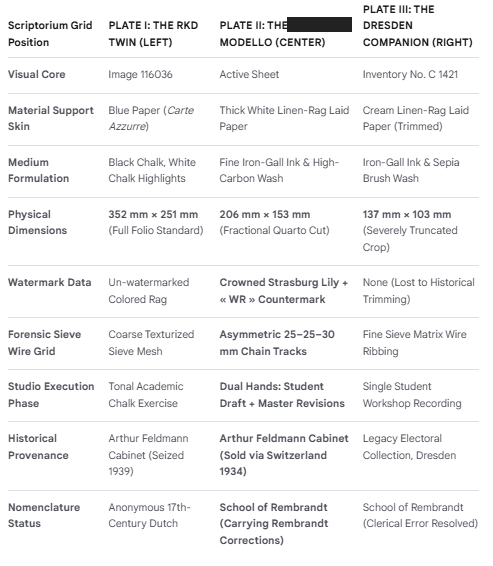
An unattributed drawing on laid paper. RKD 116036 has the same composition. Dresden C 1421 is a related subject and workshop context, not the same design. A reported inscription on the RKD sheet opens a Ter Borch family and workshop question; it does not attribute this drawing. Technical examination remains open.

Research status

This is a research dossier, not an authentication certificate and not a sales page. Authorship, date, sitter, media, watermark classification, and early provenance remain under investigation. The dossier distinguishes documented facts and direct observations from comparisons and working hypotheses, and records the evidence against each hypothesis as well as the evidence for it.

Object
Drawing, pen and brush in brown media on laid paper
Reported sheet
Approximately 206 × 153 mm; a later report of 203 × 153 mm is a separate, unresolved figure
Author / date
Under investigation
Custodian
Private collection (Michael)
File
CA-RD-2026-01 · ConfirmArt research ID, not an accession number
Published
5 October 2026
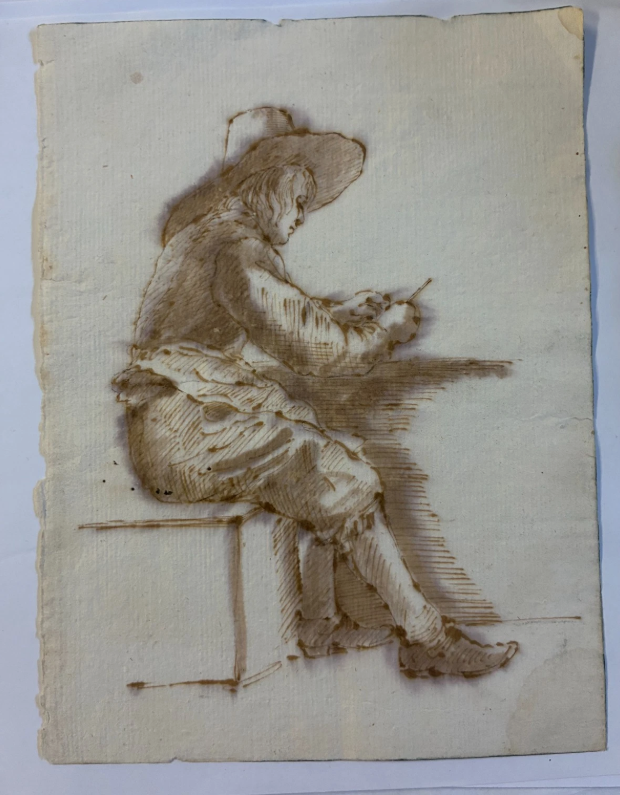
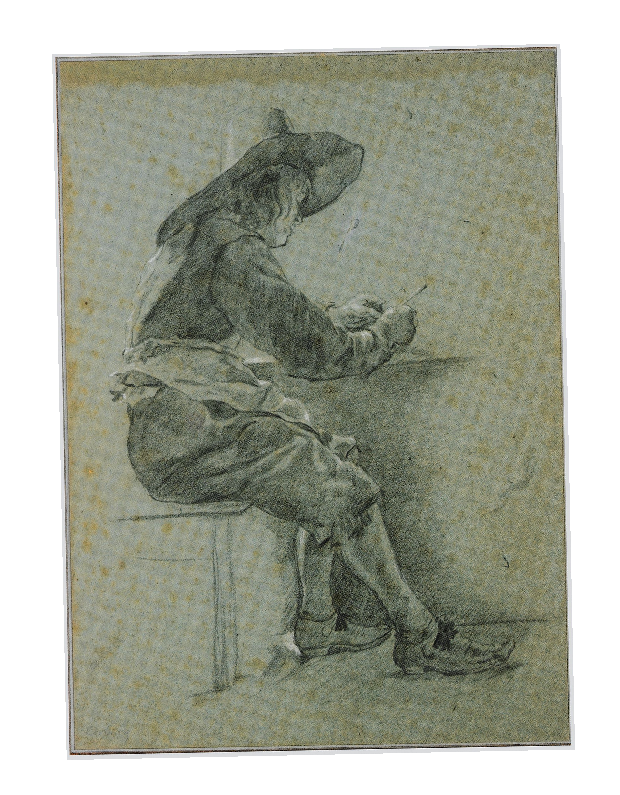
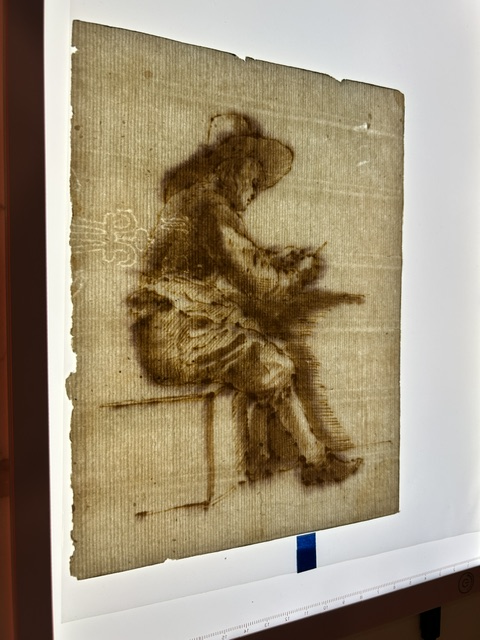
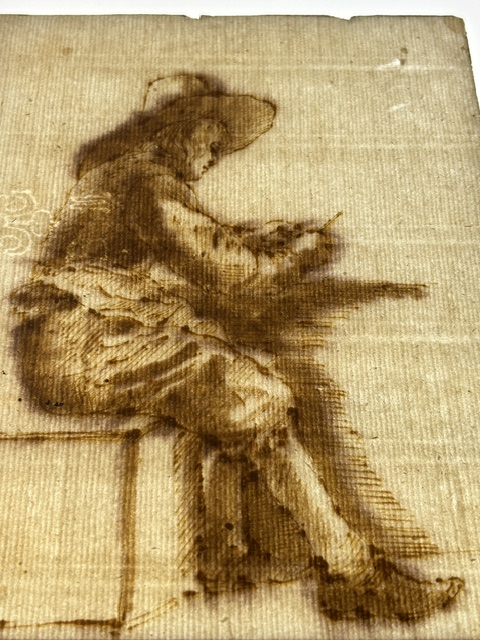
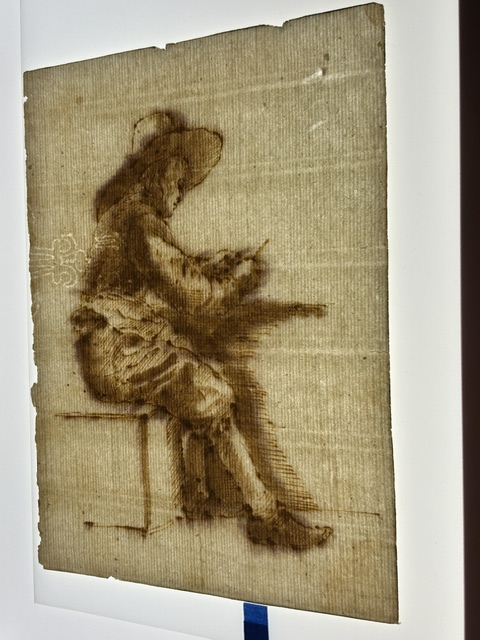
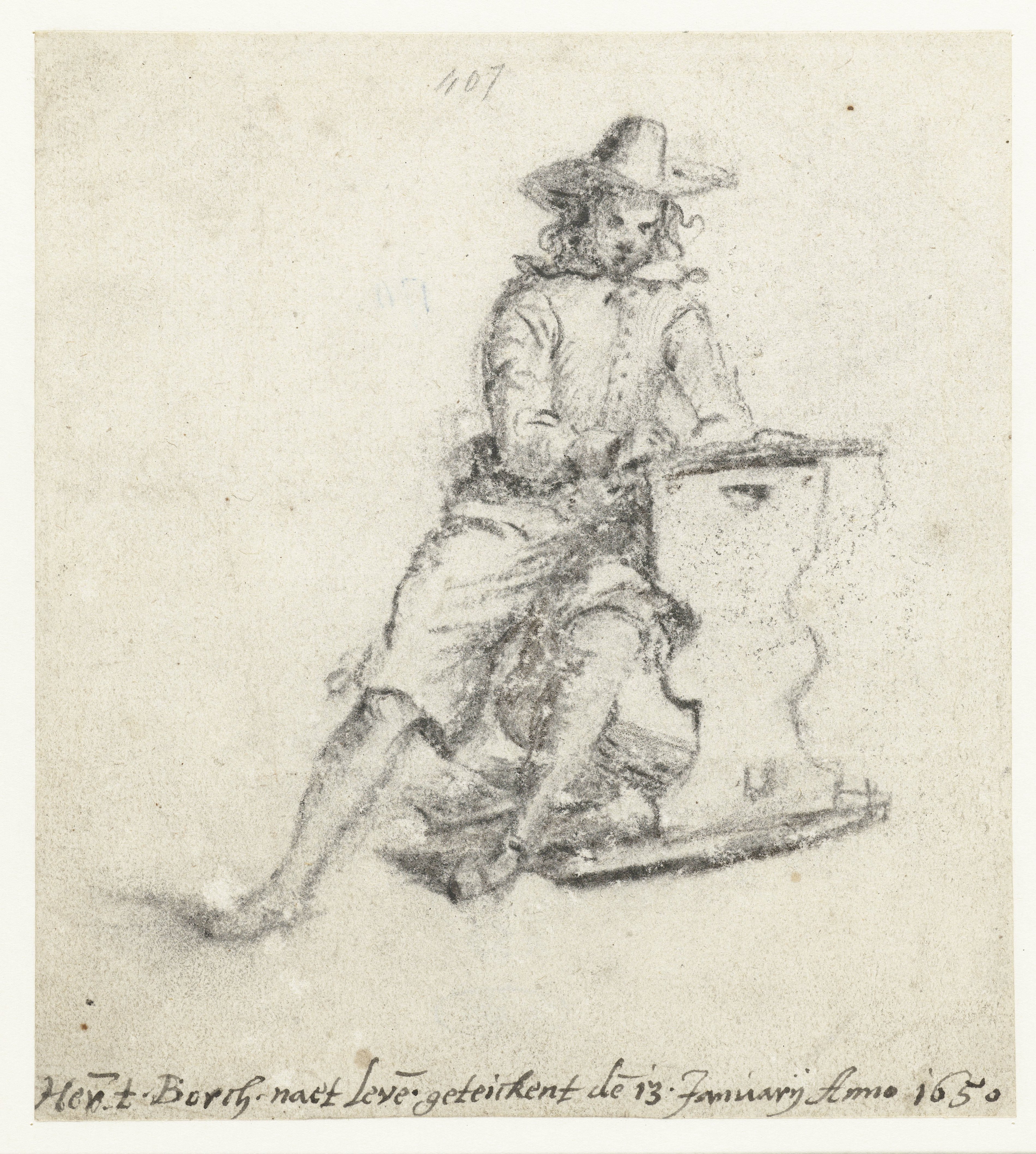
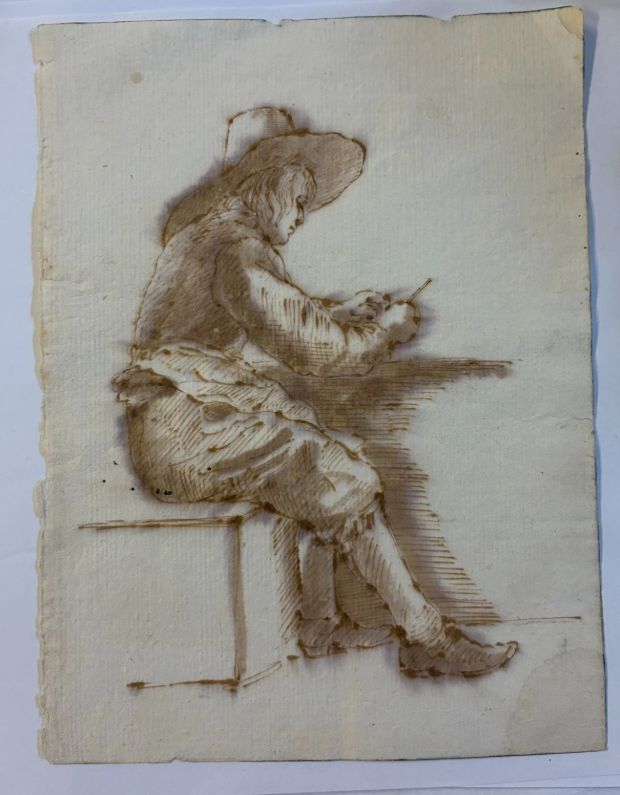
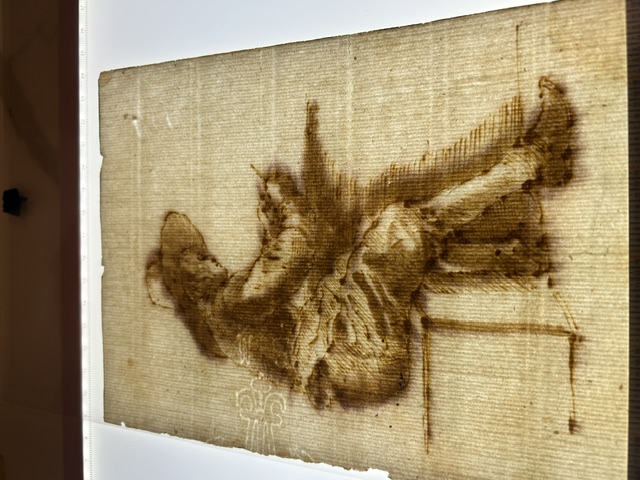
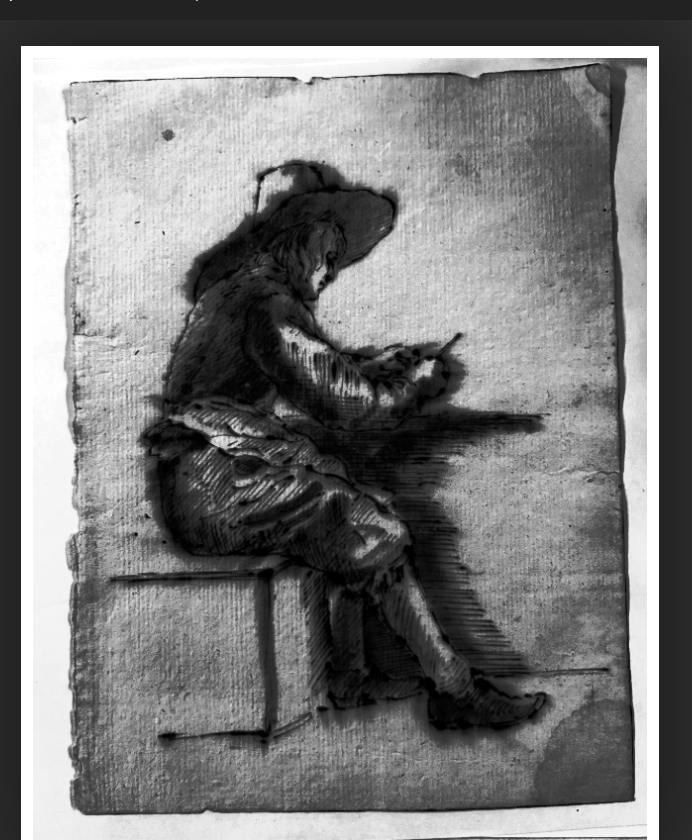
Portrait-format drawing of a seated young man in a broad-brimmed hat working over his hands, one leg extended forward.

Fullscreen view

Portrait-format drawing of a seated young man in a broad-brimmed hat working over his hands, one leg extended forward.
The recto in the clearest supplied photograph. Click for fullscreen; move the cursor to magnify. Published with the custodian's permission; metadata removed; no tonal adjustment applied.
01

Object description

Material and visual description of the sheet

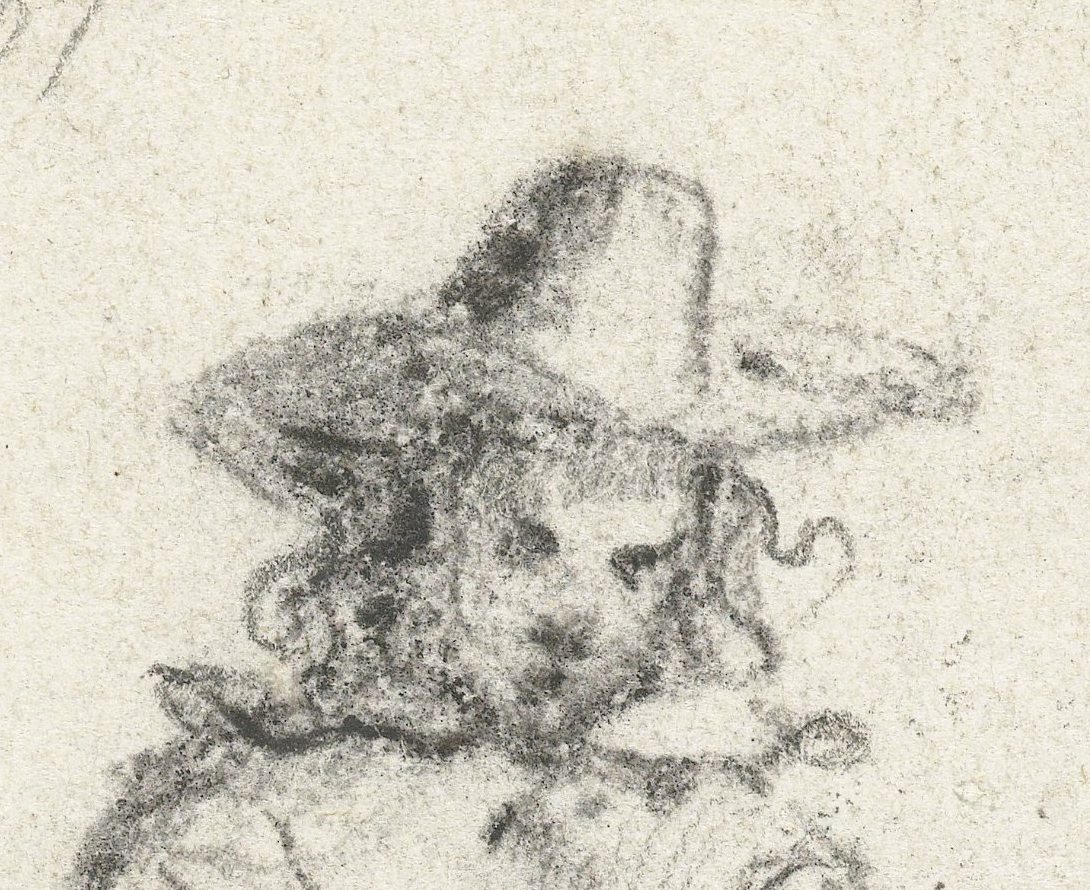
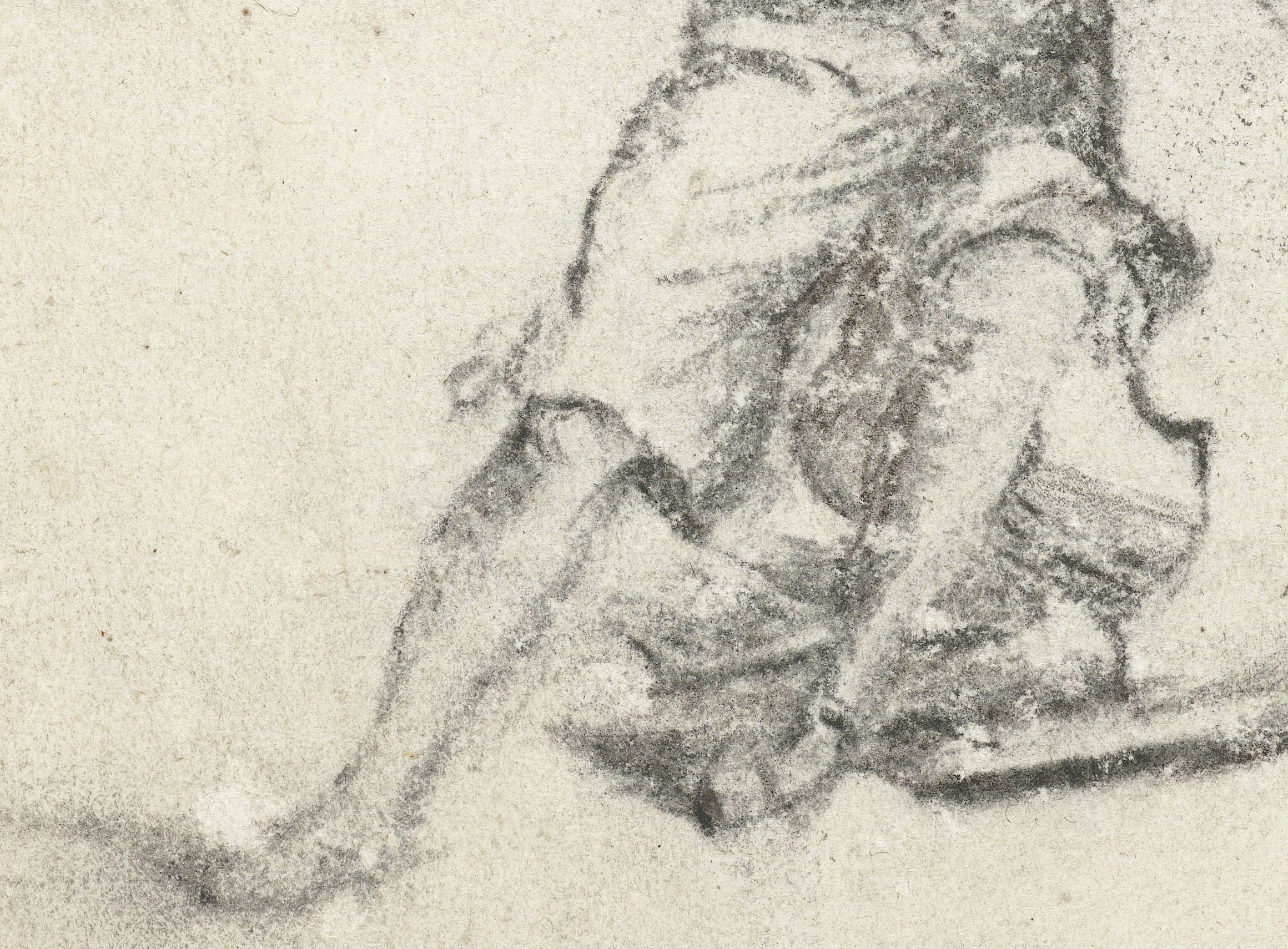
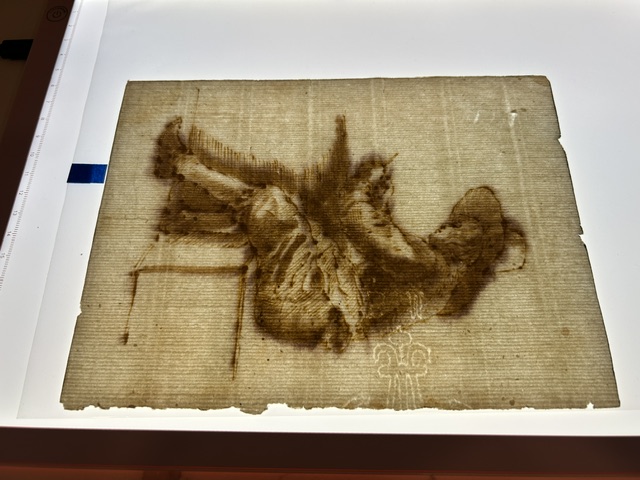
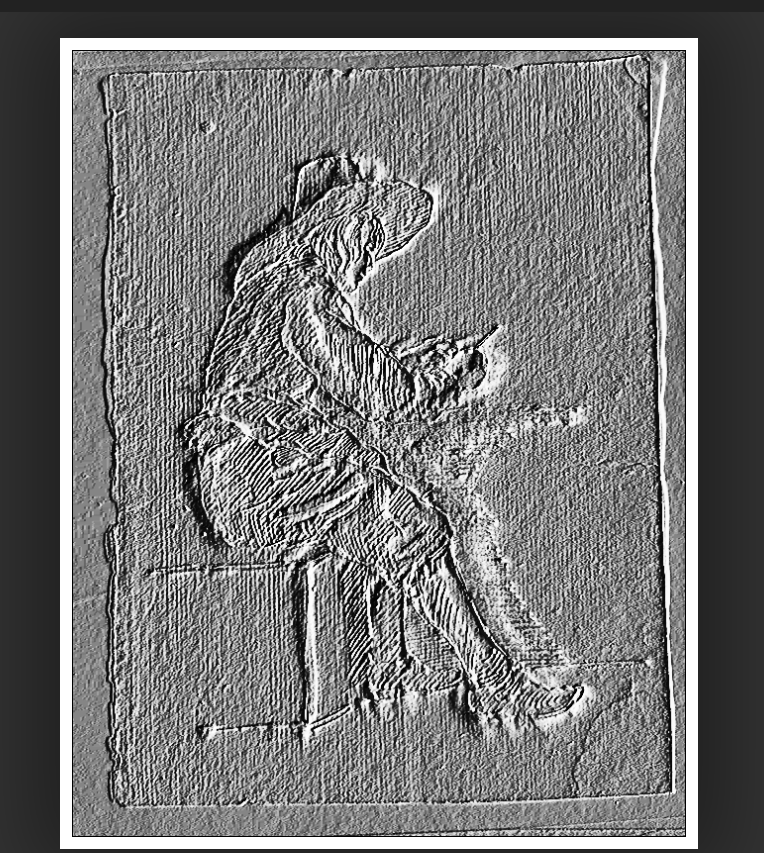
The sheet shows a young man seated on a plain wooden bench, a broad-brimmed hat over shoulder-length hair, the body bent over the work in his hands; one leg extends forward, ending in a heeled shoe whose instep, on the 27 August close photographs, reads more as a latchet or lace than as a buckle. The subject — a draughtsman recorded at close range, most plausibly by another draughtsman — belongs to a documented type of study made where drawing was practised and taught in the Dutch seventeenth century, including Rembrandt's workshop.

On the didactic context of such studies, see the Getty exhibition catalogue Drawings by Rembrandt and His Pupils: Telling the Difference (Getty, 2009–10) and, most recently, Jochem van Eijsden's study of teaching practice in Rembrandt's workshop (Kroniek van het Rembrandthuis, 2024/25). The sheet entered this research programme in July 2026 through its custodian, Michael, who had begun submitting questions about it to the relevant museums.

Direct observation

Observations from the supplied photographs

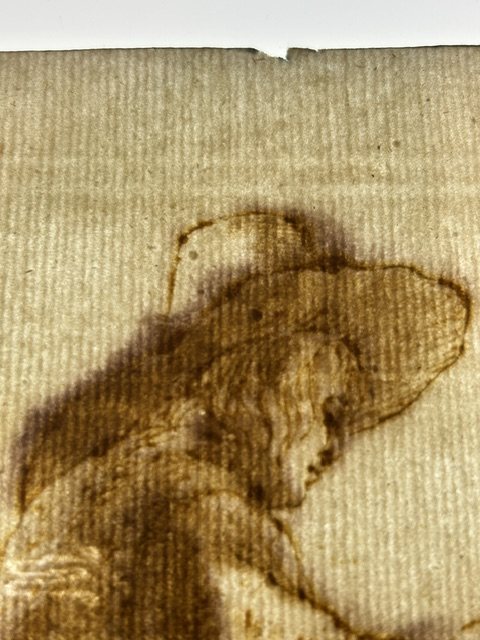
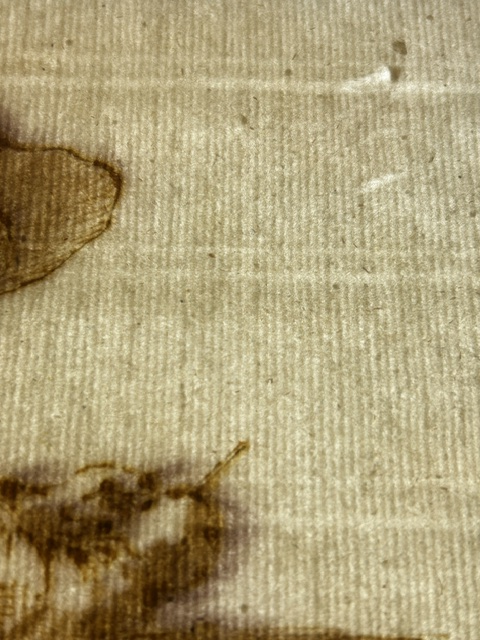
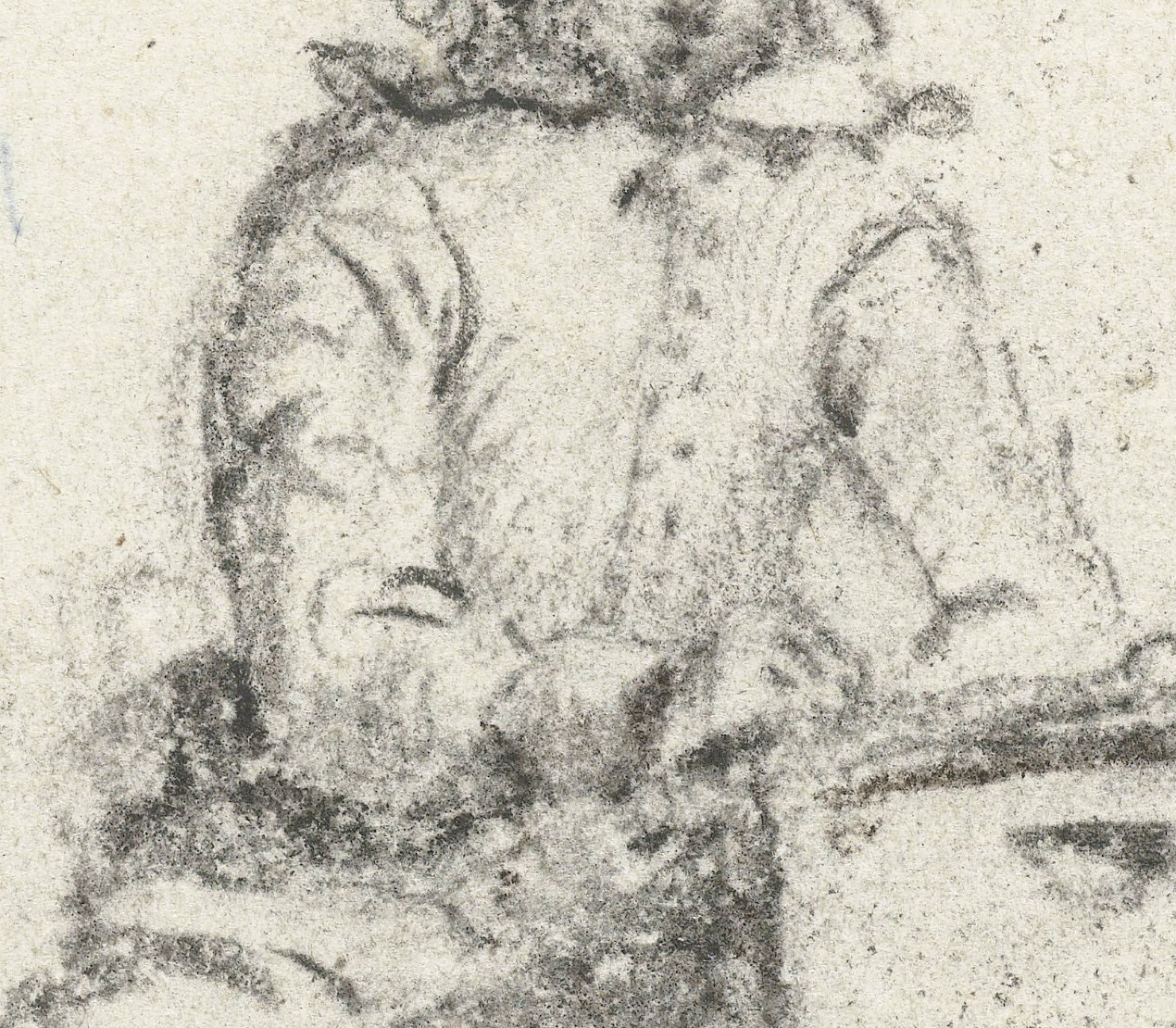
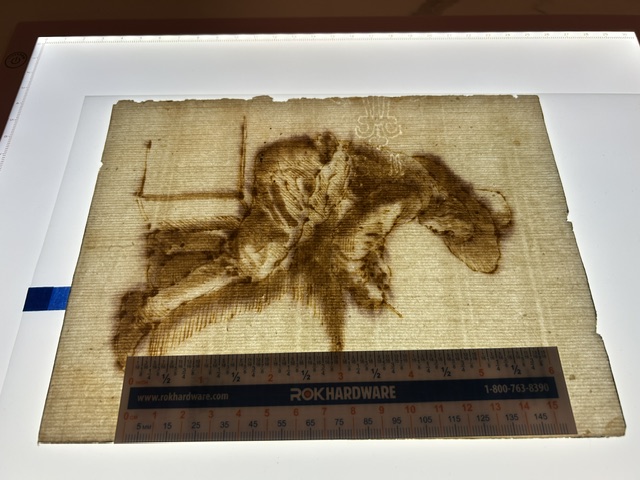
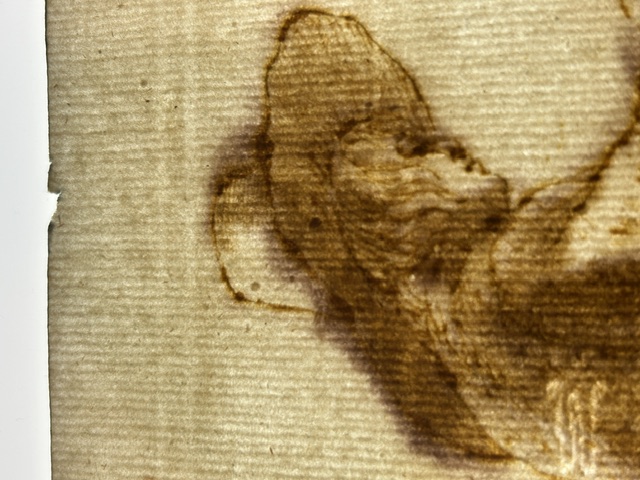
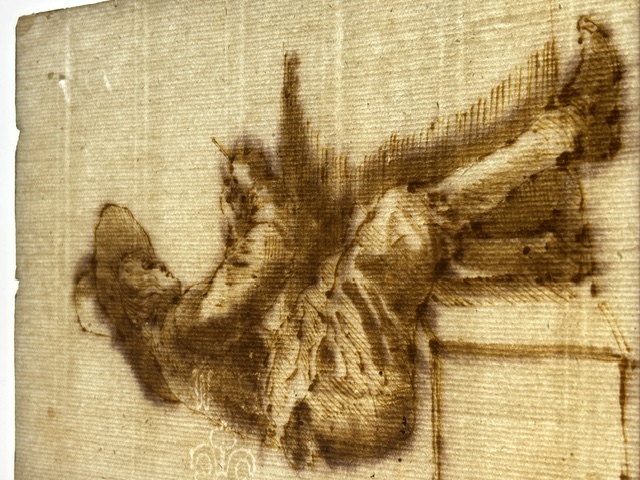
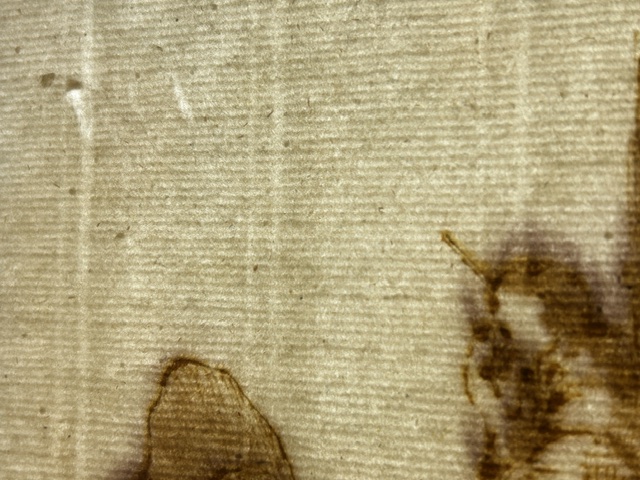
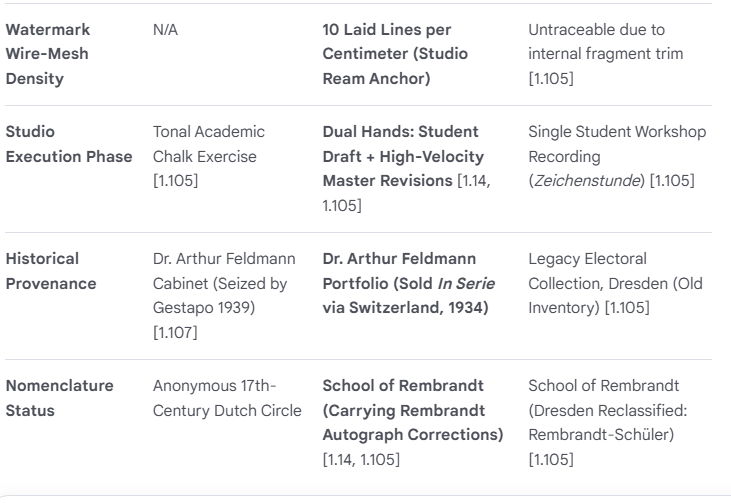
The support is handmade laid paper: laid lines and chain lines are clearly visible in transmitted light. The reported dimensions are approximately 206 × 153 mm, pending a calibrated flat measurement. A later report from the custodian gives 203 × 153 mm, 10 laid lines per centimetre and chain intervals of 25–25–30 mm. Earlier case material also includes a report of about 17 laid lines per centimetre. These are different reports, not a new measurement by this study, and the differences stay visible until the sheet is measured consistently. The figure is executed in brown linear media with brush and wash: extended parallel hatching, closed contours, and darker local reinforcements in the hat, the hands, and the seat. From the gathered hands a thin shaft with a darkened tip extends upward — a pen or chalk-holder in use, or a quill held for trimming; both readings remain open pending macro photography.

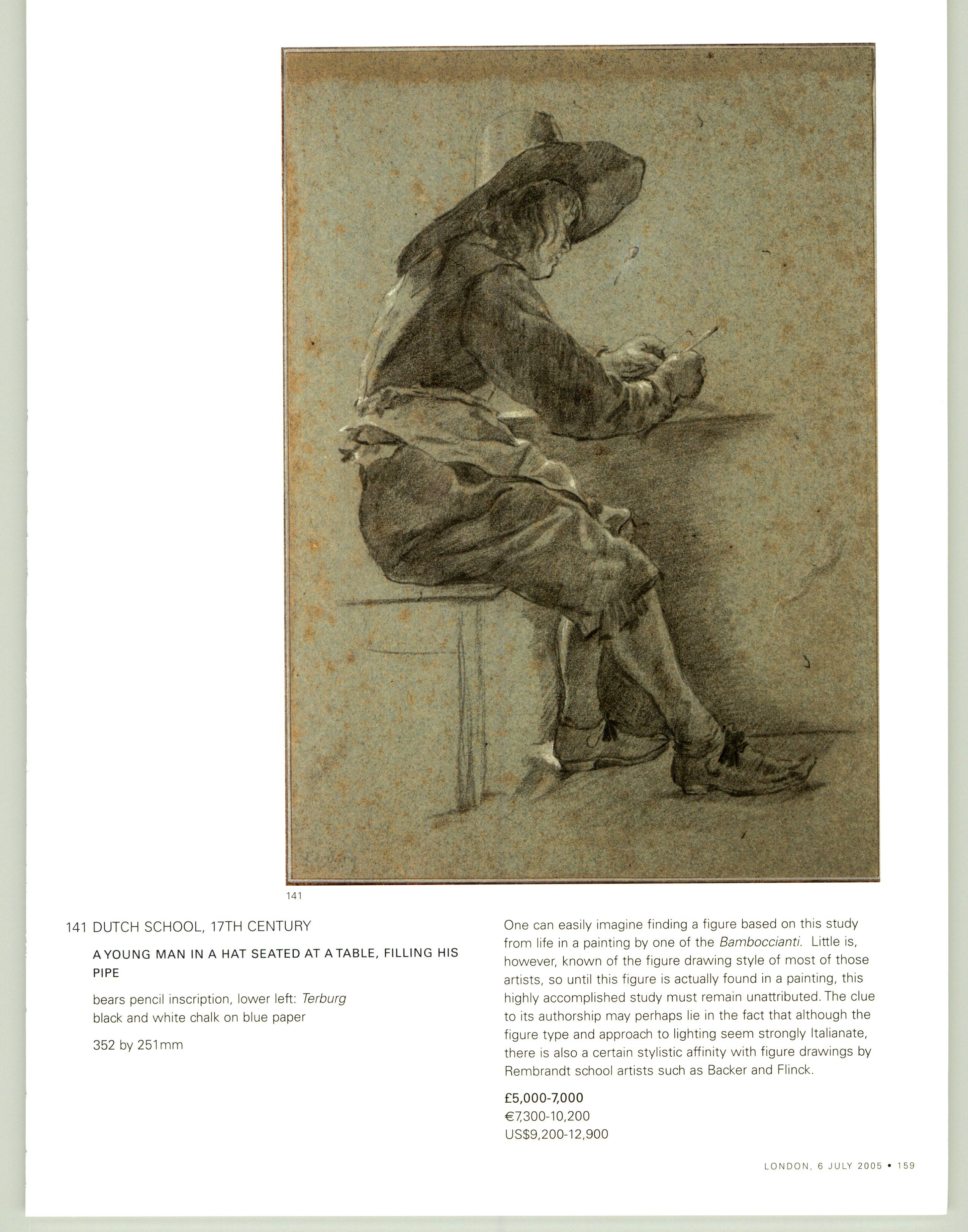
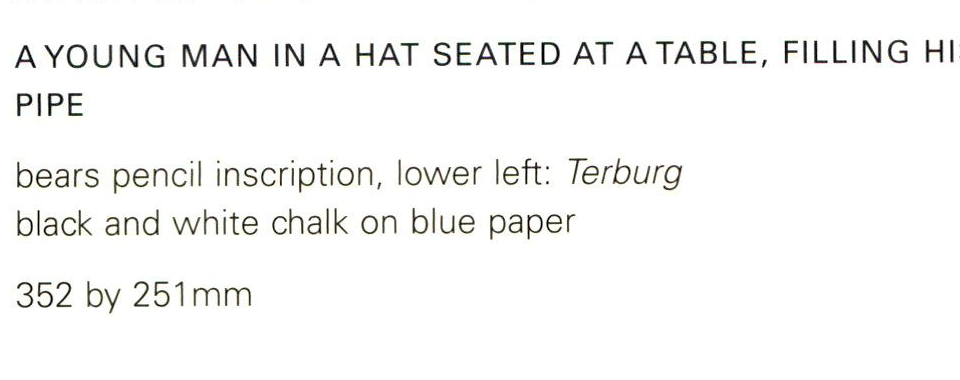
Documented source That working description of the activity is revised here because of the comparator, not replaced in silence. Sotheby's Old Master Drawings, London, 6 July 2005, lot 141, printed page 159, describes the same composition — the sheet identified with RKD 116036 — as a young man in a hat seated at a table, filling his pipe. The dossier title above is unchanged. The shaft at the hands is still unresolved in the photographs of this sheet, and the catalogue title, medium and measurements belong to lot 141. They are set out in the Ter Borch research lead.

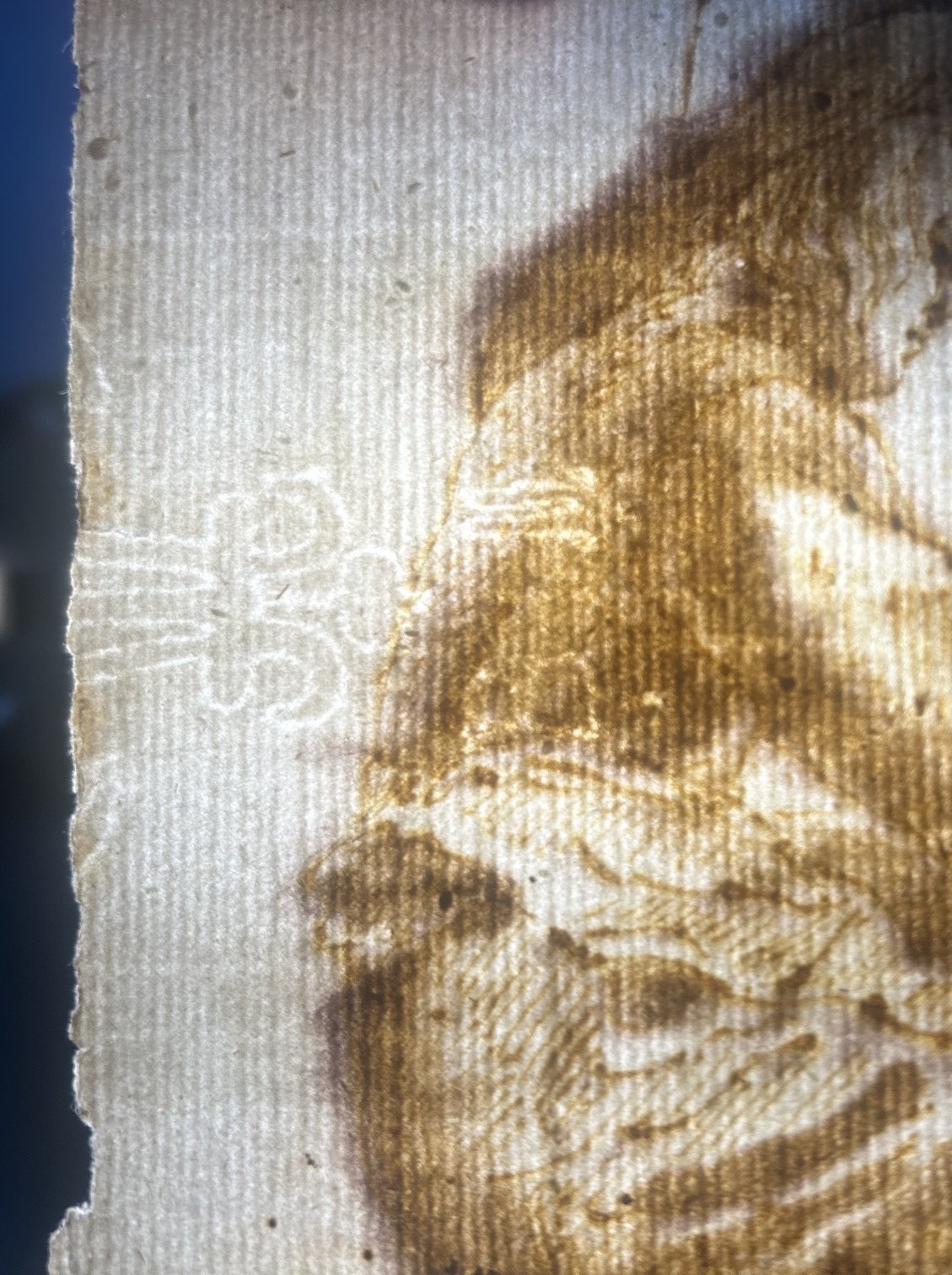
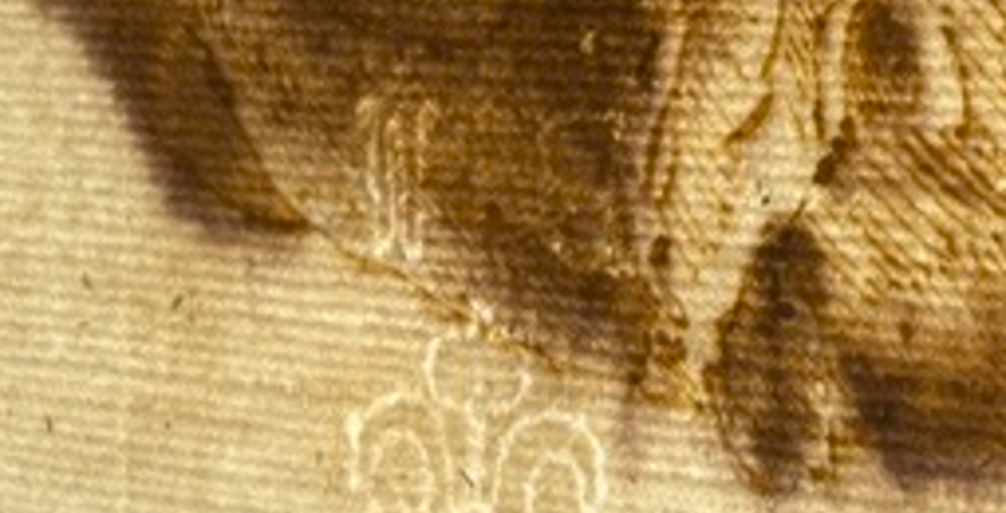
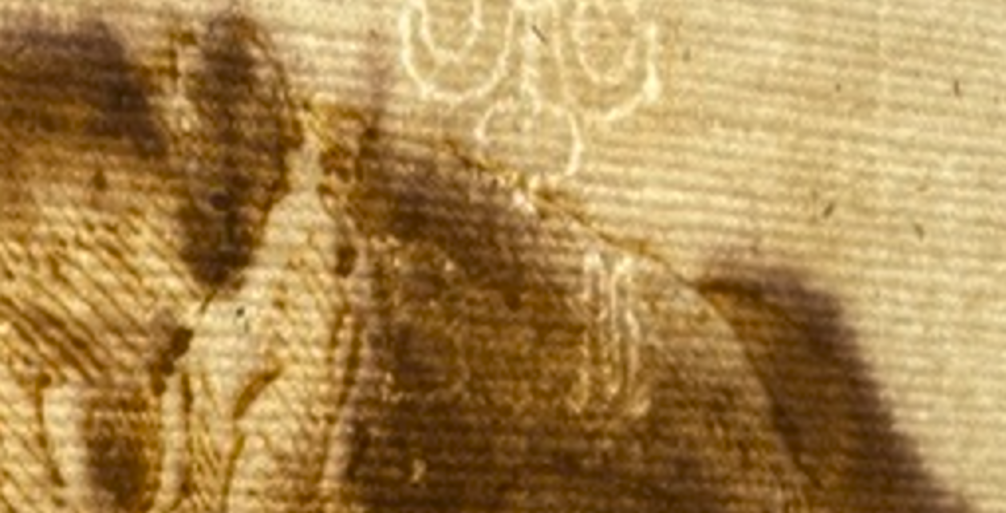
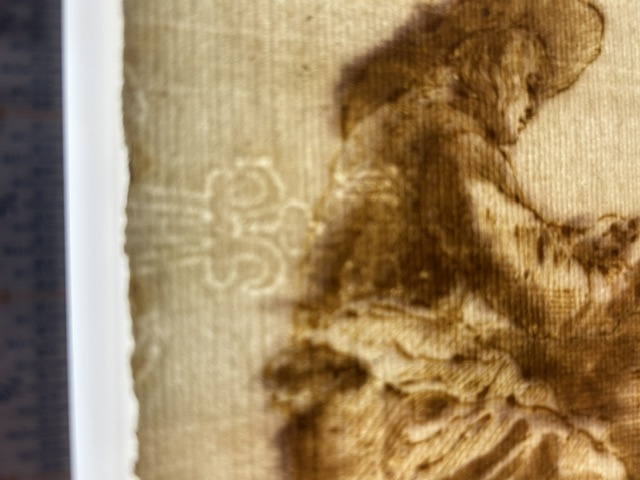
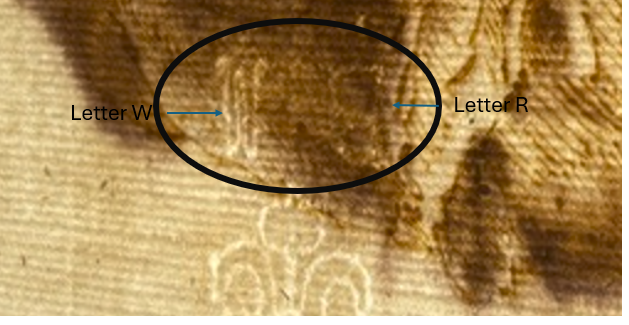
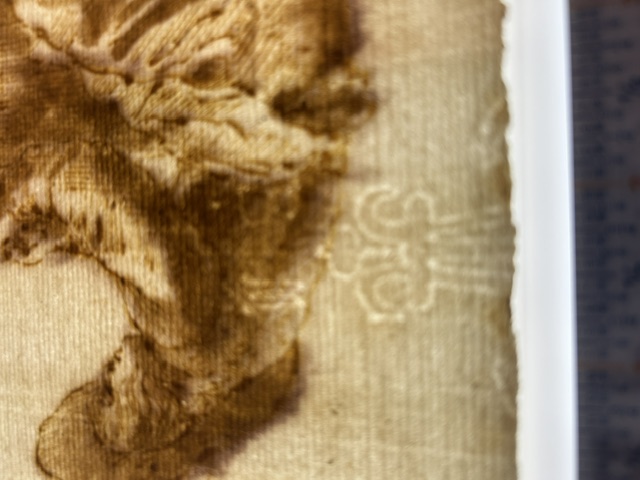
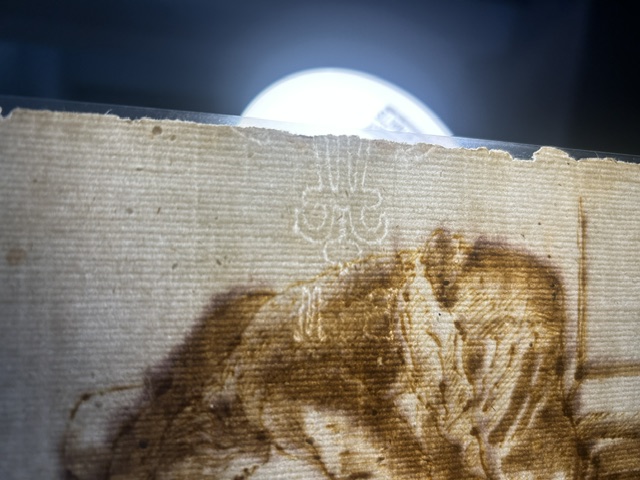
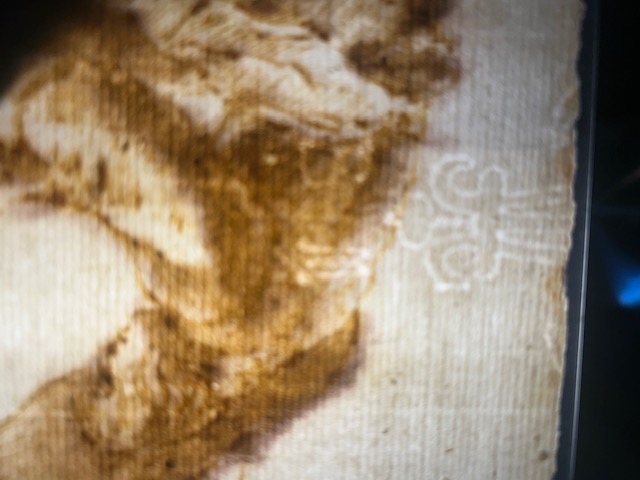
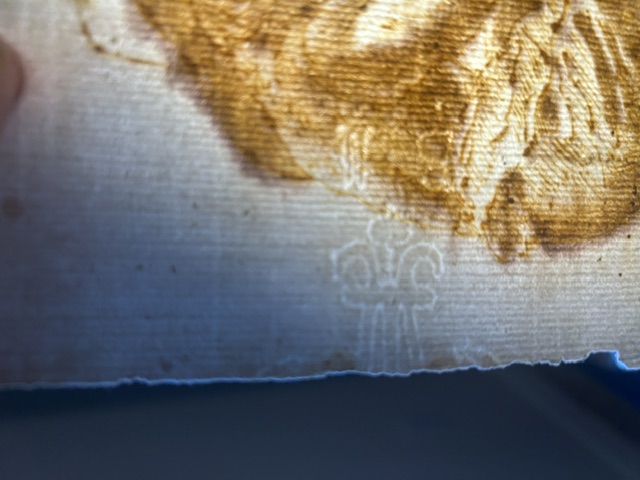
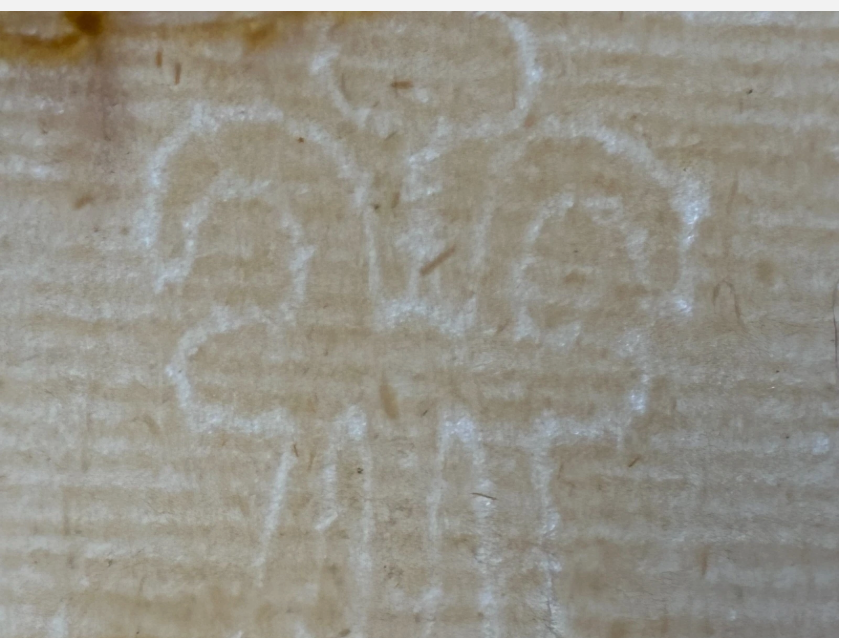
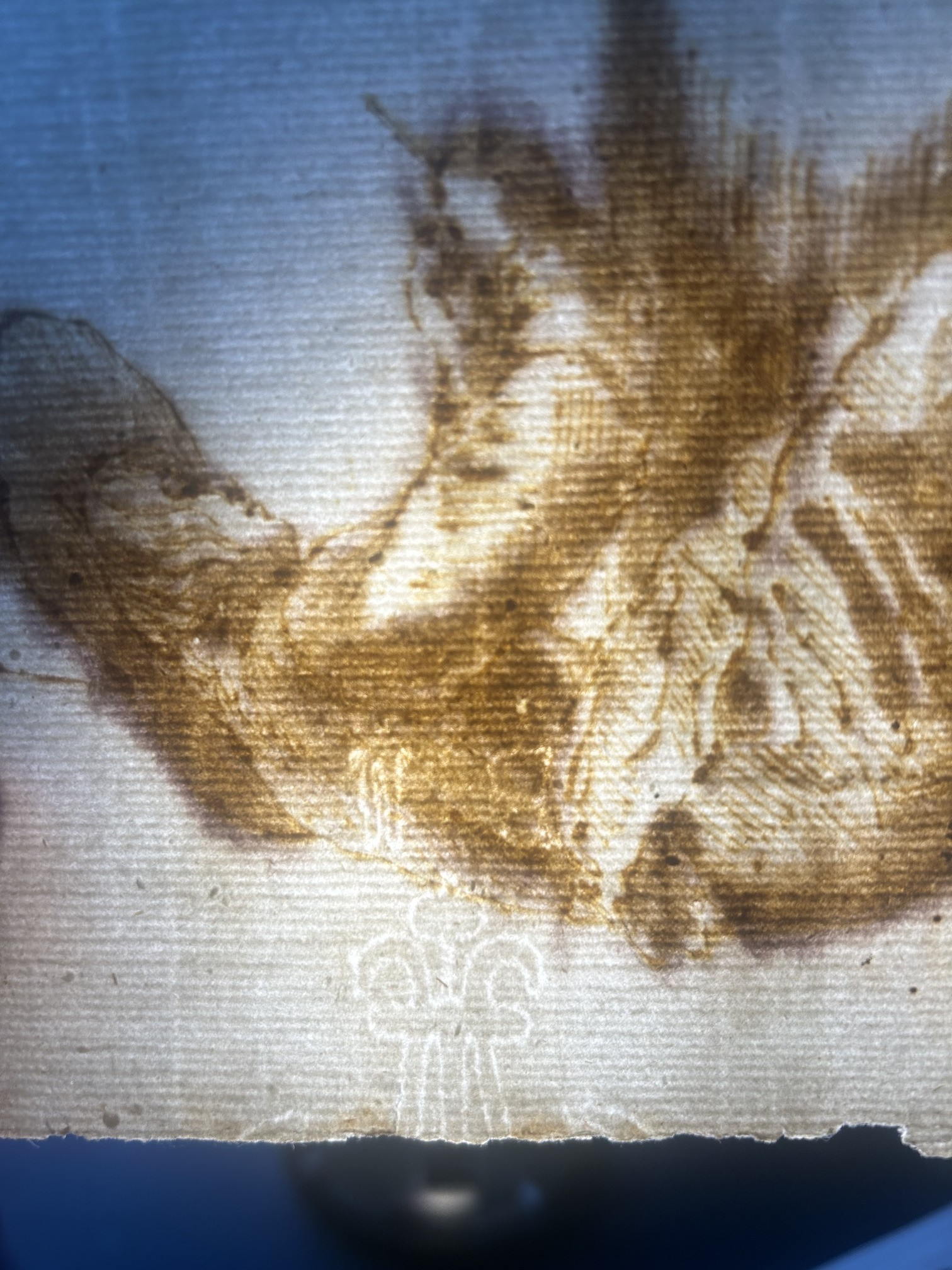
Adjacent to several worked passages are diffuse brown-grey halos where the medium has spread into the paper; these are not yet chemically characterized. Near one edge, transmitted light reveals part of a watermark — a truncated wire figure examined in section 06.

Deliberately left open

What photographs cannot establish

The chemistry of the media, the date of the paper, and the identity of the draughtsman cannot be determined from photographs, and this dossier accordingly does not determine them. Designations such as iron-gall ink, bistre, or a specific watermark variant appear here only as hypotheses for testing, following standard practice in technical art history (see the examination plan, section 10).

Established
A coherent, skilled drawing on handmade laid paper, with a partial watermark and an uncharacterized halo phenomenon.
Still open
Author, date, and context of execution. The catalogue title “filling his pipe” revises the working description of the shared composition; it does not settle what the hands on this sheet are holding.

Photographic documentation

Eight documented views, with magnification

The clearest photographs supplied for each aspect of the sheet. Click any image for fullscreen; move the cursor to magnify. All images are web derivatives: metadata removed, orientation and size adjusted, no tonal manipulation.

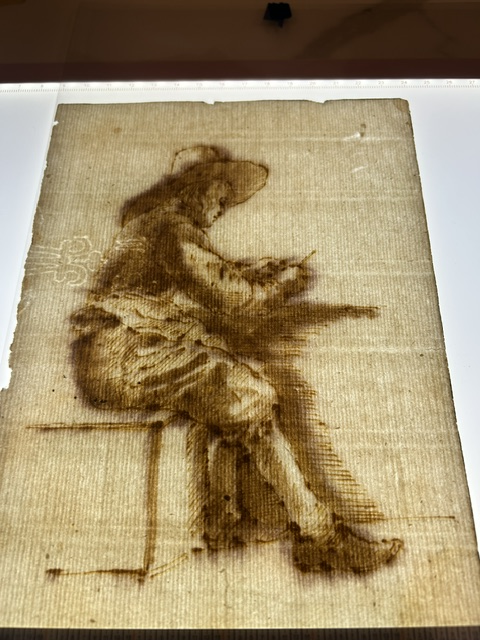
Portrait-format drawing of a seated young man in a broad-brimmed hat working over his hands, one leg thrown forward.

Full recto

The complete composition as recorded in the clearest supplied recto photograph.

Source state
Owner-supplied original capture; resized web derivative.
Public rights
Published with the custodian's permission.
Transformation
Metadata removed; orientation, resize, and WebP/AVIF encoding only. No tonal filter.
Limit
Ordinary photography does not identify the drawing media, date the support, or establish authorship.

Full recto

Portrait-format drawing of a seated young man in a broad-brimmed hat working over his hands, one leg thrown forward.

The complete composition as recorded in the clearest supplied recto photograph. Ordinary photography does not identify the drawing media, date the support, or establish authorship.

Eight further photographs, supplied on 25 September 2026

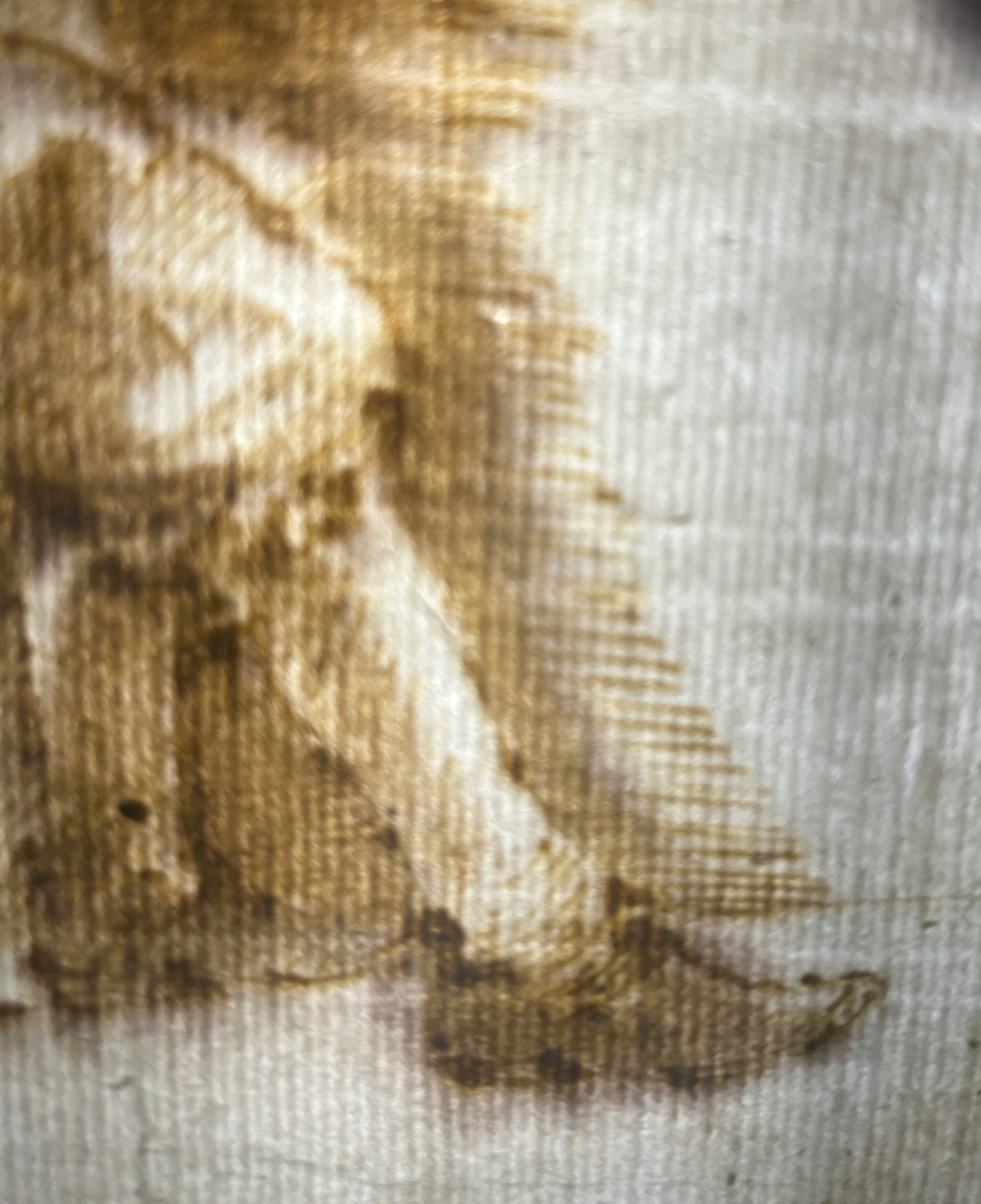
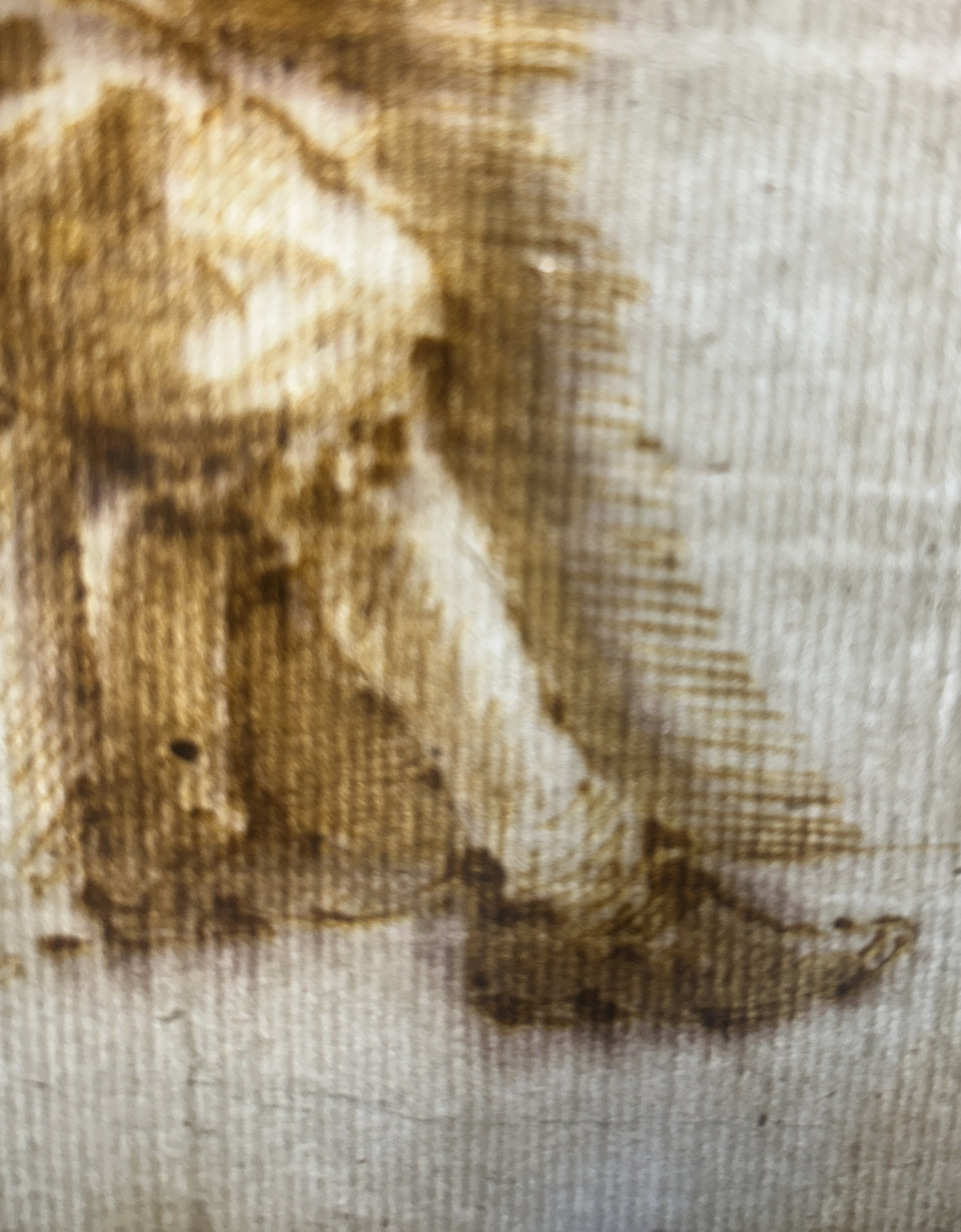
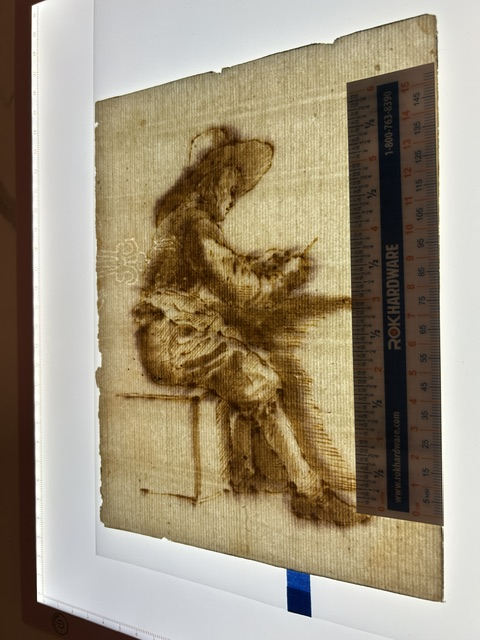
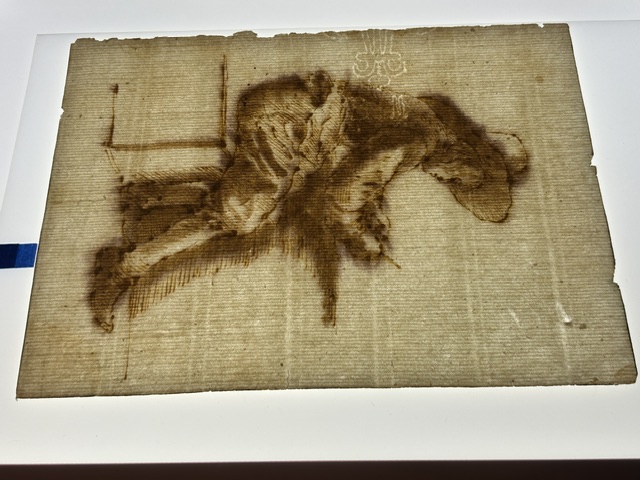
Direct observation The custodian supplied eight more photographs, IMG_6605 to IMG_6612. Each primary image is 640 × 480 pixels, shown here at that native size; enlargement adds no captured detail. The files also carry a 320 × 240 pixel HDR gain map. That auxiliary image is not a depth map, an infrared image or a radiograph, and it is not published as evidence. All eight are shown with the sitter's head up. Six were turned a quarter turn. IMG_6605 showed the drawing upside down and reversed, probably because it was taken through the back of the sheet, so it is flipped to read as the front. Each caption records its change.

The close view IMG_6608, with the overviews IMG_6605, IMG_6606 and IMG_6612, repeats a marginal group of light, curving, roughly symmetrical lines. Seen in several views, it is more plausibly a structural feature of the support, compatible with a wire element, than a single reflection. The views are oblique and unregistered, and the ruler is not a valid physical scale. They do not identify the mark as a crown, a lily, the letters WR, a mill or a date, and the irregular edges support recording each edge without proving trimming or the loss of part of a watermark. The mark remains unclassified; see section 06.

Evidence grading used in this dossier

Every substantive statement carries one of the following grades. A claimant's file is treated as an inventory of assertions to test, never as evidence. Similarity is not identity, and material compatibility is not attribution.

Direct observation
Visible or measurable in a supplied photograph of the object.
Documented source
Stated in an identified archival, institutional, or published record.
Source-reported
Reported by a named source but not independently established here.
Comparison
A controlled relationship with another work or record.
Working hypothesis
A possible explanation retained for testing.
Unresolved
Current evidence cannot yet distinguish among explanations.
Not supported
A proposition extends beyond the evidence now available.
02

Principal comparison

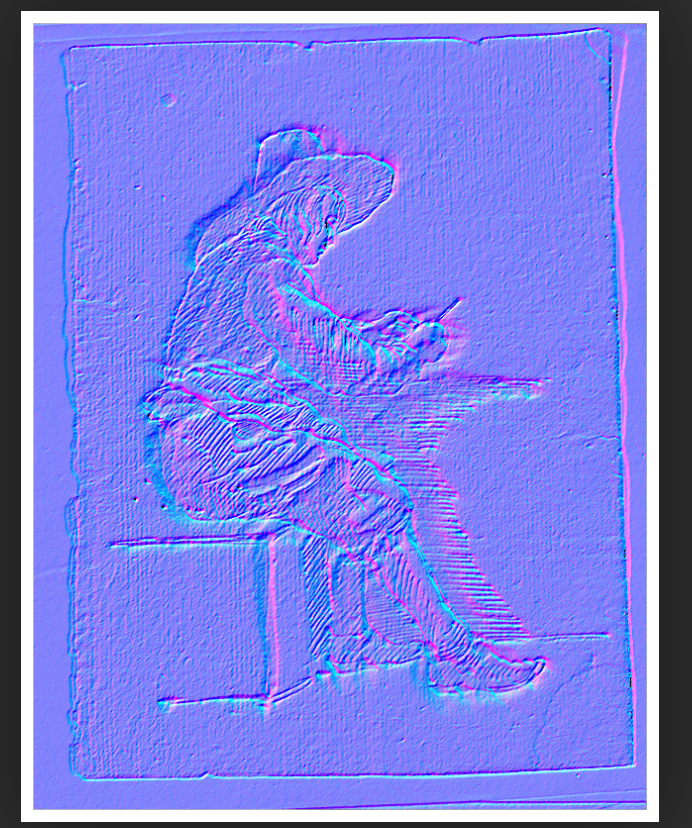
RKD 116036: the same composition

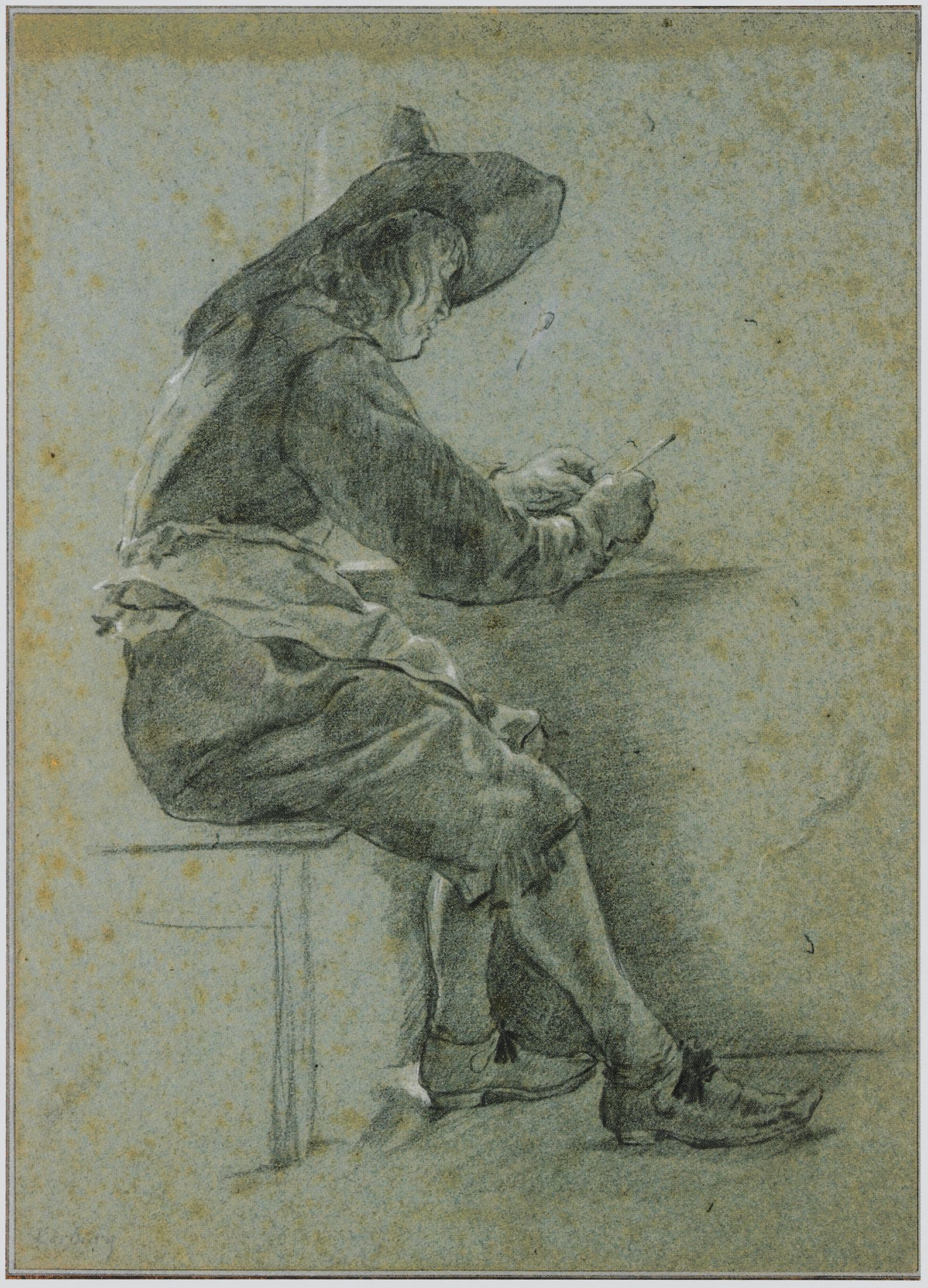
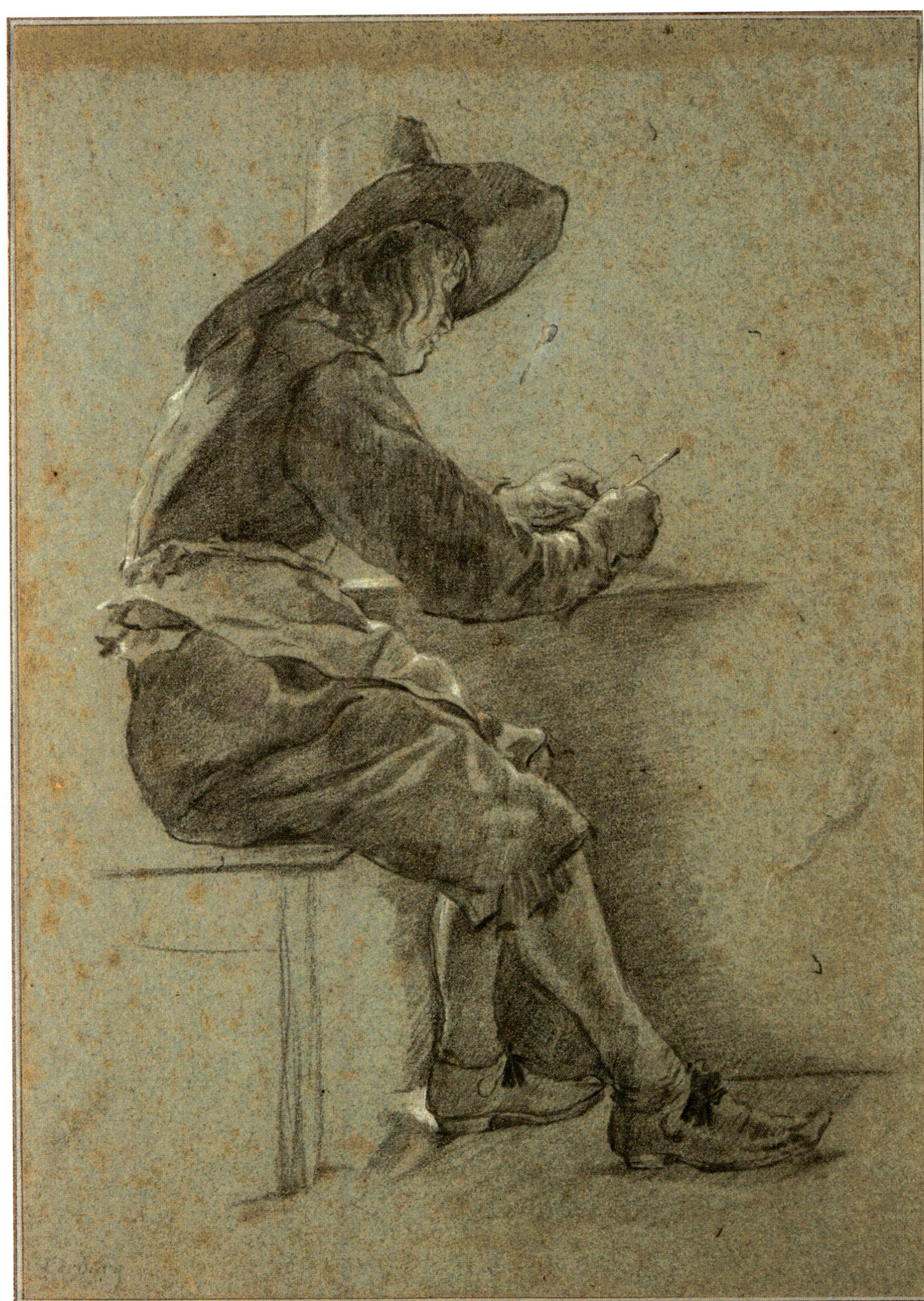
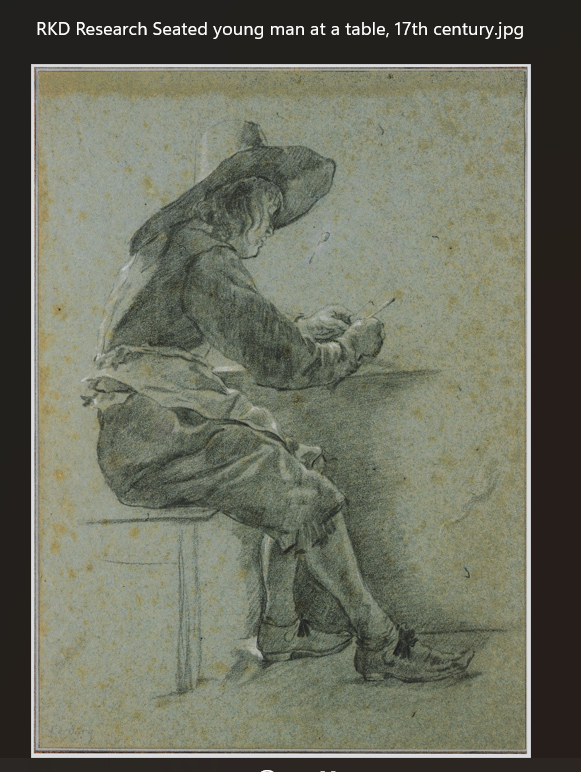
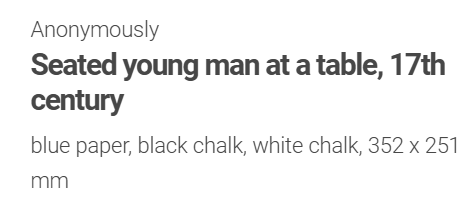
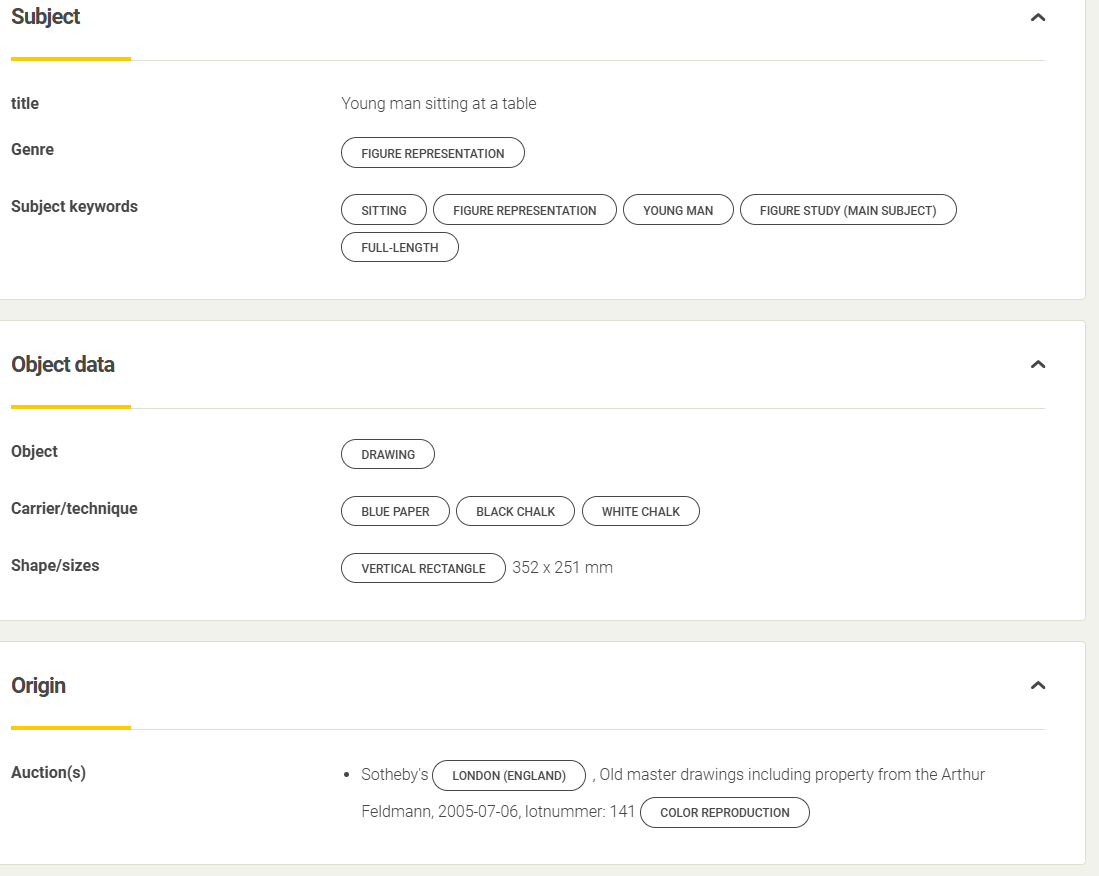
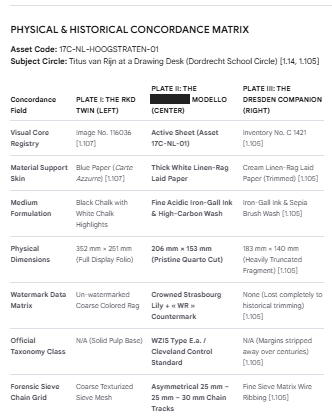
Documented source RKD records Zittende jongeman aan een tafel(Seated young man at a table), no. 116036, as an anonymous work from the Northern Netherlands, seventeenth century, in black and white chalk on blue paper, with sheet dimensions of 352 × 251 mm. These are the comparator's catalogue details; they do not establish the maker, date or materials of the present drawing. Sotheby's 2005 catalogue, discussed in the next section, uses the title “filling his pipe” for this sheet and records a pencil inscription “Terburg”. That is a revision of the working description of the shared activity. It is not an authenticated signature, and it does not change the attribution of either drawing. RKD object record

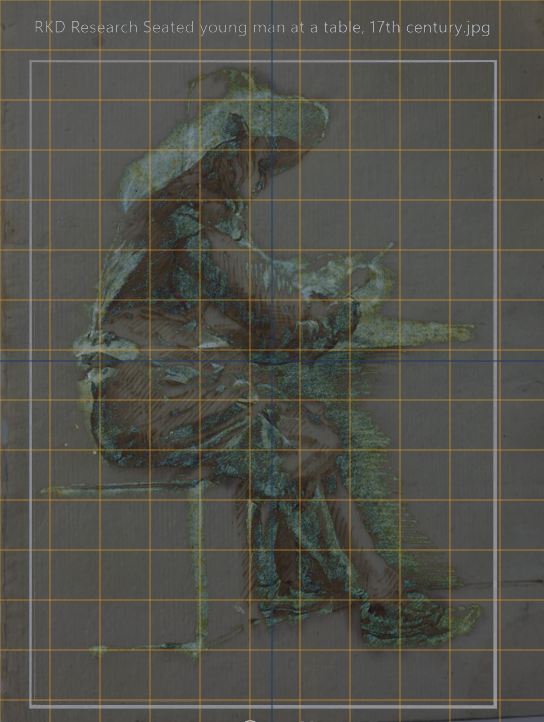
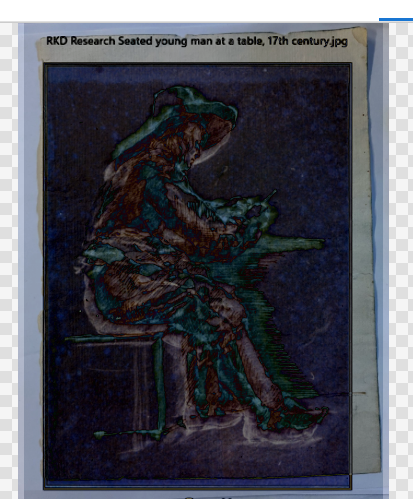
Comparison RKD 116036 has the same composition as the present sheet. The seated draughtsman, the broad hat, and the arrangement of the head, arms, clothing and legs correspond, as do several contour routes and boundaries within the drapery. Dresden C 1421 is a different design of a related subject and is discussed afterwards. The same composition does not establish that every individual stroke corresponds, or that the drawings were made by the same person.

The back: outer contour and internal modelling

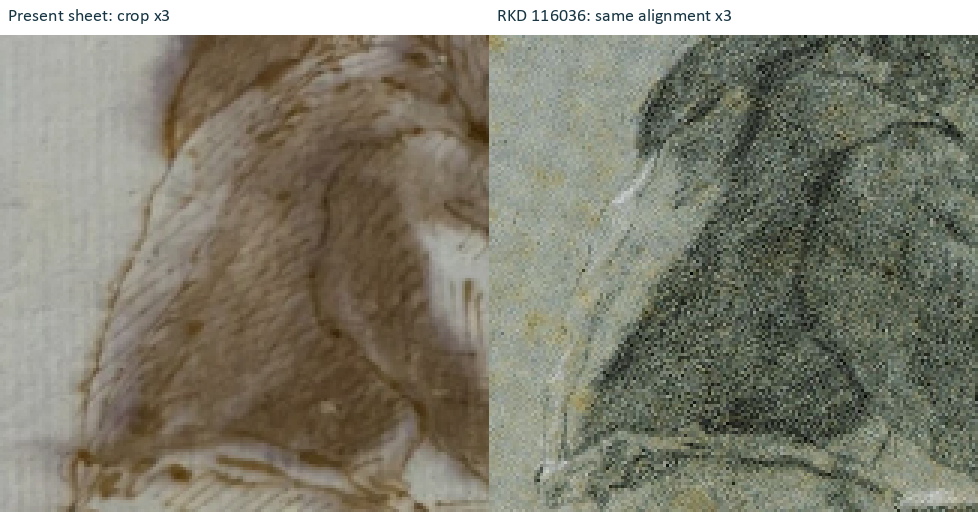
Back comparison. The RKD reproduction shows an outer light strip and more than one boundary; the present sheet uses a simpler dark outline.
Back. Present sheet, left; RKD 116036, right. Corresponding image areas under one global alignment, enlarged for inspection. The RKD image retains reproduction texture. Enlargement adds no detail, and this region has not been fitted separately.

Direct observation In the available RKD reproduction, a light outer strip and more than one boundary articulate the rear of the torso. In the present sheet, the same region is more simply bounded by a strong brown contour. With the same whole-image alignment used throughout the comparison, that contour lies near part of the inner modelling of the RKD back.

Working hypothesis This may represent a selective translation of the design, in which an internal modelling boundary becomes part of the outer silhouette. Identifying the exact line correspondence requires better reproductions. The visible boundary should not be described as the sitter's spine, and the current comparison does not demonstrate an anatomical error or a mechanical tracing.

Comparison The route taken by the back boundary in the present sheet makes the figure narrower there without producing an obvious anatomical incoherence. That observation is kept separate from a different question: what the RKD line itself is, whether an interior contour, an abandoned first line or something else, and when it was drawn. Both remain unresolved.

Related folds, different graphic treatment

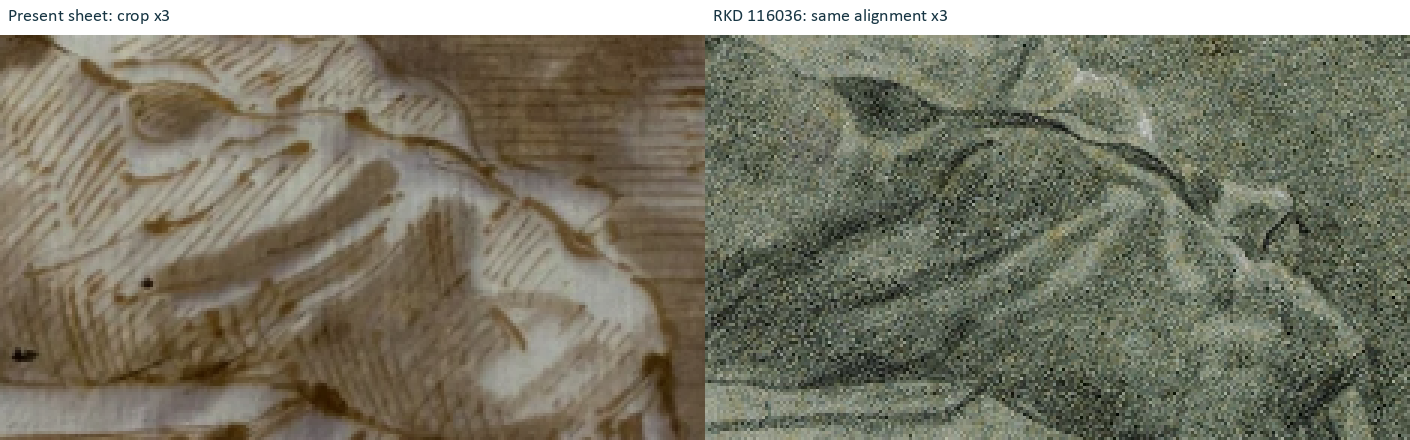
Breeches comparison showing related fold organisation with differences in contours and tonal modelling.
Breeches. Closely related fold organisation with differences in contour and tonal treatment. Same global alignment as the back comparison.
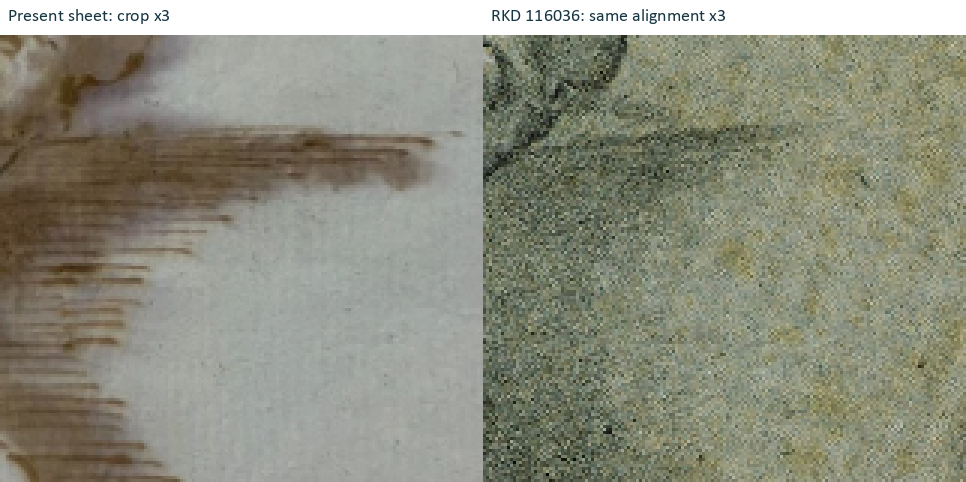
Shadow comparison. Clear horizontal stepped hatching on the left and a diffuse region on the right.
Shadow beside the working arm. Horizontal hatching in the present sheet and a more diffuse area in the RKD reproduction. This passage limits any claim of complete stroke-for-stroke identity.

Comparison The breeches provide a further correspondence in the arrangement of folds and light areas, with a more explicitly linear treatment in the present sheet. The distinction between a shared contour route and the individual marks used to draw it matters when comparing different media.

Limit of the comparison The shadow beside the working arm shows clear horizontal, stepped hatching in the present sheet. An equivalent sequence is not clearly legible in the RKD reproduction, where this area appears more diffuse. Similarities should therefore be assessed alongside local differences, rather than described as an exact match of all strokes.

Explore the superposition

Choose a colour for each drawing, adjust their visibility, or return to the images without recolouring. The alignment is fixed: changing colours, opacity or zoom does not alter the relationship between the drawings. Use the back, breeches and shadow controls to inspect the same areas discussed above.

Compare the drawings
ZoomInspect

Without recolouring · Present sheet 100% · RKD 50% · Zoom 100%

Colours also include paper tone and reproduction texture. They do not isolate ink or chalk. “Without recolouring” retains the same alignment; it does not restore the sheets to physical scale.

Present sheet: a seated young draughtsman in a broad-brimmed hat, in brown linear and tonal media.RKD 116036 reproduction, uniformly scaled and rotated into the comparison frame.
Alignment and limits

One global alignment uses uniform scale, rotation and translation, with six manually selected broad compositional points and four further points kept out of the fit. There is no local warping or separate fitting of the regions. Colours, visibility and zoom do not change the alignment.

The common canvas is 620 × 795 pixels. The photographs have not been rectified for perspective. The images do not resolve every stroke's length, interruptions or sequence. This viewer compares designs; it does not determine authorship, date, transfer method or the direction of any copying.

The images are aligned by uniform scaling, rotation and translation, without local warping. This is a comparison at a common display scale, not a display of the sheets at their physical sizes. Their reported sheet sizes differ. That difference does not rule out transfer through a resized reproduction or another copying process.

Viewing limit Colours follow image darkness and include paper tone and reproduction artefacts; they do not isolate drawing material. The small photograph of the present sheet and the available RKD reproduction do not allow a reliable comparison of every stroke's length, interruptions or order of execution.

Supported observation: a close relationship in the organisation of the designs, with both local correspondences and differences that can be inspected directly. On the present evidence, a shared design or a derivation is better supported than coincidence between two wholly independent studies. The identity of every stroke, a mechanical tracing, the direction and date of any transfer, and common authorship remain unproved.

Evidence-backed question: whether one drawing derives from the other, directly or through a reproduction, or whether both use an earlier design. A repeated design by one artist and a copy by another remain distinct possibilities.

Unresolved: the direction, date and means of any transfer, and the authorship and sitter of the present sheet. The overlay does not demonstrate a mechanical tracing or establish a common drawing session. Dresden remains relevant to the broader subject and attribution history, but differences from Dresden alone cannot establish independence from the same composition recorded as RKD 116036.

Next evidence: a better photographic source for RKD 116036, a perpendicular photograph of the present sheet, and the reproduction history of the RKD drawing. These would allow the back boundary and other particular contour routes to be tested more closely.

Present-sheet photograph supplied by the custodian. Comparator: RKD 116036, colour reproduction, digital object 9141481, used here for non-commercial research. Alignment and display derivatives prepared for this dossier. The colour file checked on 23 September 2026 is the same reproduction used to build the alignment. Catalogue details were checked against the RKD record on 19–20 September 2026 and belong to the comparator, not to the present sheet.

The two RKD image records

Documented source RKD attaches two image records to 116036: a colour reproduction, digital object 9141481, and a black-and-white photograph, 9158962. The available files differ in framing, margins, lettering and pixel dimensions, so the monochrome file is not simply a greyscale conversion of the colour one. That does not prove two independent photographic captures, and the source and date of either reproduction remain unknown. On 26 September 2026 the record, last updated on 9 April 2024, gave as provenance only the Sotheby's sale of 6 July 2005, lot 141, and listed no literature or exhibitions. RKD 116036

Established
RKD 116036 has the same composition as the present sheet. Local differences of line and tone remain visible under one global alignment.
Still open
Whether one drawing derives from the other, directly or through a reproduction, or both use an earlier design. Direction, date, means, authorship and sitter remain unresolved.
02a

Research lead

The Ter Borch family and workshop: a documented research lead

Sotheby's records a pencil inscription “Terburg” on the sheet identified with RKD 116036. That is a reason to investigate the Ter Borch family and the attribution history of that drawing. It is not an authenticated signature, and it does not attribute the present sheet to Gerard ter Borch, Moses ter Borch, or their workshop.

The sheets below are different poses. They are shown side by side for comparison. They are not layers in the present sheet–RKD viewer, and Dresden C 1421 is not returned to that selector. Bodies are not warped to force a match. No bibliography consulted for this section specifically attributes RKD 116036, or the present sheet, to Gerard or Moses.

The inscription on lot 141

Documented source Sotheby's, Old Master Drawings, London, 6 July 2005, lot 141, printed page 159, describes a young man in a hat seated at a table, filling his pipe. It gives black and white chalk on blue paper, 352 × 251 mm, and retains the attribution Dutch School, seventeenth century. The RKD record already cited in section 02 agrees on an anonymous seventeenth-century sheet of that medium and size, catalogued as Northern Netherlands. The sale reference and the matching illustration identify lot 141 with RKD 116036. They do not prove who owned the sheet before the sale. The printed reproduction is halftone and limits stroke-level comparison. RKD 116036

Limit The catalogue reports the pencil inscription “Terburg”. It does not describe that inscription as an artist's signature. “Mentioned on object”, elsewhere in this section, is the same kind of limit: a recorded name is not an authenticated signature. A dated family example, in which the father annotates a drawing by Harmen, is RP-T-1887-A-887 below. It does not identify the writer of “Terburg”. The published title revises the working description of the shared composition. The present sheet is not silently retitled, and the object in the hands of this drawing remains unresolved in the photographs.

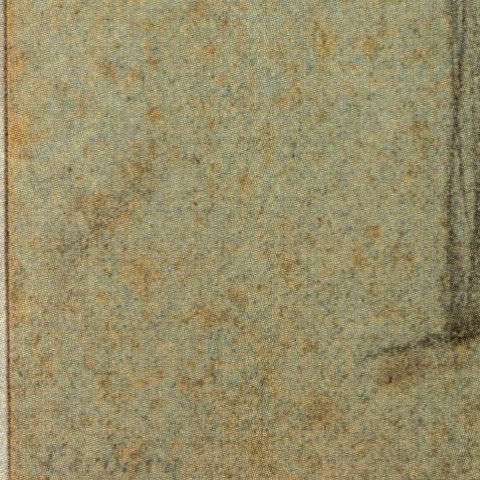
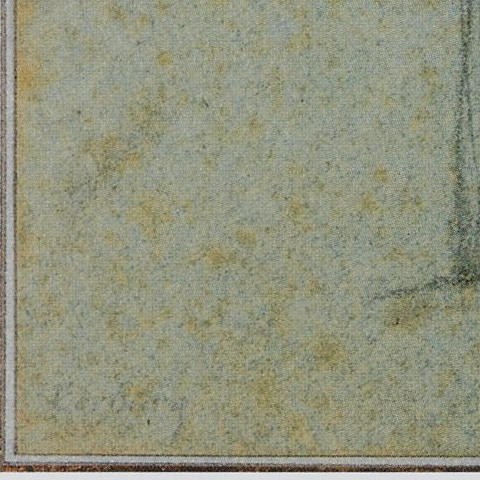
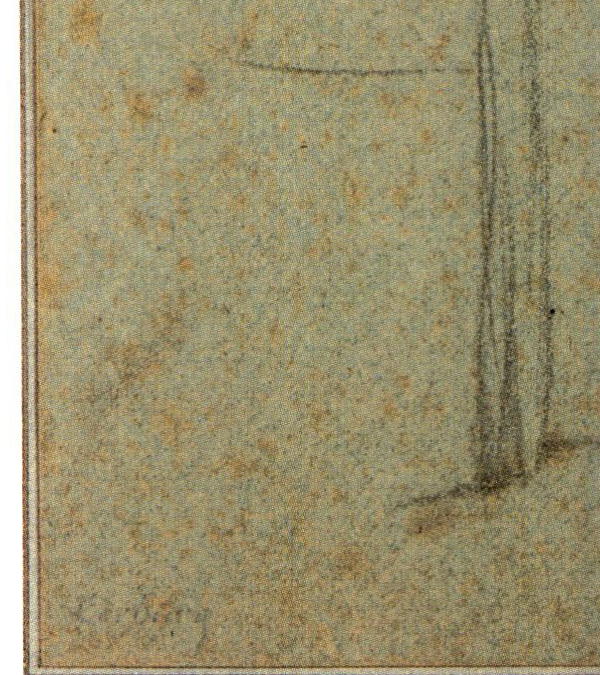
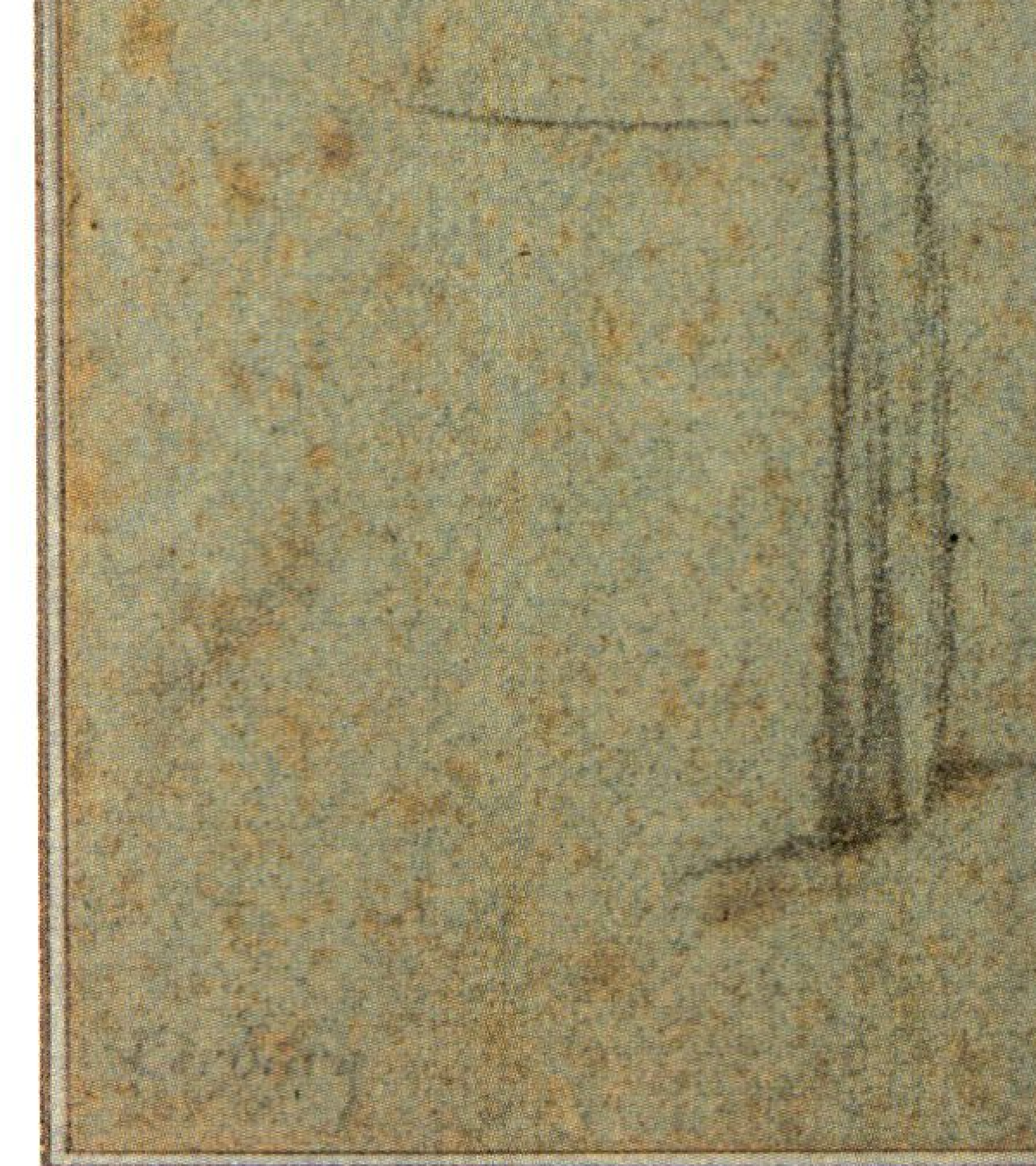
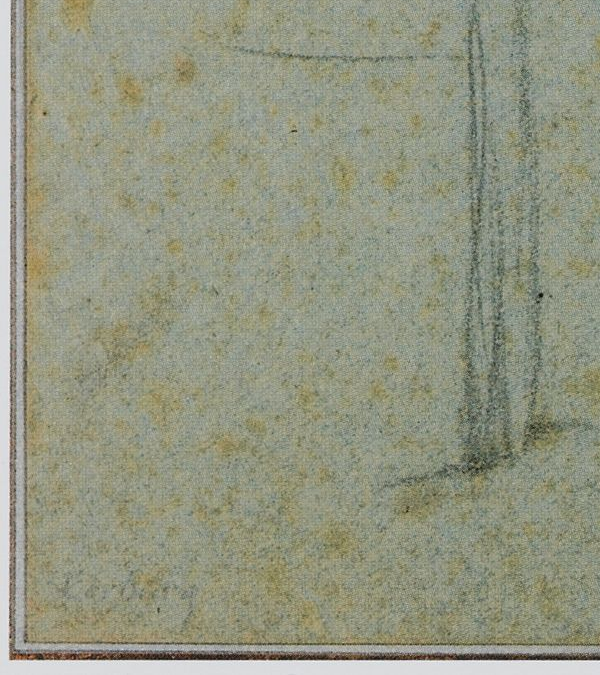
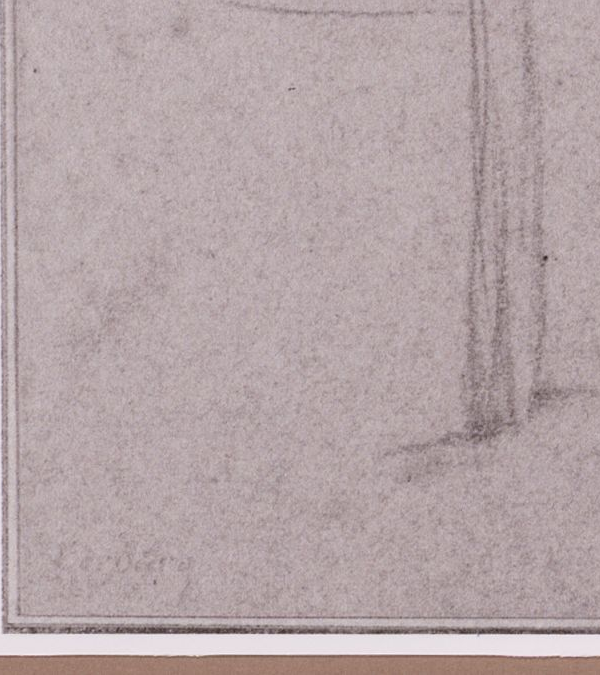
Documented source The catalogue's own words for the mark are: bears pencil inscription, lower left: Terburg. It does not say signed. The crop below is that corner of the illustration printed with lot 141. It is a halftone. The letters cannot be read from it, so this page does not offer a new reading and does not treat the mark as an authenticated signature. The reading “Terburg” remains the catalogue's.

Lower-left corner of the Sotheby's 2005 catalogue illustration, with a faint mark where the catalogue records a pencil inscription.

Fullscreen view

Lower-left corner of the Sotheby's 2005 catalogue illustration, with a faint mark where the catalogue records a pencil inscription.
Lower left of the lot 141 illustration.Sotheby's, London, 6 July 2005, lot 141, printed page 159. The catalogue says this corner bears a pencil inscription, “Terburg”. The crop is taken from that printed illustration, without recolouring, sharpening or reconstruction. The halftone does not resolve the letters. Not an authenticated signature, and not a detail of the present sheet. RKD 116036

The 2005 catalogue: the document, its note and its estimate

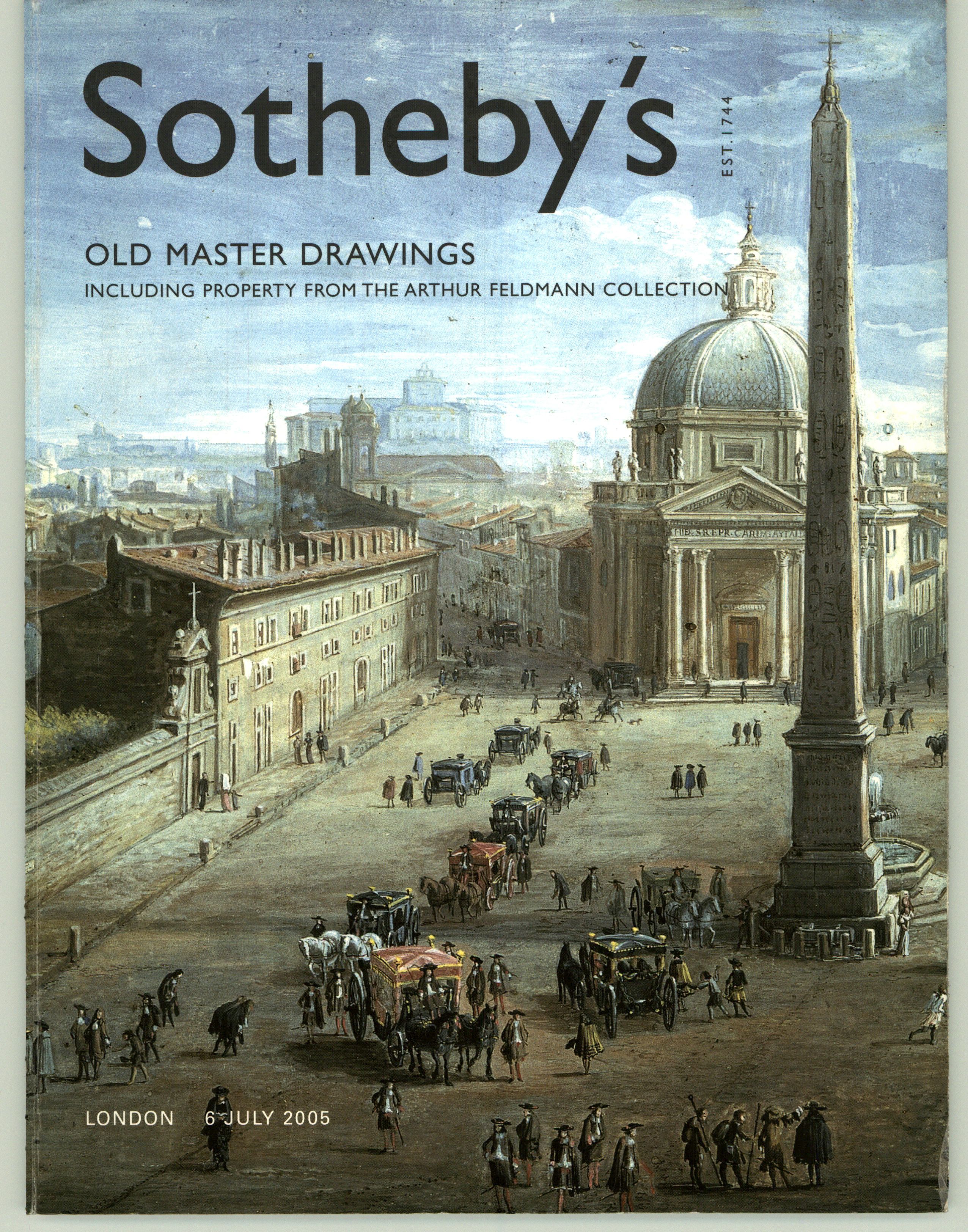
Documented source The custodian supplied a two-page PDF: the front cover and printed page 159. It is published here unchanged (PDF, 2 pages, 3.2 MB), with the two pages and the drawing as printed on page 159 below. The cover names the sale Old Master Drawings, including property from the Arthur Feldmann Collection, London, 6 July 2005. That title does not show that lot 141 was Feldmann property. The lot is catalogued as Dutch School, 17th Century, black and white chalk on blue paper, 352 × 251 mm, and reproduced as a halftone.

Documented source The same page carries a catalogue note, repeated in Sotheby's online entry for sale L05040: “One can easily imagine finding a figure based on this study from life in a painting by one of the Bamboccianti. Little is, however, known of the figure drawing style of most of those artists, so until this figure is actually found in a painting, this highly accomplished study must remain unattributed. The clue to its authorship may perhaps lie in the fact that although the figure type and approach to lighting seem strongly Italianate, there is also a certain stylistic affinity with figure drawings by Rembrandt school artists such as Backer and Flinck.” The printed estimate is £5,000–7,000 (€7,300–10,200; US$9,200–12,900). Neither the page nor the online entry records a result. Sotheby's, sale L05040, lot 141

Comparison The 2005 cataloguer recorded the “Terburg” inscription but did not discuss it. The stylistic suggestion pointed instead to the Bamboccianti, painters of Roman street life, and to Rembrandt-school figure drawings by Jacob Backer and Govert Flinck. Museum records confirm that both made figure studies in this medium: the Albertina holds Backer's knee-length study of a man with hat and cloak seated before a table, inv. 10212, black and white chalk on blue paper, once attributed to Jürgen Ovens; the Rijksmuseum's Flinck, RP-T-1977-40, is in the same medium and lists Backer as a rejected attribution; the Ackland Art Museum's Backer, 2017.1.1, is on blue-grey paper. These are cited without images. Albertina 10212 · Rijksmuseum RP-T-1977-40 · Ackland 2017.1.1

Limit The note is a 2005 opinion about lot 141, not evidence of authorship, and it bears on the present sheet only through the shared composition. The medium does not identify a circle: Ter Borch family drawings in black and white chalk on blue paper are also documented below. None of the three museum records mentions RKD 116036, and all three sheets are smaller than lot 141. The Ter Borch lead stands beside this older suggestion; neither decides the attribution.

Documented source Sotheby's online entry for lot 141 has no provenance section, whereas Feldmann lots in the same sale, such as lot 33, record Feldmann, the Gestapo seizure and the 2003 restitution to his heirs. ARTnews reported the Feldmann group as 55 drawings in a sale of 244 lots. RKD's provenance field for 116036 names only this sale. A lot printed without provenance has an undocumented earlier history, not a known one; no source consulted supplies a Feldmann provenance for lot 141. Lot 33 · ARTnews, 19 July 2005

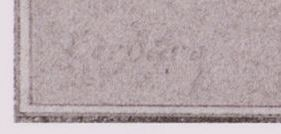
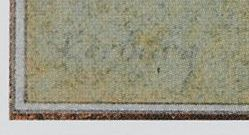
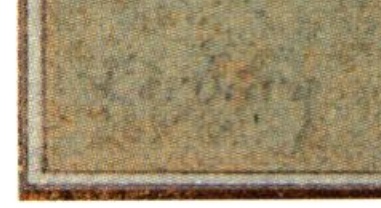
Three crops of the reported Terburg inscription

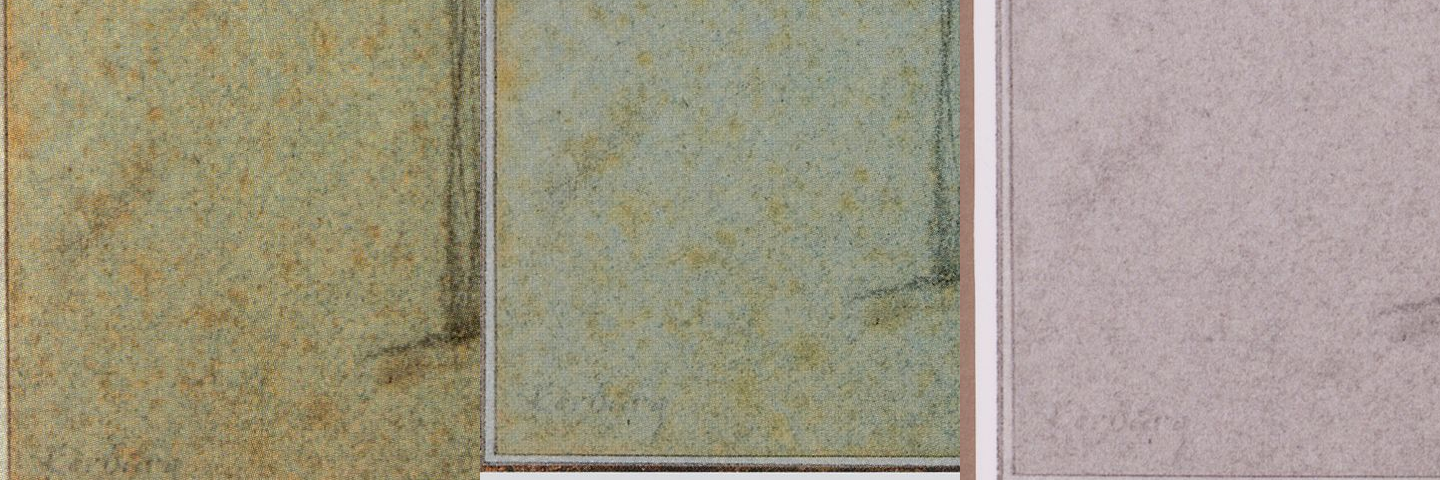
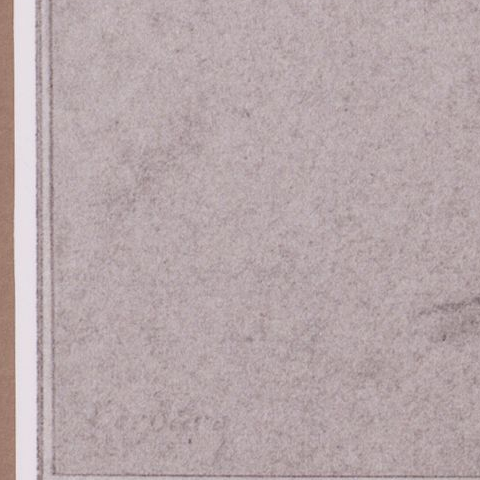
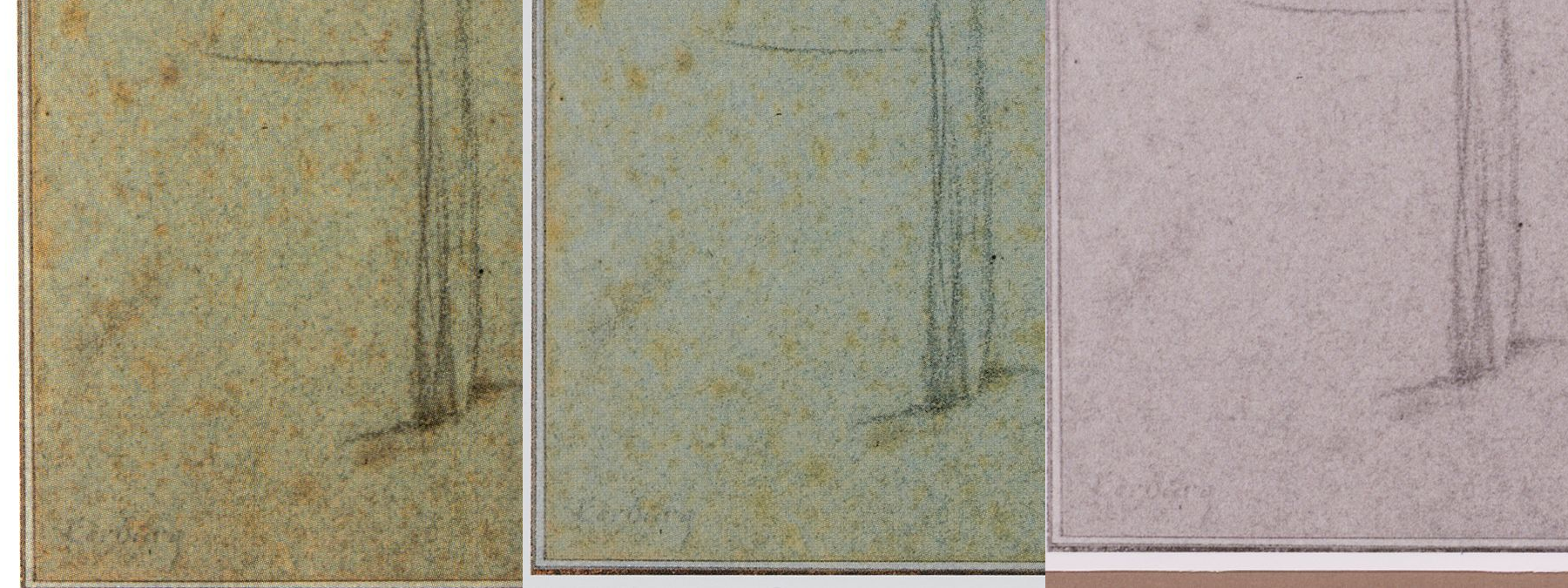
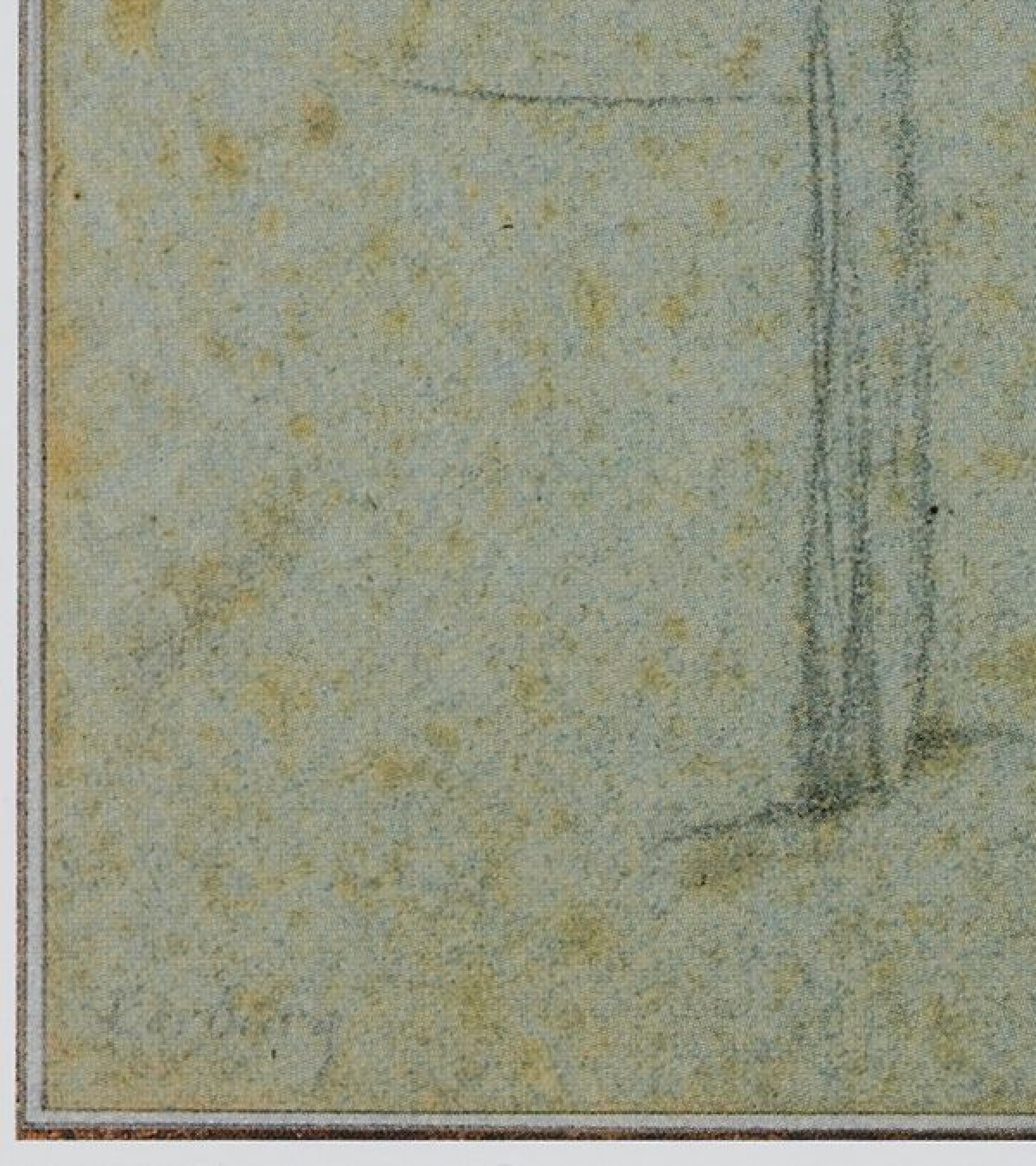
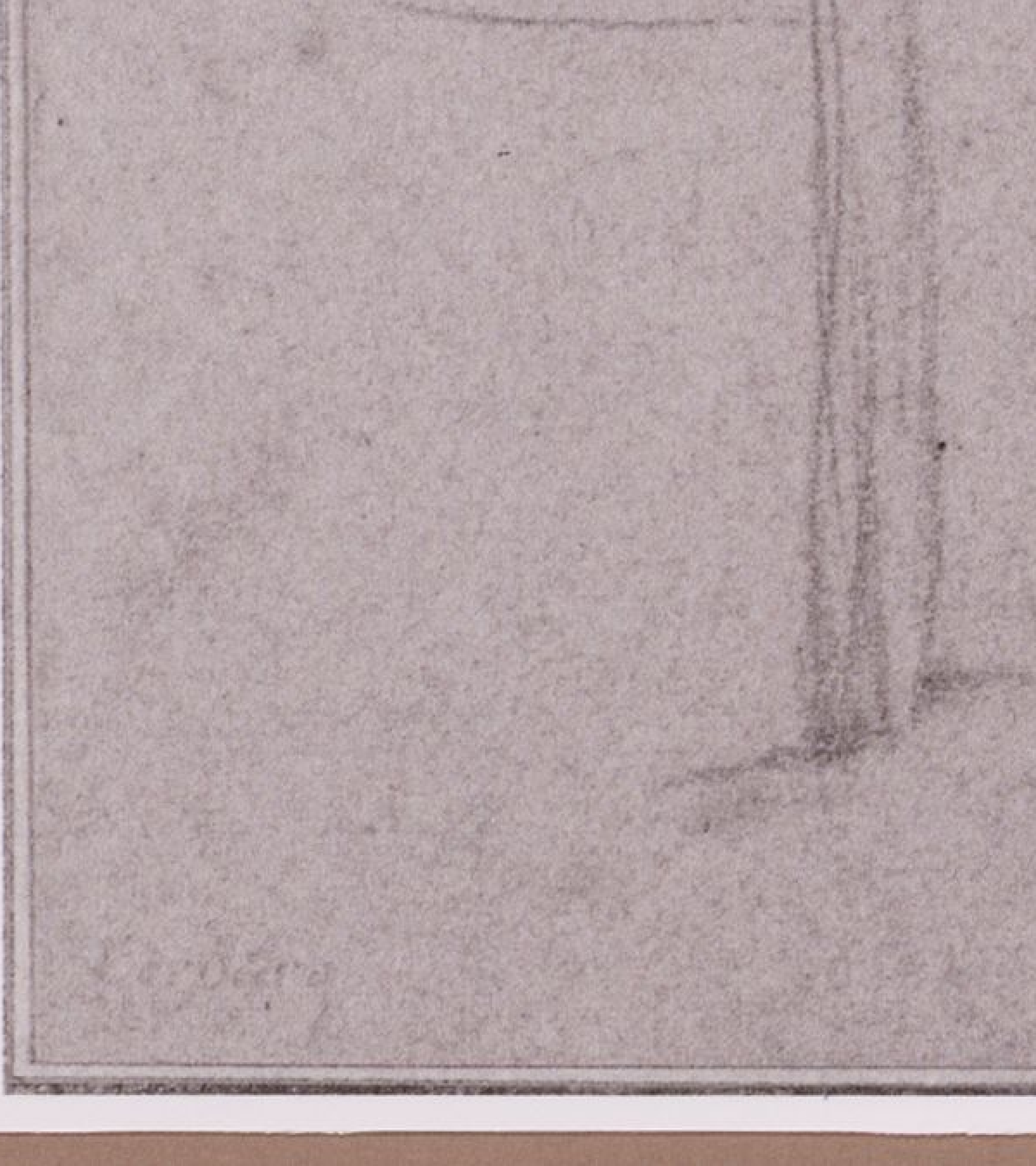
Direct observation The dossier editor supplied three crops of the lower-left corner: from the RKD monochrome reproduction, 281 × 134 pixels; from the RKD colour reproduction, 249 × 135 pixels; and from the Sotheby's PDF, 381 × 208 pixels. They are shown at their full captured size. Faint cursive marks are visible, with a reproduction pattern and limited tonal separation. Enlargement makes the marks easier to inspect but cannot restore detail the reproductions do not contain.

Limit These are three reproductions of one drawing, not three signed works. They support examination of the reported reading “Terburg”; they do not authenticate a signature, identify its writer, date the inscription, or distinguish Gerard from Moses or a later annotator. Its autograph status remains unverified.

Reproduction-quality comparisons (19 crops)

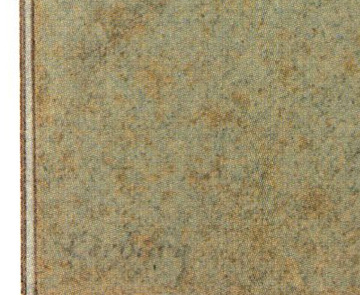
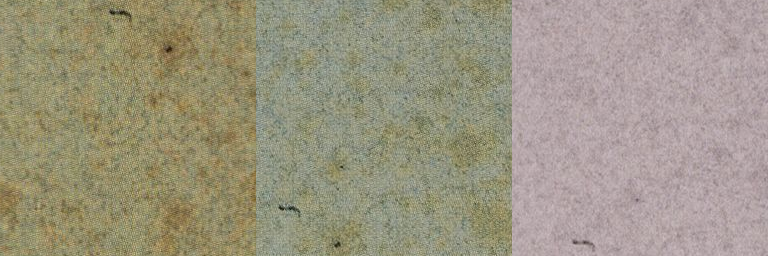
Native crops of the inscription corner, a blank paper area and the printed lot description, with nearest-neighbour ×3 enlargements. They compare the reproduction pattern of the catalogue scan and the two RKD files. A ×3 enlargement adds no detail, and printed catalogue lettering is distinct from an inscription on the drawing.

  • Blank paper area, three reproductions side by side (native)Documentary comparison of the catalogue/RKD reproduction. Native crop or assembled comparison; retain the visible reproduction pattern. Printed catalogue lettering is distinct from a readable autograph inscription on the drawing.Sotheby’s catalogue / RKD, as labelled in the image; research derivative. Research derivative; rights follow the constituent sources.Download PNG (768 × 256 px, 331 KB)
  • Blank paper area, catalogue scan (native)Documentary comparison of the catalogue/RKD reproduction. Native crop or assembled comparison; retain the visible reproduction pattern. Printed catalogue lettering is distinct from a readable autograph inscription on the drawing.Sotheby’s catalogue / RKD, as labelled in the image; research derivative. Research derivative; rights follow the constituent sources.Download PNG (256 × 256 px, 132 KB)
  • Blank paper area, catalogue scan (×3 nearest-neighbour)Documentary comparison of the catalogue/RKD reproduction. Nearest-neighbour enlargement ×3; it does not add detail. Printed catalogue lettering is distinct from a readable autograph inscription on the drawing.Sotheby’s catalogue / RKD, as labelled in the image; research derivative. Research derivative; rights follow the constituent sources.Download PNG (768 × 768 px, 174 KB)
  • Lower left, catalogue scan (native)Documentary comparison of the catalogue/RKD reproduction. Native crop or assembled comparison; retain the visible reproduction pattern. Printed catalogue lettering is distinct from a readable autograph inscription on the drawing.Sotheby’s catalogue / RKD, as labelled in the image; research derivative. Research derivative; rights follow the constituent sources.Download PNG (480 × 480 px, 480 KB)
  • Lower left, three reproductions side by side (native)Documentary comparison of the catalogue/RKD reproduction. Native crop or assembled comparison; retain the visible reproduction pattern. Printed catalogue lettering is distinct from a readable autograph inscription on the drawing.Sotheby’s catalogue / RKD, as labelled in the image; research derivative. Research derivative; rights follow the constituent sources.Download PNG (1,440 × 480 px, 1.1 MB)
  • Blank paper area, RKD colour (native)Documentary comparison of the catalogue/RKD reproduction. Native crop or assembled comparison; retain the visible reproduction pattern. Printed catalogue lettering is distinct from a readable autograph inscription on the drawing.Sotheby’s catalogue / RKD, as labelled in the image; research derivative. Research derivative; rights follow the constituent sources.Download PNG (256 × 256 px, 123 KB)
  • Blank paper area, RKD colour (×3 nearest-neighbour)Documentary comparison of the catalogue/RKD reproduction. Nearest-neighbour enlargement ×3; it does not add detail. Printed catalogue lettering is distinct from a readable autograph inscription on the drawing.Sotheby’s catalogue / RKD, as labelled in the image; research derivative. Research derivative; rights follow the constituent sources.Download PNG (768 × 768 px, 159 KB)
  • Lower left, RKD colour (native)Documentary comparison of the catalogue/RKD reproduction. Native crop or assembled comparison; retain the visible reproduction pattern. Printed catalogue lettering is distinct from a readable autograph inscription on the drawing.Sotheby’s catalogue / RKD, as labelled in the image; research derivative. Research derivative; rights follow the constituent sources.Download PNG (480 × 480 px, 394 KB)
  • Blank paper area, RKD monochrome (native)Documentary comparison of the catalogue/RKD reproduction. Native crop or assembled comparison; retain the visible reproduction pattern. Printed catalogue lettering is distinct from a readable autograph inscription on the drawing.Sotheby’s catalogue / RKD, as labelled in the image; research derivative. Research derivative; rights follow the constituent sources.Download PNG (256 × 256 px, 61 KB)
  • Blank paper area, RKD monochrome (×3 nearest-neighbour)Documentary comparison of the catalogue/RKD reproduction. Nearest-neighbour enlargement ×3; it does not add detail. Printed catalogue lettering is distinct from a readable autograph inscription on the drawing.Sotheby’s catalogue / RKD, as labelled in the image; research derivative. Research derivative; rights follow the constituent sources.Download PNG (768 × 768 px, 85 KB)
  • Lower left, RKD monochrome (native)Documentary comparison of the catalogue/RKD reproduction. Native crop or assembled comparison; retain the visible reproduction pattern. Printed catalogue lettering is distinct from a readable autograph inscription on the drawing.Sotheby’s catalogue / RKD, as labelled in the image; research derivative. Research derivative; rights follow the constituent sources.Download PNG (480 × 480 px, 202 KB)
  • Printed lot description, catalogue scan (native)Documentary comparison of the catalogue/RKD reproduction. Native crop or assembled comparison; retain the visible reproduction pattern. Printed catalogue lettering is distinct from a readable autograph inscription on the drawing.Sotheby’s catalogue / RKD, as labelled in the image; research derivative. Research derivative; rights follow the constituent sources.Download PNG (960 × 380 px, 144 KB)
  • Inscription area, catalogue scan (native)Documentary comparison of the catalogue/RKD reproduction. Native crop or assembled comparison; retain the visible reproduction pattern. Printed catalogue lettering is distinct from a readable autograph inscription on the drawing.Sotheby’s catalogue / RKD, as labelled in the image; research derivative. Research derivative; rights follow the constituent sources.Download PNG (600 × 675 px, 831 KB)
  • Inscription area, catalogue scan (×3 nearest-neighbour)Documentary comparison of the catalogue/RKD reproduction. Nearest-neighbour enlargement ×3; it does not add detail. Printed catalogue lettering is distinct from a readable autograph inscription on the drawing.Sotheby’s catalogue / RKD, as labelled in the image; research derivative. Research derivative; rights follow the constituent sources.Download PNG (1,800 × 2,025 px, 1.1 MB)
  • Inscription area, three reproductions side by side (native)Documentary comparison of the catalogue/RKD reproduction. Native crop or assembled comparison; retain the visible reproduction pattern. Printed catalogue lettering is distinct from a readable autograph inscription on the drawing.Sotheby’s catalogue / RKD, as labelled in the image; research derivative. Research derivative; rights follow the constituent sources.Download PNG (1,800 × 675 px, 1.9 MB)
  • Inscription area, RKD colour (native)Documentary comparison of the catalogue/RKD reproduction. Native crop or assembled comparison; retain the visible reproduction pattern. Printed catalogue lettering is distinct from a readable autograph inscription on the drawing.Sotheby’s catalogue / RKD, as labelled in the image; research derivative. Research derivative; rights follow the constituent sources.Download PNG (600 × 675 px, 689 KB)
  • Inscription area, RKD colour (×3 nearest-neighbour)Documentary comparison of the catalogue/RKD reproduction. Nearest-neighbour enlargement ×3; it does not add detail. Printed catalogue lettering is distinct from a readable autograph inscription on the drawing.Sotheby’s catalogue / RKD, as labelled in the image; research derivative. Research derivative; rights follow the constituent sources.Download PNG (1,800 × 2,025 px, 918 KB)
  • Inscription area, RKD monochrome (native)Documentary comparison of the catalogue/RKD reproduction. Native crop or assembled comparison; retain the visible reproduction pattern. Printed catalogue lettering is distinct from a readable autograph inscription on the drawing.Sotheby’s catalogue / RKD, as labelled in the image; research derivative. Research derivative; rights follow the constituent sources.Download PNG (600 × 675 px, 357 KB)
  • Inscription area, RKD monochrome (×3 nearest-neighbour)Documentary comparison of the catalogue/RKD reproduction. Nearest-neighbour enlargement ×3; it does not add detail. Printed catalogue lettering is distinct from a readable autograph inscription on the drawing.Sotheby’s catalogue / RKD, as labelled in the image; research derivative. Research derivative; rights follow the constituent sources.Download PNG (1,800 × 2,025 px, 498 KB)

Cleveland, and seated and standing figures

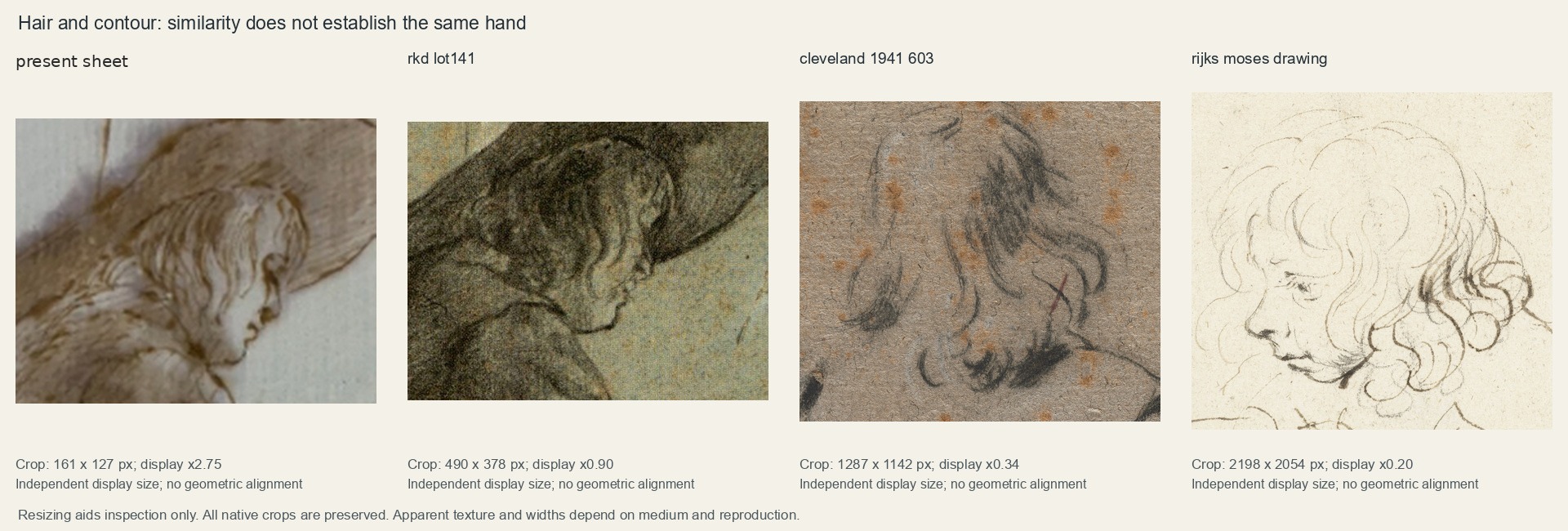
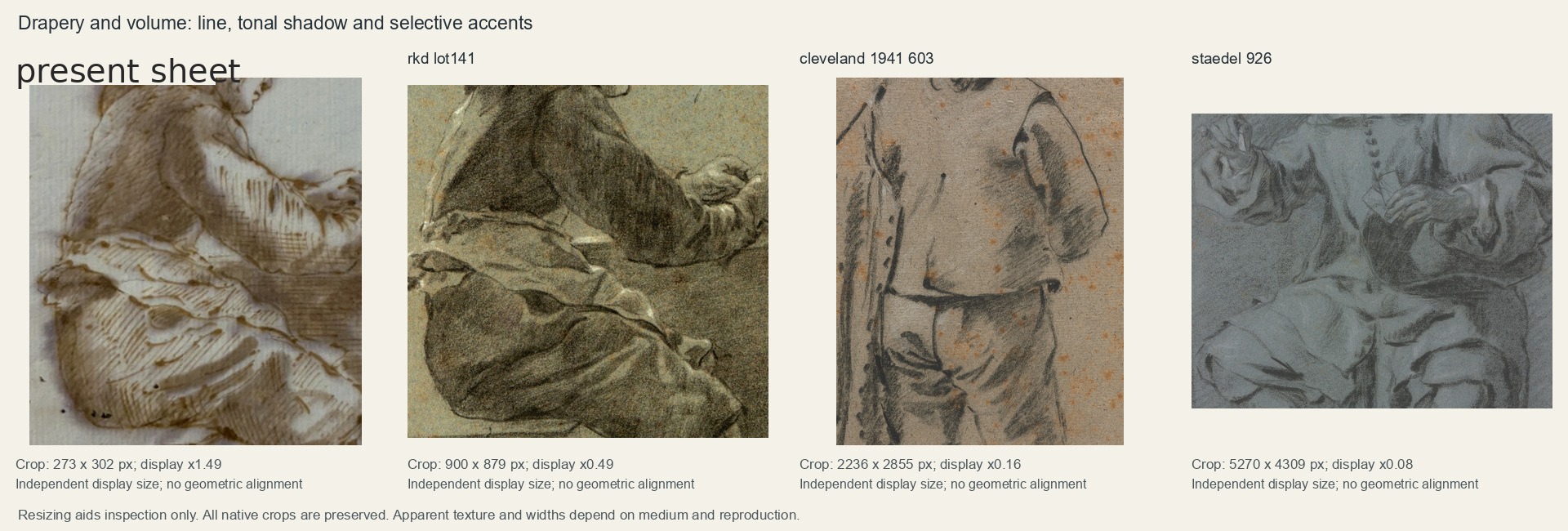
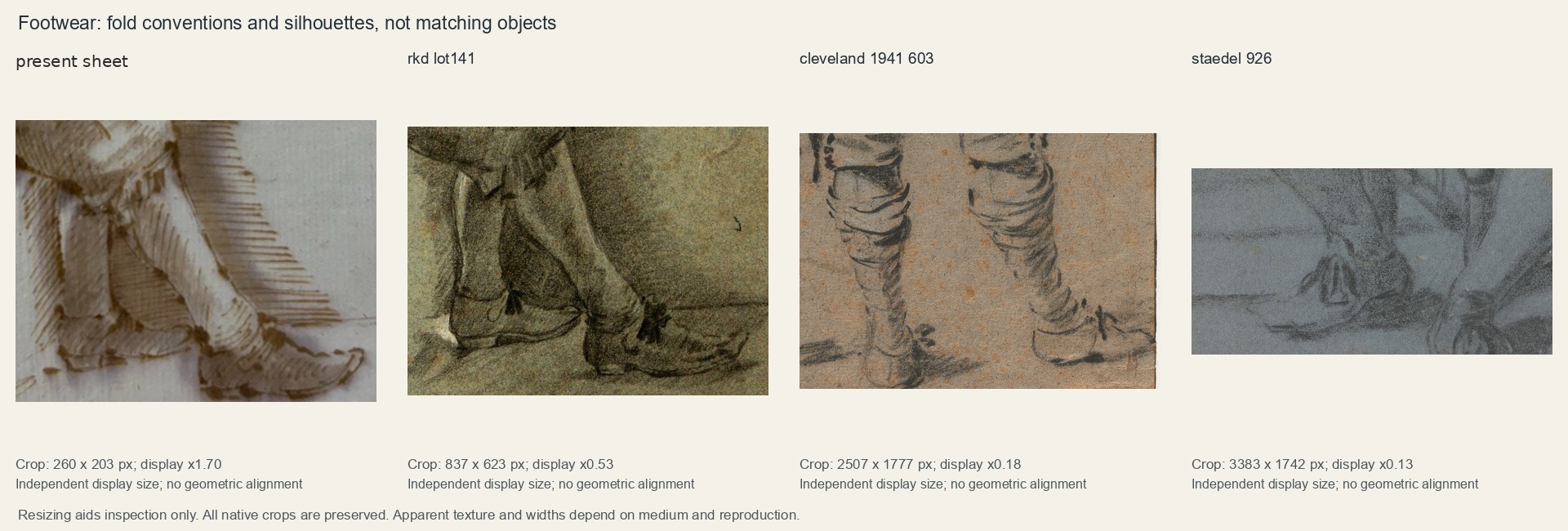
Comparison The comparison can now go beyond the broad-brimmed hat. In the Cleveland Museum of Art's A Man Standing Seen from the Back, catalogued as Gerard ter Borch, c. 1630, longer contours coexist with short fold accents, and soft shading and stronger dark marks distinguish the clothing's volumes. Hair, the transitions between jacket and breeches, and folded footwear are useful points of comparison. These are visual affinities, not a demonstrated match of individual drawing habits. Cleveland records black chalk with traces of white on brown laid paper, sheet 289 × 150 mm, and a graphite name on the verso. That name is recorded as an inscription, not authenticated as a signature. A Google Arts & Culture page repeats Cleveland's record; it is not an independent second attribution. Cleveland 1941.603 · Cleveland API

Gerard ter Borch, A Man Standing Seen from the Back, c. 1630.Black chalk with traces of white, brown-ink framing lines, on brown laid paper, 289 × 150 mm. Cleveland Museum of Art, 1941.603, Gift of Robert Hays Gries. CC0. Long contours, short fold accents and soft hatching coexist. The graphite name on the verso is an inscription, not an authenticated signature. Museum record

Related seated and standing figures at Boijmans and the Städel, and a Sotheby's workshop drawing, broaden the comparison. The attributions differ. Some records name Gerard II, others keep a question mark or a Moses alternative from a note on the mount, and Sotheby's uses Studio of Gerard ter Borch II. Repeated folds and selectively strengthened outlines deserve comparison. This mixed group is not a uniform sample of one artist's hand.

Reproduced on request · no open licence documented

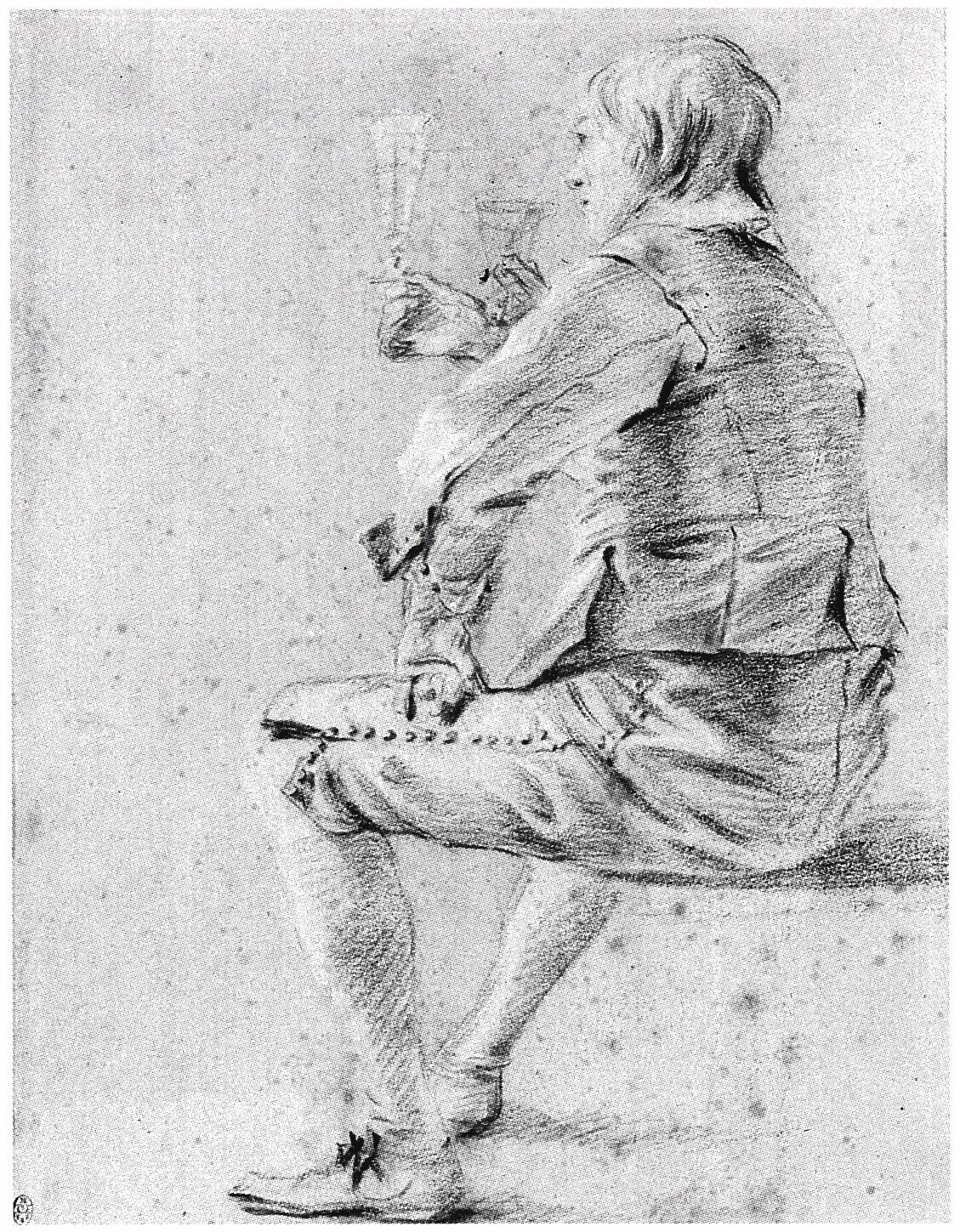
Seated Young Man Holding a Wineglass, Facing Left

Boijmans lists this as Gerard ter Borch II, c. 1650–1675: black chalk, heightened with white, inventory H 223 (PK). It is a comparison for figure construction and tonal modelling. It does not establish a shared sitter or author. The museum identifies it as a missing drawing from the Franz Koenigs collection, citing Albert J. Elen, Missing Old Master Drawings from the Franz Koenigs Collection claimed by the State of The Netherlands(The Hague, 1989). It is not described here as a sheet that can be consulted in Rotterdam today, and its provenance is not transferred to the present drawing. No object-specific open image licence was found; the image is reproduced for research at the dossier editor's request, with the museum's credit: Collection Museum Boijmans Van Beuningen, Rotterdam.

Boijmans H223

Gerard ter Borch the Younger, Card player sitting on a chair.Städel Museum, Frankfurt am Main, 926 Z. Sheet 385 × 274 mm. The technical record includes white heightening and retains uncertainty over chalk and charcoal; the watermark is recorded as not examined, not as absent. The hands, sleeves, seated balance, and the relationship between outlines and shading are points of comparison. Public domain. Städel 926 Z
Reproduced on request · Studio of

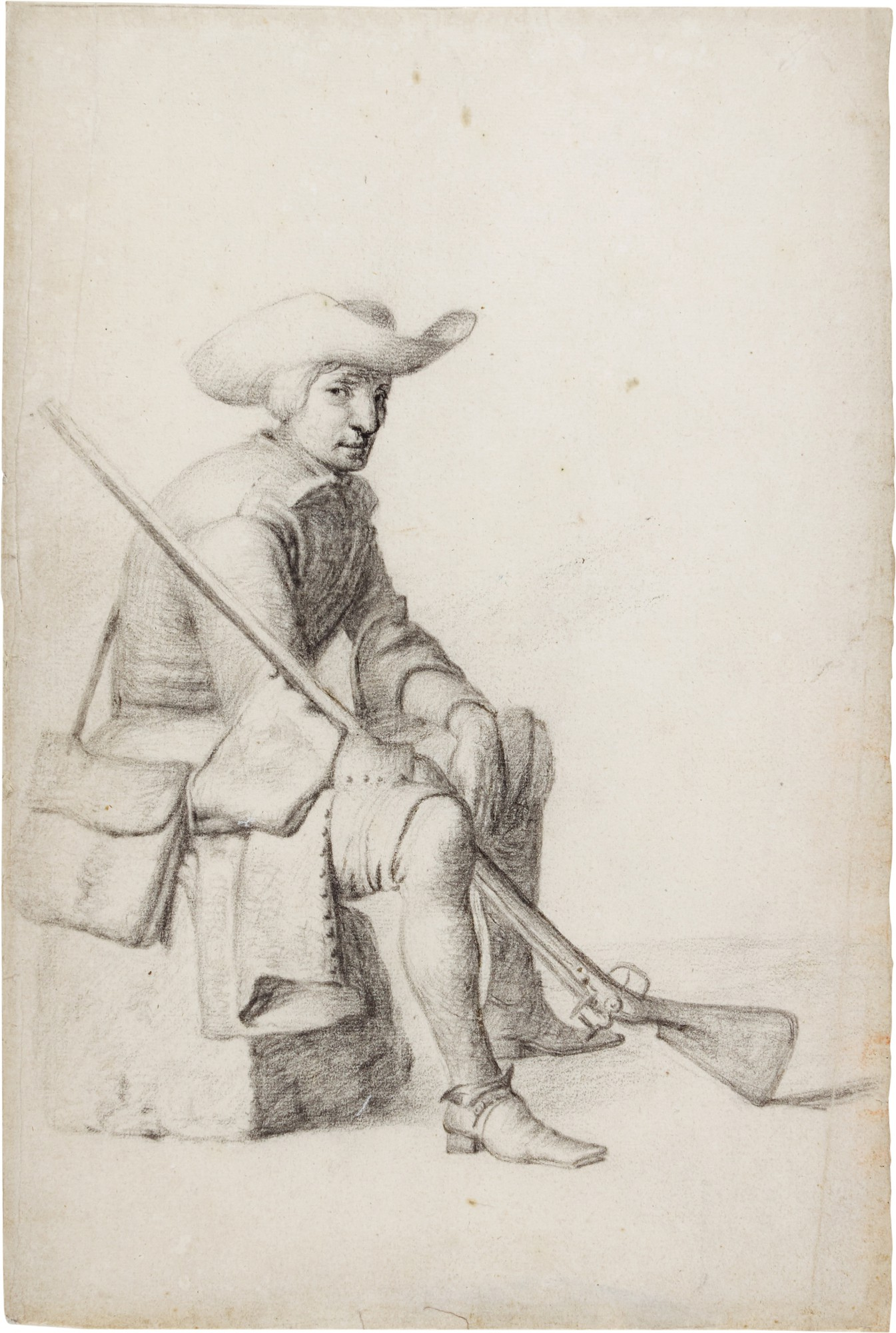
Seated Man with a Rifle

Sotheby's, 26 January 2022, lot 169, catalogued this black-chalk drawing, 311 × 208 mm, as Studio of Gerard ter Borch II. That is the lot description, not a shortened heading adopted as an autograph attribution. The note cites Alison McNeil Kettering, Drawings from the Ter Borch Studio Estate(The Hague, 1988), vol. II, pp. 856–861, appendix I, nos. 86, 87 and 91–96, a group assigned to an unidentified pupil. Those volumes were not read directly here. The citation is not extended to the other sheets in this section. The drawing offers a workshop comparison, not a securely attributed Gerard or Moses sheet. No open reproduction licence was found; the image is reproduced for research at the dossier editor's request, credited to Sotheby's.

Sotheby's 2022, lot 169

Gerard ter Borch the Younger ?, Hunter with musket and bag.Städel 924 Z. Red chalk on handmade laid paper, 295 × 183 mm. Moses ter Borch is recorded as an alternative draughtsman by a note on the mount. The verso bears a pencil inscription “Terburg”, together with the number 773. A watermark described as arms with wings [?] and B belongs to this sheet only. Neither the name nor this comparison resolves the authorship of RKD 116036 or of the present sheet. Public domain. Städel 924 Z
Gerard ter Borch the Younger ?, Junger Mann, an einem Pfosten stehend, c. 1660–1667.Städel 2917 Z. Red chalk on handmade paper, 299 × 181 mm. Moses is again a mount-based alternative. The museum links 2916 Z as a copy of this design. The pair is a documented comparison for the repetition of a figure, not a statement that 2917 itself is a copy. Watermark described as arms with swords. Public domain. Städel 2917 Z
Gerard ter Borch the Younger ?, Young man standing at a post — counterproof, c. 1660–1667.Städel 2916 Z, 299 × 177 mm. Catalogued as a red-chalk Abklatsch, or counterproof, with 2917 Z as its reference. The same question mark and mount-based Moses alternative are retained. This is a transfer example for these two sheets. It does not establish tracing, a change of scale, or the transfer process between the present sheet and RKD 116036. Public domain. Städel 2916 Z

Limits of the graphic affinities

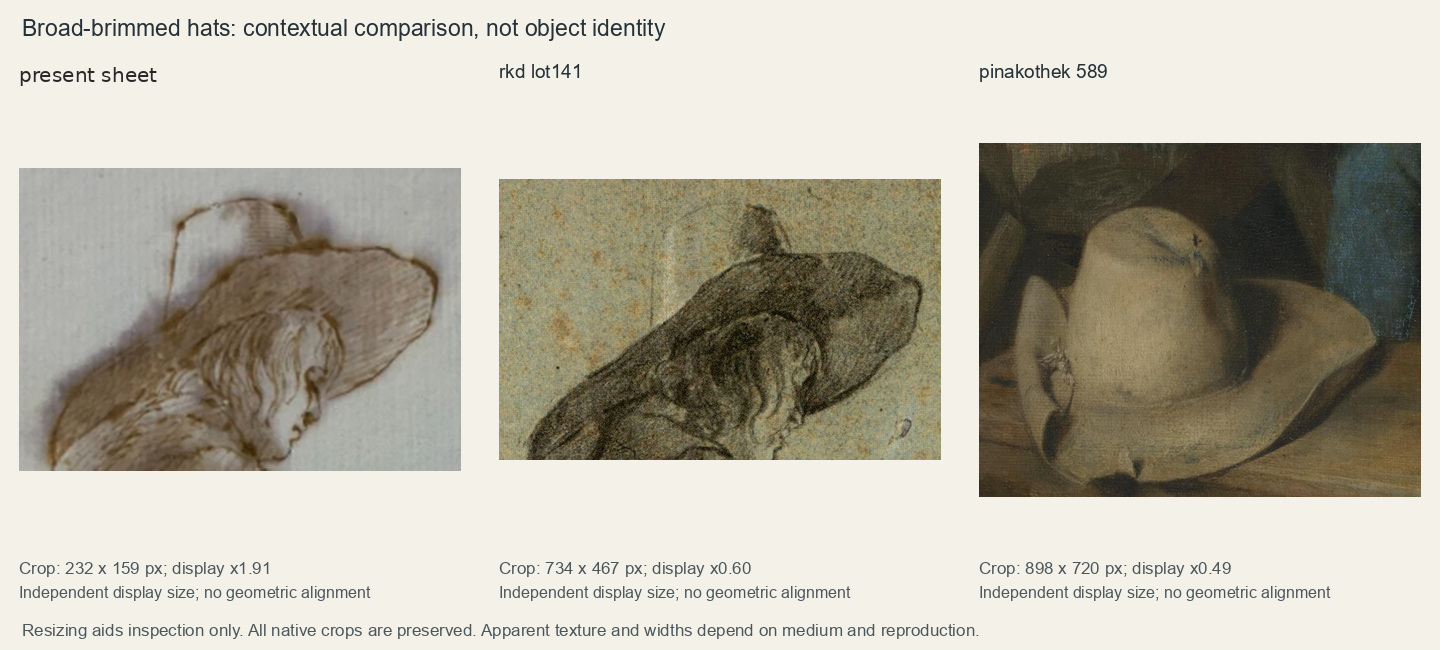
Comparison The regional observations below summarise what the photographs support. Continuity of design, already discussed for RKD 116036, and the behaviour of the execution are different questions. Nothing here asserts the same hand, the same speed, the same tool, or the same hat.

Contour

  • Curved boundaries and selectively reinforced edges can be compared across the RKD reproduction and the Ter Borch-associated controls.
  • Curves, spacing and emphasis vary. No exclusive recurring configuration was found.
  • Compatible with a shared repertoire. Not diagnostic of one hand.

Hair

  • Curved locks appear in more than one sheet and offer a point of comparison.
  • Spacing and emphasis differ. The comparison does not identify the sitter or the draughtsman.

Clothing

  • In the Cleveland jacket, and in the sleeves and breeches of Städel 926 Z, short fold accents coexist with longer contours and tonal shadows.
  • This is more specific than the broad-brimmed hat alone. Medium, pose and function differ, and the group is not one uniform autograph corpus.

Footwear

  • Repeated fold curves and outlined soles can be compared in several controls.
  • Footwear types, viewpoint and drawn shapes differ. No matching personal habit is established. The specificity is low to moderate.

Hat

  • A broad brim, a crown and folding belong to a comparable costume repertoire, including the Munich painting below.
  • The geometry is not the same, and none of these hats is identified as one physical object. A painting is not a drawing. The specificity is low.

Execution

  • The present sheet shows relatively regular bands of hatching in several shadow areas. Gerard II's pen drawing of Moses, below, uses sparse, variable contours and selective dark accents.
  • Photographs do not measure drawing speed. An interrupted line does not identify an artist. This weighs against an immediate same-hand claim. It does not name another hand.

The four plates below set cropped regions side by side: hair and contour, drapery and volume, footwear, and broad-brimmed hats. Scale, pose and medium differ between the crops. Each plate illustrates one row above and carries the same limit; the constituent images are credited in the comparison register at the end of this section.

A pen control by Gerard II

Comparison The Rijksmuseum's Moses ter Borch, Drawingis a closer comparison of pen execution than the chalk figure studies. The sitter is Moses. The author, in the museum's record, is Gerard ter Borch II. Those roles are not reversed. The graphite or chalk beginnings and the variable ink reinforcement discussed by Korevaar and Tauber concern documented Ter Borch works, not an established sequence in the present sheet. RP-T-1887-A-1202 · Korevaar and Tauber 2014, p. 360, fig. 8

Gerard ter Borch II, Moses ter Borch, Drawing, c. 1650–1655.Pen and brown ink over traces of black chalk, 103 × 100 mm. Rijksmuseum, RP-T-1887-A-1202, purchased with the support of the Vereniging Rembrandt. Public domain. Sparse, variable contours and selective dark accents. Moses is the recorded sitter, not the artist. The reproduction includes the mount and a scale. This is an execution control, not an identification of the youth on the present sheet. Rijksmuseum record
Separate Rembrandt-school control

What this pen comparison does not do

The British Museum sheet Oo,9.96, already illustrated with the workshop group, remains a Drost control. Its catalogue treats that attribution as plausible and the group as heterogeneous. Parallel hatching and a broad hat also occur there. It is not a pattern for every hatted youth, and it is not part of the Ter Borch argument.

Christie's A Standing Woman to the Right, catalogued as Backer despite a Ter Borch inscription, is a control of another kind: a name on an object is not an author. It does not make RKD 116036, or the present sheet, a Backer. British Museum Oo,9.96 · Christie's, lot 6282045

An absorbed figure in pen and brush, a generation earlier

Documented source The Rijksmuseum's Girl Reading, also titled Portrait of a Girl Reading a Book, RP-T-1887-A-764, is by Gerard ter Borch the Elder, the father of Gerard II and Moses. The museum dates it c. 1630–1635, records it as made in Zwolle and signed by the artist, with the inscription “Ger Sr; G Ter Borch Sr”, and cites Kettering GSr 107, vol. I, pp. 78–79. Pen in brown, brush in brown and grey, red chalk, 97 × 88 mm. The Wikimedia Commons description calls the girl probably the artist's eldest daughter Anna; the current museum record does not name her. RP-T-1887-A-764

Comparison Like the present sheet and Gerard II's drawing of Moses, it records a family member absorbed in an occupation: the head bowed, the eyes lowered to the hands, drawn at close range. Its medium, brown pen with brush, is nearer to the present sheet than the chalk drawings in this section. In the reproduction, the grey and brown washes stay within the figure on an untouched ground. That is comparable to the local, contour-bound wash that section 07 identifies in the present sheet as a divergence from the Rembrandt-school exemplars. The modelling differs: here it is carried by wash, with parallel pen strokes only in the hair, where the present sheet relies on serial hatching.

Gerard ter Borch the Elder, Girl Reading, c. 1630–1635.Pen in brown, brush in brown and grey, red chalk, 97 × 88 mm. Rijksmuseum, RP-T-1887-A-764, purchased with the support of the Vereniging Rembrandt. Public domain. An absorbed figure with wash kept within the contours; a generation earlier and by another hand. Not evidence of the maker, sitter or date of the present sheet. Rijksmuseum record
Limits of a family comparison

What this drawing adds, and what it does not

It gives the contour-bound wash noted in the present sheet a parallel inside the Ter Borch family's own drawings, alongside the parallels outside the Rembrandt school discussed in section 08. It is one small sheet, a generation or more earlier than the period discussed for the present sheet, by the father rather than a son, and it is judged here from a reproduction. It does not narrow the hand, and it does not identify the youth on the present sheet.

The inscription “Ger Sr; G Ter Borch Sr” is recorded by the museum as a signature. It distinguishes the father from his son of the same name; it is not a model for the pencil “Terburg” reported on lot 141.

Documented repetition and transfer

Documented source Repetition and transfer are documented in works by and associated with Ter Borch. The Rijksmuseum's three studies of a horse and sleigh show one motif repeated at different sizes. Korevaar and Tauber discuss that sheet alongside evidence of transfer from blackened drawing versos. The Städel counterproof 2916 Z, above, is a separate documented transfer, limited to its pair with 2917 Z. Neither example establishes how the present sheet and RKD 116036 became so closely related, and neither explains their difference of scale. The sleigh is not claimed to be geometrically exact, and it is not offered as the transfer mechanism, or as proof of tracing, for this case. RP-T-1887-A-789 · Korevaar and Tauber 2014, pp. 352–353

Gerard ter Borch II, Three Studies of a Sleigh Drawn by a Horse, 31 January 1631.Pen and brown ink over traces of black chalk, 80 × 180 mm. Rijksmuseum, RP-T-1887-A-789, purchased with the support of the Vereniging Rembrandt. Public domain. The date inscription is recorded as the father's handwriting. Repeated motif at different sizes, cited by Korevaar and Tauber as proportional copying. Not a measured match, and not the method that related the present sheet and RKD 116036. Rijksmuseum record

How Korevaar and Tauber tell a repeat from its model

Documented source The full article was read on 26 September 2026. It is a technical study of two pairs of painted portraits: Godard van Reede, in the Rijksmuseum and at Slot Zuylen, and Jacob de Graeff, in the Rijksmuseum and in Saint Louis. It concludes that Ter Borch painted both versions of each pair (pp. 349, 376–377). It does not study drawings, and it does not mention the present sheet or RKD 116036. What it offers this case is a method.

It orders two versions by their changes. The Oud-Zuilen portrait follows the final painted hairline of the Rijksmuseum portrait and lacks that portrait's one pentimento (p. 361). In the De Graeff pair, the eyes were moved early in the Amsterdam version and the corrected position was copied to Saint Louis (p. 376). Short, faint parallel lines, shifted by 2–3 mm, are read as the double register of a mechanical transfer (p. 362). Three transfer methods are defined: tracing through a blackened or whitened verso, pouncing through pinpricks, and the counterproof, which gives a mirror image (note 11, p. 378). Blackened versos survive in the Ter Borch family drawings (pp. 352–353, fig. 3). The sheet in those figures is RP-T-1887-A-810, given in the article to Gerard II or Harmen. It is not RP-T-1887-A-887. No blackened verso, transfer or watermark is established for A-887. Gerard II could also copy free hand, enlarging or reducing a motif while keeping its parts in proportion (p. 353, fig. 4).

The authors also set a limit on handling. The Saint Louis portrait is so much freer that “one might suspect another hand”. They still give it to Ter Borch, because the two versions share pentimenti and construction, and they note that the replica has minor pentimenti of its own (p. 376). Their list of Deventer pupils (Caspar Netscher, Antoni Jordens and Bartholt Berentsen, with Pieter van Anraedt and Roelof Koets accepted as working in the studio) is the documented circle for paintings (note 4, p. 377). None of them is proposed here for either drawing.

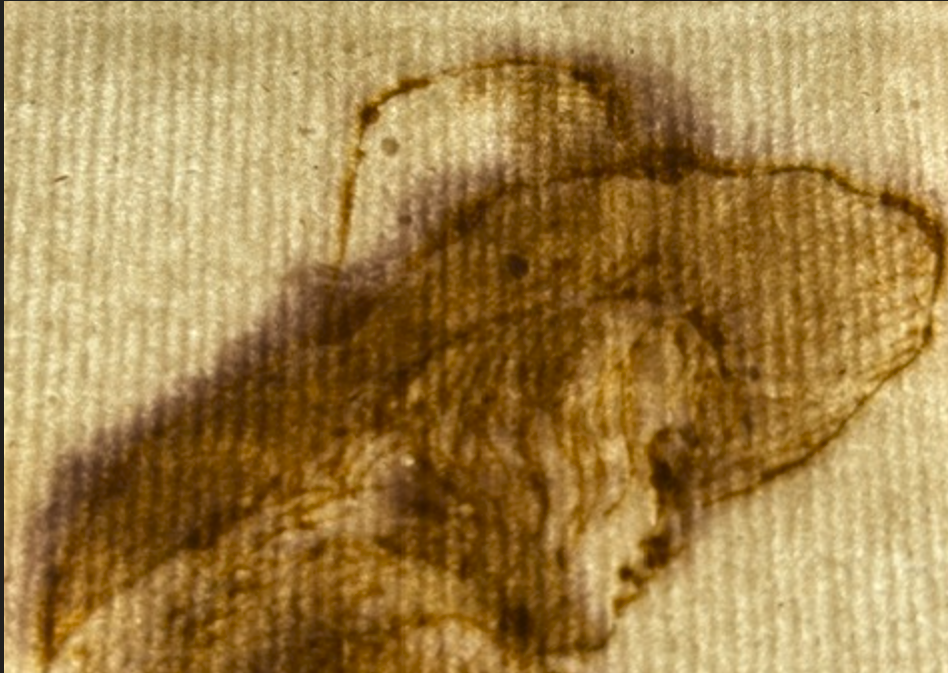
Working hypothesis Applied to this case, the method narrows the questions without answering them. The superposition above uses no reflection, so the two figures face the same way; a counterproof, as defined in the article, is not their direct relation. The reported sheet sizes differ, about 206 × 153 mm against 352 × 251 mm, but the figures have not been measured on the sheets. Tracing, pouncing and counterproofs transfer a design at the same size. If the figures prove to differ in size as the sheets do, none of the three methods linked the two sheets directly; a resized intermediary or proportional free-hand copying would remain possible. Proportional copying is documented practice (p. 353), not an observation on these sheets. The ordering test asks which drawing carries first placements that the other lacks. The RKD back shows more than one boundary; the present sheet shows one, and a possible first placement at the hat crown is recorded as a possibility only (section 05). Neither can be read as a change of mind, or put in order, from the present reproductions. Differences of handling and medium do not decide the hand, in either direction.

Physical checks Four checks follow and are added to the conservation session: the verso for blackening or chalk rubbing; raking light for stylus indentation along the contours; transmitted light for pinpricks; and magnification for doubled, slightly shifted lines. A negative result on the present sheet would not exclude free-hand copying. Korevaar and Tauber 2014, pp. 348–381

A costume comparison, not an authorship argument

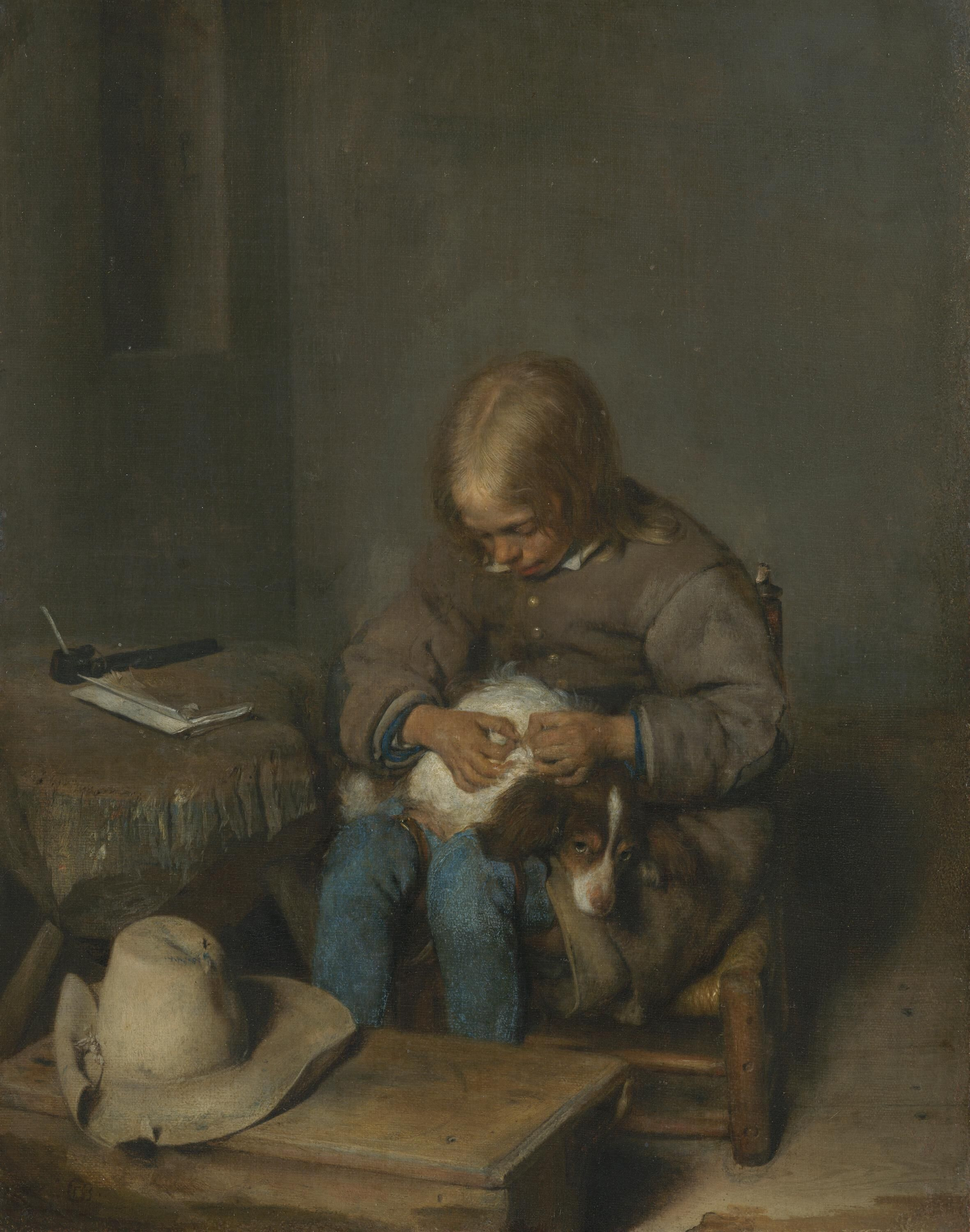
Comparison The hat in Gerard II's A Boy Picking Fleas off a Dog is a further costume comparison, and a secondary one. Its crown and folded brim belong to a comparable visual repertoire. The painting does not establish the same physical hat, the same sitter, or the same drawing hand. The museum record consulted for this dossier does not publish a signature. Image dimensions are 344 × 271 mm; the support is canvas laid on wood. This painting does not lead the question of authorship. Alte Pinakothek, inv. 589

Gerard ter Borch the Younger, A Boy Picking Fleas off a Dog, c. 1655.Bayerische Staatsgemäldesammlungen – Alte Pinakothek München, inv. 589. Image 344 × 271 mm, not a sheet size. A broad brim and folded crown are a costume comparison only. The reproduction and this size adaptation are CC BY-SA 4.0. Adaptation: resized and converted to sRGB; full frame retained. That licence applies to this image only, not to the rest of the page. Museum record

Moses, materials, and an autograph signature

Comparison The Moses group is kept separate from Gerard's signature control. The two chalk self-portraits are material comparisons for the catalogue description of RKD 116036, which is also black and white chalk. They are not evidence that Moses was the sitter or the maker of the present sheet, whose visible medium is brown. The horse is an inscription control: the Rijksmuseum describes it as signed by the artist. That institutional statement does not authenticate the pencil inscription on lot 141.

Moses ter Borch, Two Self-Portraits, 1661.Black and white chalk on blue paper, 143 × 234 mm. Rijksmuseum, RP-T-1887-A-1048(R), purchased with the support of the Vereniging Rembrandt. Public domain. A material comparison for the RKD catalogue description. Different subject and format. Not evidence that Moses made the present sheet or sat for it. Rijksmuseum record
Moses ter Borch, Self-Portrait with a Cap, 1661.Black and white chalk on blue paper, 144 × 112 mm. Rijksmuseum, RP-T-1887-A-1046. The record's qualifier is “mentioned on object”; that is not an authenticated signature. Similar materials and a head covering are not personal criteria for attribution. Public domain. Purchased with the support of the Vereniging Rembrandt. Rijksmuseum record
Gerard ter Borch II, Horse Facing Right, 1665.Black chalk, possibly dipped in oil, with brown pen framing lines, 243 × 360 mm. Rijksmuseum, BI-1887-1463-46, purchased with the support of the Vereniging Rembrandt. Public domain. The museum describes this sheet as signed by the artist. It is a control for what an institutional autograph signature looks like in this corpus. Different subject and signature format. It does not authenticate “Terburg” on lot 141. Rijksmuseum record
Reproduced on request · verso inscription

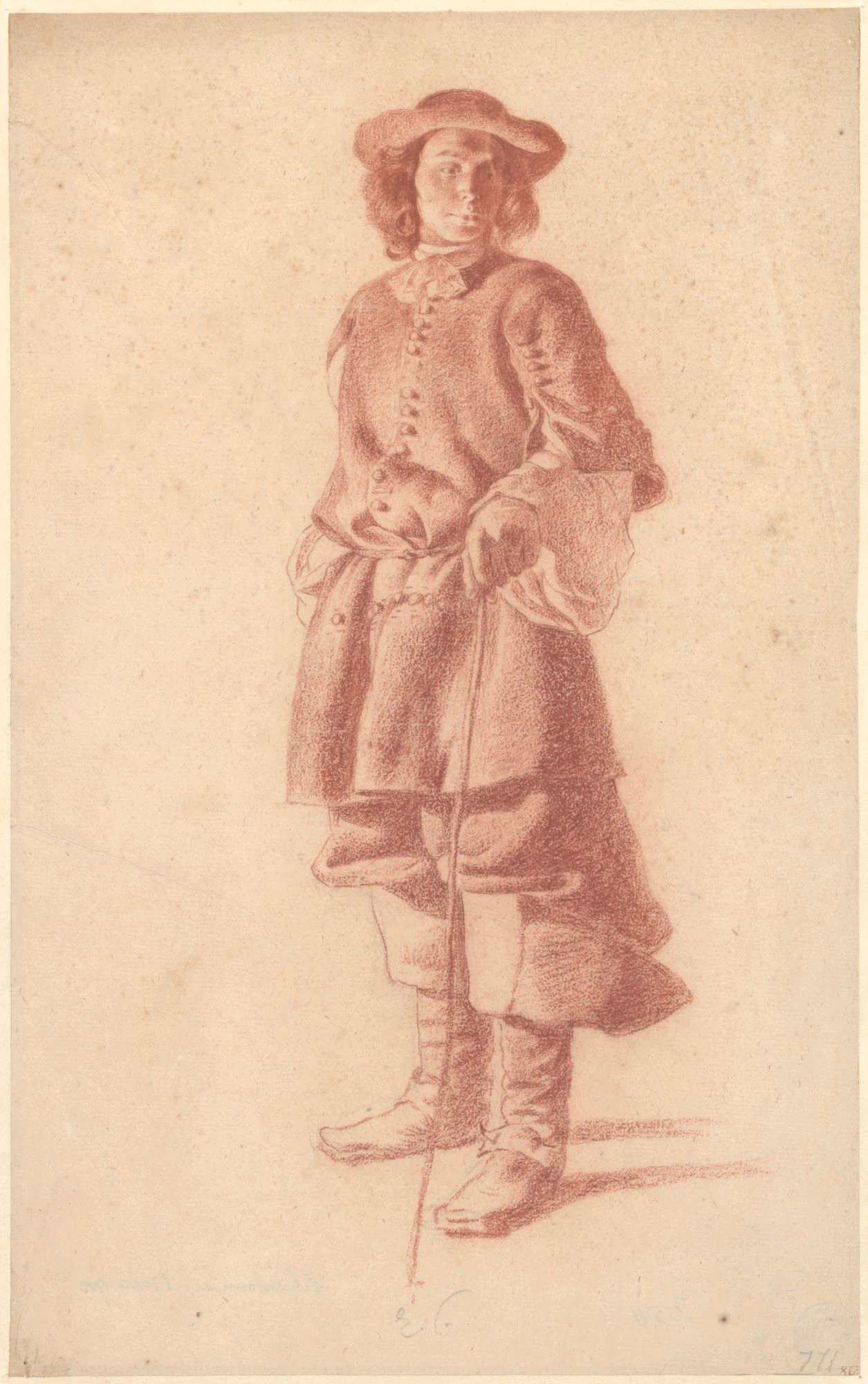
Standing Figure

Fondation Custodia, inv. 5111, discusses a standing figure by Moses ter Borch, early 1660s as the collection presents it, red chalk over black chalk, 297 × 183 mm, formerly sold as Gerard. The sheet carries a verso inscription reading v. J. Terburg. The English and French records do not agree on the tool used for that inscription, so this page says only “verso inscription” and adopts neither material. A note on the record about a Baltimore study and a Berlin copy documents another case of repetition. It is not a relationship with RKD 116036 or with the present sheet. No open image licence was established; the image is reproduced for research at the dossier editor's request, credited to the Fondation Custodia, Collection Frits Lugt.

Custodia, English record · Custodia, French record

A dated hat, drawn from life: Moses's portrait of his father, 1660

Documented source The Rijksmuseum's Portrait of Gerard ter Borch the Elder, RP-T-1887-A-1042, is by Moses ter Borch and is dated by its inscription. Along the lower edge, in pen and brown ink and in the father's handwriting according to the museum, it reads “Mosus ter Borch. nae het leven getijckent den 23. Januarij 1660”: drawn from life on 23 January 1660. The museum records it as made in Zwolle, when Moses was fifteen and his father nearly eighty. Black chalk heightened with white, some black brush, on blue paper, 287 × 230 mm; Kettering M 54, vol. I, pp. 316–317, as cited by the museum. RP-T-1887-A-1042

Comparison The resemblance to the present sheet lies in the hat and its handling. Both show a very broad brim and a raised, round-topped crown, with hair falling below the brim, and in both the brim is shaded in parallel hatching. The medium is the black and white chalk on blue paper recorded for RKD 116036, as in Moses's two self-portraits above. The differences are as plain: an old man in a frontal bust rather than a youth seated in profile, and chalk rather than the brown medium of the present sheet.

Moses ter Borch, Portrait of Gerard ter Borch the Elder, 23 January 1660.Black chalk heightened with white chalk, some black brush, on blue paper, 287 × 230 mm. Rijksmuseum, RP-T-1887-A-1042, purchased with the support of the Vereniging Rembrandt. Public domain. Inscribed below in pen and brown ink by the father. A dated costume and material comparison; not evidence of the maker, sitter or date of the present sheet. Rijksmuseum record
Limits of a hat comparison

What this portrait adds, and what it does not

It adds a securely dated example, drawn from life in Zwolle in January 1660, of the broad, uncocked hat worn on the present sheet. That is consistent with this dossier's view that such a hat is not an anachronism in the 1660s. An elderly man may keep an older fashion, so the portrait does not date the hat on the present sheet, and a hat type is not a criterion of hand.

The inscription is the father's annotation of a son's drawing, like the date on the sleigh sheet. It is not a signature by Moses. It is not a model for the pencil “Terburg” reported on lot 141, which differs in tool and is not legible in the catalogue halftone.

Harmen ter Borch, 13 January 1650: draughtsman, possible sitter, and the father’s annotation

Documented source The Rijksmuseum records RP-T-1887-A-887, Zittende, tekenende man (Gerard de Jonge?), translated here as Seated man drawing (Gerard the Younger?), under Harmen ter Borch (mentioned on object). The English title is a translation, not a second official identification. The question mark in the title stays. The date is 13 January 1650, and the place is Zwolle (possibly). The drawing is black chalk on paper; the sheet measures 154 × 139 mm. These are the museum’s particulars, not findings from the original. Rijksmuseum record · Dutch record

The brown-pen annotation along the lower edge reads “Her[man].t.Borch. naet leve[n]. geteickent de[n] 13.Januarij Anno 1650”: “Her[man] t. Borch, drawn from life on 13 January 1650.” Geteickent means drawn, not a signature. The museum assigns the handwriting to Gerard ter Borch the Elder. The annotation is in pen; the figure is catalogued as black chalk. This is a control for the reported “Terburg” inscription on RKD 116036: a name on a drawing can be written by someone else. It does not show who wrote “Terburg”, whether that inscription is contemporary, or whether either sheet belongs to the family.

RoleMuseum recordLimit
DraughtsmanHarmen ter Borch, mentioned on objectKeep the museum’s qualification.
Possible sitterGerard de Jonge?A tentative title. The question mark is essential.
Writer of the lower annotationGerard ter Borch the ElderThe father wrote; the record does not say that he drew the figure.

Comparison In the museum image: a broad hat with an uneven brim, curled locks, short curved marks at the sleeves, angular and curved boundaries in loose breeches, grouped hatching, and stronger dark accents at selected folds. The chalk handling is relevant to the RKD chalk drawing, and the sheet adds a documented seated figure in Harmen’s recorded work. The figure is more frontal, with different arms, legs and furniture. It is not the same design as the present sheet and RKD 116036. It is shown in its own orientation, not in the registered overlay, and no geometric agreement is claimed. Short or interrupted marks can come from medium, paper and reproduction. They do not establish a hand or a speed. The hat and clothing are period features, not exclusive family traits.

Limit This sheet does not establish Harmen, Gerard or Moses as the maker of the present drawing or of lot 141. It supplies no common sitter, paper or date for those sheets. No watermark description was found in the inspected public record for A-887. That is a limit of the record, not evidence that the sheet has no watermark. The same date on RP-T-1887-A-888, Seated Child and a Child Playing the Violin, also under Harmen, with an annotation the museum likewise gives to the father, documents a family habit of annotation. It does not prove a shared sitting. RP-T-1887-A-888

Documented source The museum cites Alison McNeil Kettering, Drawings from the Ter Borch Studio Estate (The Hague, 1988), vol. I, H 69, p. 226, illustration p. 227, displayed as “Kettering 69-H”. That printed entry has not been read for this update. H 68, the adjacent entry for A-888, is cited by the museum on the same pages and is useful for the father’s annotations. It is not an independent reassessment of H 69. Rijksmuseum publication record

Comparison register: all 20 comparison and control images

Every comparison and control used in this section, with the attribution as the holding institution or sale catalogue gives it. Question marks, “Studio of”, and alternatives recorded from a mount are kept as published. Where a sheet shows a named person, the sitter is listed separately from the artist. Städel 2916 Z is a counterproof precedent for its pair with 2917 Z only. For public-domain museum files larger than 3,200 pixels, the enlargement is a 3,200-pixel derivative and the full master is linked at the museum.

  • Seated Young Man Holding a Wineglass, Facing Left
    Artist, as catalogued
    Gerard ter Borch (II)
    Inventory
    H 223 (PK)
    Medium
    Black chalk, heightened with white
    Date
    circa 1650–1675
    Listed by Boijmans as Gerard ter Borch II, c.1650–1675: a seated young man holding a wineglass. Black chalk with white heightening. This is a comparison for figure construction and tonal modelling; it does not establish a shared sitter or author.Collection Museum Boijmans Van Beuningen, Rotterdam. Reproduced for research at the dossier editor’s request; no open licence documented.Source recordDownload PNG (1,129 × 1,449 px, 3.5 MB)
  • Card player sitting on a chair
    Artist, as catalogued
    Gerard ter Borch the Younger
    Inventory
    926 Z
    Medium
    Pencil drawing; chalk drawing?; charcoal drawing?; white heightening
    Date
    17th century
    Sheet
    385 × 274 mm
    Städel lists this seated card player as Gerard ter Borch the Younger, sheet 385 × 274 mm. Its technical record includes white heightening and retains uncertainty over chalk and charcoal. The hands, sleeves, seated balance and relationship between outlines and shading provide points of comparison.Städel Museum, Frankfurt am Main. Public domain (museum record).Source recordFull master at the museum (6,506 × 9,167 px)
  • Seated Man with a Rifle
    Artist, as catalogued
    Studio of Gerard ter Borch II
    Inventory
    Old Master and British Works on Paper, 26 January 2022, lot 169
    Medium
    Black chalk
    Date
    Not separately specified in lot description
    Sheet
    311 × 208 mm
    Sotheby's catalogued this black-chalk drawing, 311 × 208 mm, as Studio of Gerard ter Borch II. Its note cites Kettering's group assigned to an unidentified pupil. It therefore offers a workshop comparison, not a securely attributed Gerard or Moses drawing.Image: Sotheby's, 2022 sale, lot 169. Reproduced for research at the dossier editor’s request; no open licence documented.Source recordDownload JPEG (1,345 × 2,000 px, 705 KB)
  • Hunter with musket and bag
    Artist, as catalogued
    Gerard ter Borch the Younger ?
    Alternative
    Moses ter Borch — draughtsman; by note on mount
    Inventory
    924 Z
    Medium
    Red chalk on handmade laid paper
    Date
    17th century
    Sheet
    295 × 183 mm
    Städel retains Gerard ter Borch the Younger ? and records Moses as an alternative based on a mount annotation. Red chalk on handmade laid paper, 295 × 183 mm. The verso bears a pencil inscription Terburg. Neither the name nor this comparison resolves the authorship of RKD 116036 or of the present sheet.Städel Museum, Frankfurt am Main. Public domain (museum record).Source recordFull master at the museum (5,968 × 9,644 px)
  • Junger Mann, an einem Pfosten stehend
    Artist, as catalogued
    Gerard ter Borch the Younger ?
    Alternative
    Moses ter Borch — draughtsman; by note on mount
    Inventory
    2917 Z
    Medium
    Red chalk on handmade paper
    Date
    circa 1660–1667
    Sheet
    299 × 181 mm
    This red-chalk figure, 299 × 181 mm, is listed as Gerard ter Borch the Younger ?, with Moses recorded as a mount-based alternative. The museum links a second sheet, 2916 Z, as a copy. The pair provides a documented comparison for the repetition of a figure design.Städel Museum, Frankfurt am Main. Public domain (museum record).Source recordFull master at the museum (4,407 × 7,205 px)
  • Young man standing at a post — counterproof
    Artist, as catalogued
    Gerard ter Borch the Younger ?
    Alternative
    Moses ter Borch — draughtsman; by note on mount
    Inventory
    2916 Z
    Medium
    Red chalk (Abklatsch) on handmade laid paper
    Date
    circa 1660–1667
    Sheet
    299 × 177 mm
    The related 2916 Z, 299 × 177 mm, is catalogued as a red-chalk Abklatsch, or counterproof, with 2917 as its reference. This establishes a transfer example for these two sheets only. It does not establish tracing, a change of scale, or how the present sheet and RKD 116036 became related.Städel Museum, Frankfurt am Main. Public domain (museum record).Source recordFull master at the museum (4,318 × 7,221 px)
  • A Man Standing Seen from the Back
    Artist, as catalogued
    Gerard ter Borch (1617–1681)
    Inventory
    Cleveland 1941.603
    Medium
    Black chalk with traces of white; brown-ink framing lines; brown laid paper
    Date
    c. 1630
    Long contours, short fold accents and soft hatching coexist. Graphite name on verso is recorded as an inscription, not authenticated as a signature.Cleveland Museum of Art, Gift of Robert Hays Gries. CC0 1.0 (museum record).Source recordFull master at the museum (3,388 × 6,344 px)
  • A Boy Picking Fleas off a Dog
    Artist, as catalogued
    Gerard ter Borch the Younger
    Inventory
    Alte Pinakothek 589
    Medium
    Painting on canvas laid on wood (museum: Leinwand auf Holz)
    Date
    c. 1655
    A broad brim and folded crown offer a costume comparison. The hat is not identified as the same physical object. Dimensions are image dimensions, not sheet dimensions.Bayerische Staatsgemäldesammlungen – Alte Pinakothek München. CC BY-SA 4.0.Source recordDownload JPEG (2,362 × 3,000 px, 1.2 MB)
  • Moses ter Borch, Drawing
    Artist, as catalogued
    Gerard ter Borch (II)
    Sitter
    Moses ter Borch (recorded sitter, not the artist)
    Inventory
    RP-T-1887-A-1202
    Medium
    Pen and brown ink over traces of black chalk
    Date
    c. 1650–1655
    A relevant pen control: sparse, variable contours and selective dark accents. Moses is the recorded sitter, not the artist. The native image includes mount and scale.Rijksmuseum, purchased with the support of the Vereniging Rembrandt. Public domain (museum record).Source recordFull master at the museum (4,487 × 6,522 px)
  • Portrait of a Girl Reading a Book
    Artist, as catalogued
    Gerard ter Borch (I), the Elder; recorded as signed by the artist
    Sitter
    A girl reading; not named in the museum record
    Inventory
    RP-T-1887-A-764
    Medium
    Pen in brown, brush in brown and grey, red chalk
    Date
    c. 1630–1635
    Sheet
    97 × 88 mm
    A figure absorbed in an occupation, head bowed and eyes lowered to the hands, in pen and brown ink with brown and grey brush. In the reproduction the washes stay within the figure on a blank ground, comparable to the local, contour-bound wash of the present sheet; the modelling is by wash rather than serial hatching. A generation earlier and by another hand; not evidence of the maker, sitter or date of the present sheet.Rijksmuseum, purchased with the support of the Vereniging Rembrandt. Public domain (museum record).Source recordFull master at the museum (4,134 × 4,552 px)
  • Three Studies of a Sleigh Drawn by a Horse
    Artist, as catalogued
    Gerard ter Borch (II)
    Inventory
    RP-T-1887-A-789
    Medium
    Pen and brown ink over traces of black chalk
    Date
    1631-01-31
    Repeated motif at different sizes; cited by Korevaar and Tauber, p. 353, as proportional copying. It does not establish geometrically exact scaling, or the relation between the present sheet and RKD 116036. The date inscription is recorded as the father’s handwriting.Rijksmuseum, purchased with the support of the Vereniging Rembrandt. Public domain (museum record).Source recordFull master at the museum (5,754 × 2,520 px)
  • Two Self-Portraits
    Artist, as catalogued
    Moses ter Borch
    Sitter
    Moses ter Borch (self-portraits)
    Inventory
    RP-T-1887-A-1048(R)
    Medium
    Black and white chalk on blue paper
    Date
    1661
    A material comparison for the catalogue description of RKD 116036: black and white chalk on blue paper. Different subject and format; not evidence for Moses as the sitter or maker of the present sheet.Rijksmuseum, purchased with the support of the Vereniging Rembrandt. Public domain (museum record).Source recordFull master at the museum (6,058 × 3,738 px)
  • Self-Portrait with a Cap
    Artist, as catalogued
    Moses ter Borch; record qualifier: mentioned on object
    Sitter
    Moses ter Borch (self-portrait; name mentioned on object)
    Inventory
    RP-T-1887-A-1046
    Medium
    Black and white chalk on blue paper
    Date
    1661
    Preserve the inscription qualifier. Similar materials and a head covering are not personal attribution criteria.Rijksmuseum, purchased with the support of the Vereniging Rembrandt. Public domain (museum record).Source recordFull master at the museum (3,958 × 5,062 px)
  • Portrait of Gerard ter Borch the Elder
    Artist, as catalogued
    Moses ter Borch
    Sitter
    Gerard ter Borch the Elder (recorded sitter, the artist’s father)
    Inventory
    RP-T-1887-A-1042
    Medium
    Black chalk heightened with white chalk, some black brush, on blue paper
    Date
    23 January 1660
    Sheet
    287 × 230 mm
    Drawn from life on 23 January 1660, according to the pen inscription in the father’s hand. A broad brim with a raised, rounded crown, hair falling below the brim and a hatched underside: a costume comparison for the present sheet, and a dated one. Black and white chalk on blue paper, the medium recorded for RKD 116036. Different subject, view and medium from the present sheet; not evidence of its maker, sitter or date.Rijksmuseum, purchased with the support of the Vereniging Rembrandt. Public domain (museum record).Source recordFull master at the museum (3,700 × 4,538 px)
  • Seated man drawing (Gerard the Younger?)
    Artist, as catalogued
    Harmen ter Borch (mentioned on object)
    Sitter
    Gerard de Jonge? — tentative title only
    Inventory
    RP-T-1887-A-887
    Medium
    Black chalk on paper; lower annotation in brown pen
    Date
    13 January 1650; Zwolle (possibly)
    Sheet
    154 × 139 mm
    Harmen ter Borch (mentioned on object), Seated man drawing (Gerard the Younger?), 13 January 1650. Black chalk on paper, sheet 154 × 139 mm. The English title translates the Dutch title; it is not a separate official identification. The lower-edge writing is kept in this full image. Zwolle (possibly). Not the same design as the present sheet or RKD 116036, and not placed in the registered overlay.Rijksmuseum, Amsterdam. Purchased with the support of the Vereniging Rembrandt.. Public domain — Rijksmuseum.Source recordDownload JPEG (3,800 × 4,234 px, 3.7 MB)
  • Horse Facing Right
    Artist, as catalogued
    Gerard ter Borch (II); signed by the artist according to Rijksmuseum
    Inventory
    BI-1887-1463-46
    Medium
    Black chalk, possibly dipped in oil; brown pen framing lines
    Date
    1665
    An institutional autograph-signature control, unlike the unverified name Terburg on lot 141. Different subject and signature format; it does not authenticate the lot inscription.Rijksmuseum, purchased with the support of the Vereniging Rembrandt. Public domain (museum record).Source recordFull master at the museum (5,832 × 4,008 px)
  • Standing Figure
    Artist, as catalogued
    Moses ter Borch
    Inventory
    Fondation Custodia 5111
    Medium
    Red chalk over black chalk
    Date
    Early 1660s, as discussed by Custodia
    Formerly sold as Gerard; verso name v. J. Terburg. English and French records disagree on the inscription medium. Do not select one without examination.Fondation Custodia / Collection Frits Lugt. Reproduced for research at the dossier editor’s request; no open licence documented.Source recordDownload JPEG (1,255 × 2,000 px, 591 KB)
  • The present sheet, recto
    Artist, as catalogued
    Unattributed
    Inventory
    Case object
    Medium
    Brown linear and tonal media visible; chemistry unverified
    Date
    Undetermined
    620 × 795 pixel photograph; dimensions approximate and owner-reported. Regular hatching and contour routes can be compared, but line fragmentation remains resolution-limited.Photograph supplied by the custodian. Published with the custodian’s permission.Section on this pageDownload PNG (620 × 795 px, 646 KB)
  • Young Man in a Hat Seated at a Table, Filling His Pipe
    Artist, as catalogued
    Dutch School, 17th Century (Sotheby’s 2005)
    Inventory
    RKD 116036 / Sotheby’s 2005 lot 141
    Medium
    Black and white chalk on blue paper (catalogue)
    Date
    17th century, catalogue attribution
    The drawing as reproduced on printed page 159. The catalogue reports a pencil inscription “Terburg” and keeps the work unattributed. This is a scan of a printed halftone; it limits stroke-level comparison.Sotheby’s London, 6 July 2005, lot 141, printed p.159; supplied scan. Reproduced for research at the dossier editor’s request; no open licence documented.Source recordDownload PNG (1,580 × 2,225 px, 6.8 MB)
  • A Boy in a Wide-Brimmed Hat
    Artist, as catalogued
    Willem Drost; catalogue describes attribution as plausible
    Inventory
    British Museum Oo,9.96
    Medium
    Pen and brown ink with brown wash
    Date
    c. 1650–1655
    Parallel hatching and a broad hat also occur in this earlier control. Its abbreviated forms and emphatic dark passages differ from the more sustained contour-following in the present sheet.British Museum; image as embedded in a supplied presentation. Reproduced for research at the dossier editor’s request; no open licence documented.Source recordDownload PNG (687 × 646 px, 824 KB)

Bibliography and what remains open

Working hypothesis The evidence supports a focused research question: does the RKD design have a connection to the Ter Borch family or workshop? Even a future attribution of that sheet would not identify the person who made the present drawing. Same-hand repetition, workshop copying, another intermediary, and later derivation remain distinct possibilities. A later copyist is not ruled out. These examples do not date the present sheet, and they do not make Titus, Moses, or Gerard the identity of the youth.

Documented source Consulted for this lead, on 25 September 2026, were the specified pages and records, not every volume in full. Kettering 1988 was not read directly for those stylistic comparisons; references were checked through institutional records and the 2022 Sotheby's note. Part I was later consulted for the seven watermark entries and the correction of M 18 in section 06. The watermark plates in part II, pp. 776–802, are still outstanding and have not been inspected. That paper reading does not reassess the stylistic comparators on this page. The 2022 note is not used to assign the other comparators to the unidentified-pupil appendix. Rijksmuseum bibliographic record. Korevaar and Tauber 2014 was first read at pp. 352–353 and 360, and read in full on 26 September 2026 from a copy supplied by the dossier editor; it does not study these two drawings. DOI. John Smith's 1842 supplement, Gerard Terburg, pp. 529–537, and Émile Michel, Gérard Terburg (Ter Borch) et sa famille (1887), are historiography. They mention young men, hats, study scenes, a pipe, family resemblances, and the Munich boy with a dog. No object-specific link to RKD 116036 or to the present sheet was identified, so those generic subjects are not used as proof of authorship. Michel is not a current authority for reassigning either drawing.

Luijten's 2005 article on Moses learning to draw, the 1974 and 2004/2005 exhibition catalogues, Hofstede de Groot 1913, and Plietzsch 1944 were not used as read sources for this section. The immediate priorities are a better photograph of the RKD original and of its inscription, and direct examination of the relevant catalogue entries and attribution history.

Established
Lot 141, identified with RKD 116036, carries a reported pencil inscription “Terburg” and remains Dutch School, seventeenth century, in the 2005 catalogue. The inscription is not an authenticated signature. Affinities with Ter Borch-associated sheets are comparative.
Still open
Whether the RKD design connects to the Ter Borch family or workshop. Same-hand repetition, workshop copying, an intermediary and later derivation stay separate. The maker, date and sitter of the present sheet are not decided by this lead.
02b

Dresden comparator

Dresden C 1421: subject, workshop context and attribution history

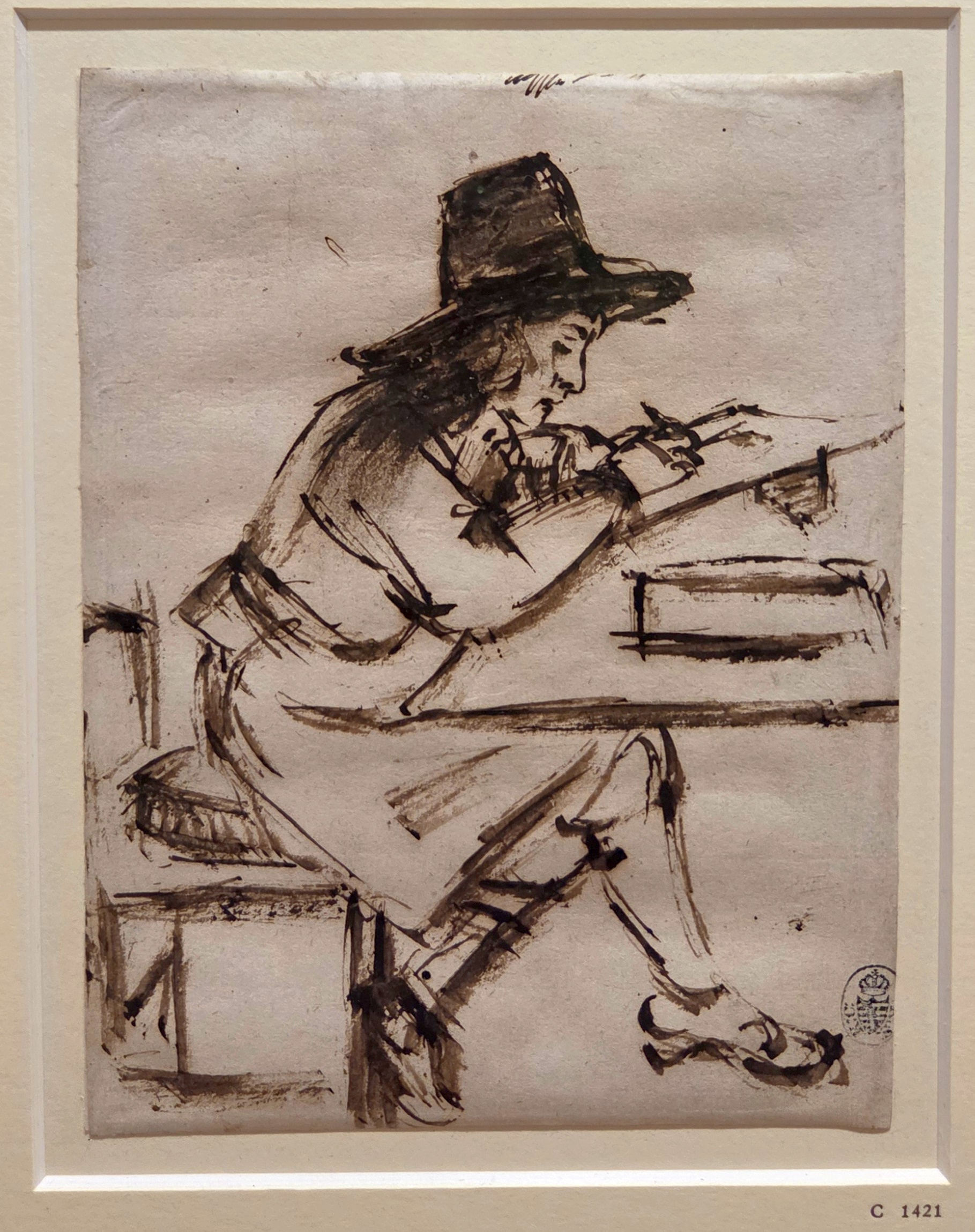
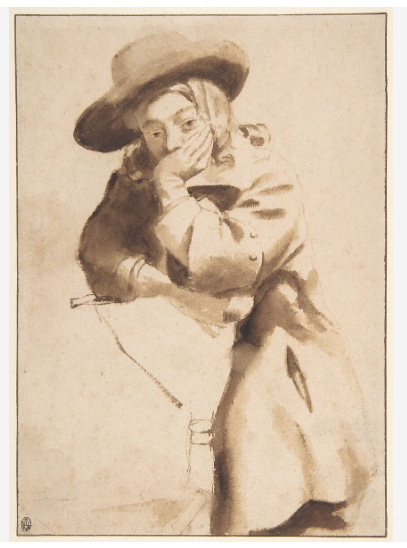
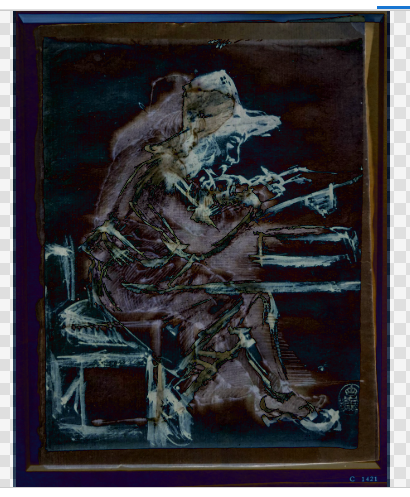
Dresden C 1421, catalogued as Junger Mann mit breitkrempigem Hut an einem Pult, is a related subject: a seated youth in a broad hat, studied for workshop context and attribution history. It is not the same composition. That composition is RKD 116036, examined in the previous section. These are three separate drawings; neither an attribution nor a sitter identification transfers between them.

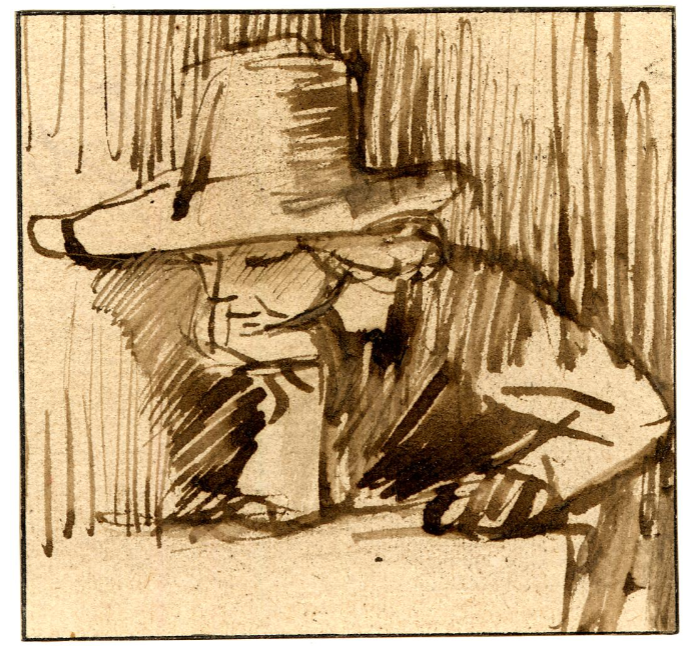
The current museum record gives: School of Rembrandt / circle of Samuel van Hoogstraten, 1655–1659, pen in bistre and brush, 183 × 140 mm, in the collection before 1756 (SKD online collection, C 1421). The sheet was long considered an autograph Rembrandt: Hofstede de Groot listed it among the Dresden Rembrandts in 1906 (no. 244) after expressing doubts in 1890; Valentiner and Benesch retained the attribution (Benesch, no. 1095); Sumowski (1961) and the 2004 Dresden catalogue (Dittrich & Ketelsen, cat. 95) moved it to a Rembrandt pupil of the second half of the 1650s. The available images show a related subject with differences in pose, contour construction, hatching and the description of the furniture. The present sheet has more continuous enclosing contours and more explicit repeated hatching than C 1421. These observations do not establish the relative speed of execution or independence of the design.

Before 1756

C 1421 is recorded in the Dresden collection; the sheet bears the Kupferstich-Kabinett stamp (Lugt 1647).

1890

Hofstede de Groot, in manuscript notes in the Dresden archive, doubts the Rembrandt attribution — “competent pupil’s work” — citing the floating desk and the overlong thighs on which the desktop appears to rest (reported in Ketelsen 2004).

1906

Hofstede de Groot nevertheless lists the sheet among the Rembrandt drawings in Dresden, no. 244.

1961

Sumowski questions the Rembrandt attribution and relates the handling to Van Hoogstraten’s manner of the late 1650s.

2004

Ketelsen catalogues the sheet as the work of a Rembrandt pupil, 1655–1659, within the seated-youth group Benesch 1091–1095 (cat. 95).

2026

The Kupferstich-Kabinett confirms in writing that the Barent Fabritius association was an inventory error; the missing Barent sheet is C 1359.

Image note:the C 1421 photograph reproduced in sections 03–05 is a Wikimedia Commons reproduction of the public-domain artwork, and is labelled as such; the museum's own photography remains under its rights policy (museum record).

Established
The museum record and the 2004 catalogue document C 1421. Its comparison with the present sheet is a visual assessment made in this dossier; those sources do not document the present drawing.
Still open
How C 1421 relates to the present sheet as subject and workshop context. The same composition is RKD 116036 (section 02).
03

Attribution history of C 1421

The 1987 inventory error: why C 1421 circulated as “Barent Fabritius”, and the missing C 1359

Online reproductions of C 1421 commonly carry the name Barent Fabritius — a name the museum does not use. In August 2026 the Kupferstich-Kabinett confirmed in writing that the association rests on a documented inventory error, and identified the drawing to which the Barent attribution actually belongs.

In 1987 Christian Dittrich published the catalogue of drawings missing from the Kupferstich-Kabinett (Vermisste Zeichnungen des Kupferstich-Kabinetts Dresden). At no. 389 he recorded C 1421 as lost. The number was a transposition: C 1421 was in the collection, while the sheet actually missing was — and remains — C 1359, a drawing attributed to Barent Fabritius. The 2004 Dresden catalogue had already noted the confusion (Dittrich & Ketelsen 2004, cat. 95, note); the museum's written communication of 18 August 2026 confirmed it for this case. Derivative databases and image repositories continue to reproduce the erroneous name — including the Wikimedia file under which the drawing circulates (Commons file, retaining the obsolete attribution).

Two consequences follow. First, C 1421 cannot support a Barent Fabritius attribution for any related sheet, because it does not validly carry that name itself. Any argument for Barent must be made from his documented corpus (section 09). Second, a genuine Barent Fabritius drawing — C 1359 — remains unlocated; its description in Dittrich 1987, no. 389 is being sought, since its subject is potentially relevant to this case and cannot be assumed.

The correction of the public record — initiated by the custodian's direct inquiry to the museum — is the first documented result of this research programme.

Dresden C 1421: rapid pen-and-brush sketch of a young man in a broad-brimmed hat leaning over a desk.

Fullscreen view

Dresden C 1421: rapid pen-and-brush sketch of a young man in a broad-brimmed hat leaning over a desk.
School of Rembrandt (circle of Samuel van Hoogstraten), Young Man in a Broad-Brimmed Hat at a Desk, 1655–1659.Pen in bistre and brush, 183 × 140 mm. Kupferstich-Kabinett, Staatliche Kunstsammlungen Dresden, inv. C 1421. Reproduction: Wikimedia Commons (public-domain artwork), retained here with the museum's current attribution. Museum record
Established
C 1421 is catalogued as School of Rembrandt, 1655–1659; the Barent Fabritius label derives from Dittrich 1987, no. 389, an inventory transposition confirmed by the museum in 2026.
Still open
The subject and appearance of the missing C 1359 (Dittrich 1987, no. 389 — record requested).
04

The 1650s workshop group

Ketelsen's grouping of C 1421 with the seated-youth studies attributed to Drost and Maes

The 2004 Dresden catalogue does not treat C 1421 as an isolated sheet. Ketelsen places it within the group of studies of young men in hats that Benesch had catalogued together as Rembrandt (nos. 1091–1095), and proposes that several were drawn in a single workshop session in the second half of the 1650s — different hands around the same model (Dittrich & Ketelsen 2004, cat. 95, notes 4–8).

None of the group is considered autograph Rembrandt today. Two of the London sheets are attributed to Willem Drost (workshop c. 1650–1654; Bikker 2005) and one to Nicolaes Maes, in the British Museum's 2010 catalogue by Martin Royalton-Kisch. The present sheet shows continuous enclosing contours, repeated hatching and a more fully described seat. Its relationship to the workshop group remains unresolved. The same composition in RKD 116036 adds a separate question of design transmission; it does not establish membership of the group or a shared sitting.

Rembrandt etching showing the same nude model seated and standing, with a mother teaching a child to walk in the background.

Fullscreen view

Rembrandt etching showing the same nude model seated and standing, with a mother teaching a child to walk in the background.
The documented life class: Rembrandt, Male Nude, Seated and Standing (“Het rolwagentje”), c. 1646.Etching, Rijksmuseum, RP-P-OB-251 (B. 194 / NH 233). Rembrandt etched the model directly while pupils drew him from their own positions; surviving pupil drawings from these sessions include sheets by Van Hoogstraten and the nude attributed to Barent Fabritius in London (De Witt, RKD Studies; Van Eijsden 2024/25; British Museum Oo,9.94). The child in a walking frame alludes to the proverb “practice makes perfect”. Image: Rijksmuseum (CC0). BM Oo,9.94 record
Rembrandt-school academy study of a seated male nude reading a book on a stand, Dresden C 1347.

Fullscreen view

Rembrandt-school academy study of a seated male nude reading a book on a stand, Dresden C 1347.
School of Rembrandt, Male Nude, Reading, second half of the 1650s.Pen and brush in brown and grey, 175 × 119 mm. Kupferstich-Kabinett, Dresden, inv. C 1347; published in Rembrandt's Mark (Dresden 2019), no. 42.1. A young model seated on a draped chest, absorbed in a book on a stand — the same studio world, the same decade, and a comparable sheet format (cf. C 1421 at 183 × 140 mm). Reproduction: Wikimedia Commons (public-domain artwork). Museum record
School of Rembrandt · 1650/1659

Male Nude, Seated and Leaning

Pen and brush in brown and grey wash, 184 × 136 mm. Kupferstich-Kabinett, Dresden, inv. C 1346; published with C 1347 as Rembrandt's Mark(Dresden 2019), no. 42.2. Two academy studies of the male model, catalogued as a pair, from the same School-of-Rembrandt holdings and the same decade as C 1421 — documentation of how model studies from the workshop's orbit survive in groups. No rights-cleared reproduction was located; consult the museum record.

Museum record · SKD

These documented cases — the 1646 life class recorded on Rembrandt's own etching plate, with pupil drawings of the same model surviving in Paris and London (De Witt, Samuel van Hoogstraten's Drawings, RKD Studies; Van Eijsden 2024/25), and the Dresden pair of male-nude academies of the 1650s (C 1346 and C 1347) — establish that parallel model study was normal practice in and around Rembrandt's workshop, and that the surviving sheets from such exercises differ in hand, finish, and temperament. Ketelsen himself records the same phenomenon in the same years: a comparable group of the second half of the 1650s drawn after female nude models, attributed partly to Rembrandt and partly to his pupils (Dittrich & Ketelsen 2004, cat. 83, cited under cat. 95). His session hypothesis for the hatted-youth group is thus an instance of a documented pattern, not an ad-hoc conjecture. The cards below present the group.

School of Rembrandt · circle of Van Hoogstraten · 1655–1659

Young Man in a Broad-Brimmed Hat at a Desk

Rapid pen-and-brush sketch of a young man in a broad-brimmed hat leaning over a desk, Dresden C 1421.

Fullscreen view

Rapid pen-and-brush sketch of a young man in a broad-brimmed hat leaning over a desk, Dresden C 1421.

Pen in bistre and brush, 183 × 140 mm; the catalogue records tears and small losses in the hat — damage that reproductions can make read as drawing. Kupferstich-Kabinett, Dresden, inv. C 1421. A related subject in the Rembrandt-school group (Ketelsen 2004, cat. 95), not the same composition. The same composition is RKD 116036, in section 02.

Reproduction: Wikimedia Commons (public-domain artwork). Museum record · SKD

Willem Drost (attributed) · c. 1655

A Young Man Asleep in a High-Crowned Hat

Pen-and-wash sketch of a young man in a high-crowned hat sleeping against cushions, attributed to Willem Drost.

Fullscreen view

Pen-and-wash sketch of a young man in a high-crowned hat sleeping against cushions, attributed to Willem Drost.

Pen and brown ink with wash. British Museum, 1900,0411.4 (Benesch 1092). Ketelsen (2004) identifies this sheet as the closest stylistic relative of C 1421: dry, interrupted contours and a nearly inkless brush.

Reproduction: Wikimedia Commons (public-domain artwork). Museum record · British Museum

Willem Drost (attributed) · c. 1650–1655

A Boy in a Wide-Brimmed Hat

Pen sketch of a boy in a wide-brimmed hat leaning on a table, chin in hand, attributed to Willem Drost.

Fullscreen view

Pen sketch of a boy in a wide-brimmed hat leaning on a table, chin in hand, attributed to Willem Drost.

Pen and brown ink with wash. British Museum, Oo,9.96 (Benesch 1093). The same broad hat and abbreviated body; the hands dissolve into a knot of lines, as in C 1421 (Royalton-Kisch 2010).

Reproduction: Wikimedia Commons (public-domain artwork). Museum record · British Museum

Attributed to Nicolaes Maes · c. 1655

A Man in a High-Crowned Hat, Drawing

Small pen-and-wash drawing of a man in a high-crowned hat drawing at a table, attributed to Nicolaes Maes.

Fullscreen view

Small pen-and-wash drawing of a man in a high-crowned hat drawing at a table, attributed to Nicolaes Maes.

Pen and brown ink with wash, 65 × 53 mm. British Museum, Oo,9.99 (Benesch 1091). Formerly given to Rembrandt; Schatborn (1994) preferred Drost. Royalton-Kisch (2010, Maes cat. 7) relates it directly to C 1421.

Reproduction: Wikimedia Commons (public-domain artwork). Museum record · British Museum

Willem Drost (attributed) · c. 1650–1655

A Young Man in a Hat, Seated at a Table

Pen sketch of a young man in a hat seated at a table, seen from behind, attributed to Willem Drost, Nationalmuseum Stockholm.

Fullscreen view

Pen sketch of a young man in a hat seated at a table, seen from behind, attributed to Willem Drost, Nationalmuseum Stockholm.

Pen and brown ink, 98 × 85 mm. Nationalmuseum, Stockholm, NMH 2034/1863. The working pose of the group at sketch speed: hat, table, summarily indicated chair, block-hatched thigh.

Reproduction: Wikimedia Commons (public-domain artwork). Collection · Nationalmuseum

Position untested

The present sheet

The present sheet belongs to the same broad subject family and shows continuous contours, repeated hatching and a more fully described seat. Those visible features do not establish execution speed, workshop membership or an independent study from life. The same composition, RKD 116036, is examined in section 02.

Established
C 1421 belongs to a documented group of Rembrandt-school studies dated 1655–1659, attributed today to Drost and Maes (Ketelsen 2004; Royalton-Kisch 2010).
Still open
Whether the present sheet belongs to that group, to the same exercise tradition, or to neither.
05

Derivation analysis

Testing design dependence: RKD 116036 and Dresden C 1421

The principal comparison is RKD 116036, which has the same composition as the present sheet. Differences from Dresden C 1421 remain relevant to that different design, but they do not establish independence from RKD 116036. The present question is whether the shared composition was repeated or transmitted, and, if so, through which source and process. Section 02a records repetition and transfer in other Ter Borch-associated works. Those examples are historical context only. They do not identify the process that relates this sheet to RKD 116036, and they do not explain the difference in reported sheet size.

C 1421 has been accessible in reproduction: it is recorded in Dresden’s manuscript inventories from 1865 (Franke) and 1890 (Hofstede de Groot’s archive notes), first published in print by Hofstede de Groot (1906, no. 244), reproduced in a commercial photolithograph dealer-dated c. 1920, published as a corpus plate in Benesch (1973, no. 1095, fig. 1387), republished by Schatborn (1998, fig. 4), and exhibited in Berlin and Dresden (1958), Milan (1970), and Washington/New York (1978–79). A reproduction-based derivation was therefore materially possible at several dates from the early twentieth century onward; no nineteenth-century reproduction is documented.

Repeated unusual details or spatial ambiguities can help investigate design transmission. Their absence does not by itself exclude copying, because a copy may select, simplify or alter its source. The documented observations about C 1421 below concern that drawing; they must be distinguished from this dossier's interpretation of the present sheet. C 1421 presents two documented anomalies, both noted by Hofstede de Groot in 1890 and reported in the 2004 catalogue entry: the desk plane lacks ground anchoring, and the thighs are drawn overlong, with the desktop appearing to rest upon them. The annotated comparison below records how the present sheet treats the corresponding passages.

Dresden C 1421 with annotations marking the unanchored desk plane and the overlong thighs on which the desktop appears to rest.

Fullscreen view

Dresden C 1421 with annotations marking the unanchored desk plane and the overlong thighs on which the desktop appears to rest.
  1. Desk plane without ground anchoring (Hofstede de Groot 1890, reported in Ketelsen 2004, cat. 95).
  2. Overlong thighs on which the desktop appears to rest — the second documented anomaly (Hofstede de Groot 1890, reported in Ketelsen 2004).
Dresden C 1421, annotated. Reproduction: Wikimedia Commons (public-domain artwork). Museum record
The present sheet with annotations marking the constructed bench and the resolved extended leg.

Fullscreen view

The present sheet with annotations marking the constructed bench and the resolved extended leg.
  1. Bench and ground relation described differently from C 1421.
  2. Different leg contours and a more fully described forward shoe.
  3. At the hat crown, a fine open contour: noted as a possible example of a pentimento (a first placement of the crown), recorded as a possibility only; the drawing sequence at this junction is assigned to microscopy.
The present sheet, annotated. Custodian photograph, published with permission.

The unanchored desk

The comparator's trait
In C 1421 the desk plane lacks a credible connection to the ground — an anomaly Hofstede de Groot noted in 1890 (Ketelsen 2004, cat. 95).
Expected in a copy
A repeated unusual construction may support dependence; its absence does not exclude a selective or modified copy.
Observed in the present sheet
The furniture is described differently. This difference does not demonstrate independent construction of the design.

The overlong thighs

The comparator's trait
In C 1421 the thighs are drawn overlong, and the desktop appears to rest upon them — the second anomaly recorded in 1890 (Ketelsen 2004, cat. 95).
Expected in a copy
A shared unusual anatomical construction would merit investigation, provided that the correspondence can be demonstrated.
Observed in the present sheet
One leg is bent and one extends towards the described shoe; their contours differ from C 1421. No anatomical correction or independent invention is established by that difference alone.

Scale and correspondence

The comparator's trait
C 1421 is recorded as 183 × 140 mm; the present sheet is reported as approximately 206 × 153 mm. RKD 116036 is recorded as 352 × 251 mm.
Expected in a copy
Sheet dimensions are not measurements of the drawn figure, and different sheet sizes alone do not establish or exclude a tracing.
Observed in the present sheet
The viewer rescales the images for inspection; it does not show them at their physical sizes. A transfer through a resized reproduction remains possible.
Established
Local correspondences and differences can be inspected under one global alignment.
Still open
How the designs are related, when any transfer occurred, and whether a reproduction intervened.
06

Support and paper evidence

The laid paper, the unclassified partial watermark, and the 1934 archival record

Full-sheet transmitted-light photograph with an annotation marking the partial wire figure near the left edge.

Fullscreen view

Full-sheet transmitted-light photograph with an annotation marking the partial wire figure near the left edge.
  1. Partial wire figure, compatible with the lower portion of a lily-type watermark; unclassified. See also the close view in the photographic documentation above.
The sheet in transmitted light, annotated. Custodian photograph, published with permission. Laid and chain lines are visible across the sheet; the complete wire geometry has not yet been recorded in a single calibrated capture.

Direct observation

The partial wire figure: geometry and truncation

Transmitted light shows the structure of a handmade European laid paper and, near one edge, part of a watermark. Contrast-enhanced study of the photographs (24 August 2026; see the annotated figure below) resolves the fragment into a small ring or ball element; two symmetrical volutes curling outward, each with an open eye; and two to three parallel straight wires descending to the sheet edge, where the figure is cut off. The geometry is compatible with two families: a fleur-de-lis (including the Strasbourg type, whose documented pendant monograms of `4WR` type could account for the straight strokes) or the top of a watermark crown. A 4 or a crown that is outside this photograph, or hidden by the drawing, is unknown. It is not an observed absence, and it is not a “no” on a classification tree. The proposed letters `WR` are not legible in the fragment.

The truncation itself is informative: the wire figure appears to be cut by the present edge, which would mean that the sheet was trimmed from a larger sheet through the watermark. A calibrated capture of the whole sheet should confirm it; the eight oblique photographs of 25 September record the edges but do not by themselves prove trimming or the loss of part of the mark. Any missing portion cannot be recovered from this sheet; classification must proceed by matching the surviving fragment's exact geometry against complete exemplars, as is standard for fragmentary marks (Hinterding, Rembrandt as an Etcher, 2006; Ash & Fletcher, Watermarks in Rembrandt's Prints, 1998; the Gravell and Piccard-Online repertoires). Trimming through a mark is normal for drawing sheets cut from folio stock in any century and carries no date by itself.

Documented context; classification pending

Why the lily type matters, and the limit of a negative

Lily watermarks of the Strasbourg type, some with the letters WR, are documented in papers used for Rembrandt's etchings in the 1650s, with specific variants dated c. 1652–1657 (Hinterding 2006). A dated comparator might later constrain when similar paper was made or used. Resemblance of motif or variant alone cannot establish a decade, and it would still date the paper rather than the drawing. For Dresden C 1421, the Kupferstich-Kabinett reported in writing in August 2026 that the sheet has no watermark. That does not by itself exclude a paper relationship: a mould's watermark and countermark normally fall in different halves of the full sheet, so a half-sheet or smaller piece can lack a mark and still come from marked stock. No mould, stock, ream, workshop or date relationship between C 1421 and the present sheet has been demonstrated, and none is claimed.

Contrast-enhanced grayscale transmitted-light view of the partial wire figure: a ball element, two symmetric volutes, and straight wires cut by the sheet edge.

Fullscreen view

Contrast-enhanced grayscale transmitted-light view of the partial wire figure: a ball element, two symmetric volutes, and straight wires cut by the sheet edge.
  1. Ring or ball element at the surviving top of the figure.
  2. Two symmetrical outward-curling volutes with open eyes, flanking a central vertical.
  3. Two to three parallel straight wires descending to the sheet edge, where the figure appears to be cut. Any remainder is not on this sheet.
The wire fragment, contrast-enhanced and annotated (24 August 2026).Derivative of a custodian transmitted-light photograph: grayscale conversion, contrast normalization, and sharpening only — no geometric or content edits. Laid lines run perpendicular to the descending wires. The crop uses the viewing orientation used in this derivative; that turn does not establish the original orientation of the sheet. On the sheet the mark lies on its side at the left edge, beside the sitter's back. Published with the custodian's permission.

The claimant file cited Gravell Watermark Archive record SLD.051.1 for this mark. That record has now been retrieved. It is a genuine Gravell entry: a crowned shield with fleur-de-lis on a document in the Robert Bennet papers, dated 5 September 1651, Folger Shakespeare Library, shelfmark X.d. 483 (99); primary mark about 100 × 72 mm; chain intervals recorded as 21-21-21-23-21 mm. It is English/Irish administrative paper, not this drawing. A similar lily-and-shield motif is a common European type and was copied into later centuries; the record is a motif comparison, not a mould match, not a mill identification, and not a date for the present sheet. The Dylux photograph belonging to that record is not reproduced here. The matching corpora for the classification step are the Gravell archive (over 8,500 records, incorporating unpublished Briquet material), Piccard-Online, the Bernstein “Memory of Paper” portal, and — for Rembrandt-circle papers specifically — Hinterding's corpus and the WIRE project's decision trees. Because Strasbourg-lily designs were re-cut and copied into the eighteenth century (Heawood 1950), a match must be established at the level of the individual variant and mould, not the motif. The capture specification for the conservation session — whole-sheet calibrated transmitted light or X-radiography, full chain and laid map, 1:1 comparison, twin-mould check — is recorded in the case file.

Transmitted-light photograph of the left edge of the sheet, showing laid lines and a truncated bright wire figure beside the sitter’s back, cut by the present edge.

Fullscreen view

Transmitted-light photograph of the left edge of the sheet, showing laid lines and a truncated bright wire figure beside the sitter’s back, cut by the present edge.
Direct observation The same fragment in place, at the present edge.Left edge in transmitted light, 27 August 2026. Custodian photograph; cropped web derivative, rotated a quarter turn so that the sitter's head is up; no tonal manipulation. Laid lines are visible. A truncated bright wire figure lies on its side at the present left edge, beside the sitter's back. Looping lobes and stems running to the edge are visible; the design is incomplete. This is consistent with the sheet having been trimmed through the mark, which a calibrated capture should confirm. It does not reconstruct a crown, a full shield, or the letters WR, and it does not identify a papermaker or a date.

The bright figure is truncated by a current edge. Compatibility with a lily-type fragment remains a type-level observation, not a variant classification. The letters WR are not securely legible here.

Conditional viewing test, prepared 5 October 2026

No conclusive exact mould match has been established.The photographed fragment shows features compatible with published lily-related designs and a possible WR reading. Those are comparison leads. The complete motif, the letters, the variant and any relationship to a particular mould remain unresolved. This is not a claim that every wire matches, that WR is confirmed, that the sheet shares a 1647 ream, that a quarto cut is proven, that the paper is Rembrandt's, or that the drawing is authentic.

In the supplied photograph the lobed fragment appears inverted relative to the usual lower lily inside a shield. The pair below is that photograph unchanged, and the same file turned 180°. The turn is a conditional viewing test for that lower-lily reading. It does not establish the original orientation of the sheet, the identity of the signs, or a mould match. Rotation is not reflection. The custodian's W and R arrows, in the labelled photograph, are a proposed reading. If WR were confirmed it would be a wire mark made with the paper, not an artist's signature. BM as an artist's initials is not supported. Letters are not decided by turning an ambiguous image until it looks like the preferred monogram.

Unannotated transmitted-light photograph of bright, curved and lobed lines near an edge, as supplied.
0° — supplied photograph, unchanged. The link opens the full image.
The same transmitted-light photograph turned 180 degrees, as a viewing test only.
180° — exact rotation of the same photograph. A conditional lower-lily-in-shield viewing test.

Supplied photograph, unchanged orientation.

0°: unchanged supplied image. Open the full file for the native pixels.

Rotation is not reflection. A photograph taken through the opposite side of the sheet can reverse a wiremark laterally, whereas a rotation turns it upside down. Simulated reflections kept in the research archive are viewing experiments, not captured versos and not signs of authenticity. Imaging side and wire side have to be recorded separately. These two images are not registered to another watermark and have no reliable physical scale. This control stays separate from the composition comparison of the present sheet and RKD 116036.

Eight September captures, without the head-up turns used above

These are the custodian's files as supplied, 640 × 480 pixels. The head-up derivatives earlier on this page are separate. None of these is an orthogonal, calibrated map of the whole sheet.

  • IMG_6605 — 25 September photograph, unchangedUnchanged custodian capture, one of eight oblique views. The head-up versions elsewhere on this page are separate display derivatives. This file is not an orthogonal, calibrated full-sheet structural record.Photograph supplied by the custodian. Published with the custodian’s permission.Download JPEG (640 × 480 px, 113 KB)
  • IMG_6606 — 25 September photograph, unchangedUnchanged custodian capture, one of eight oblique views. The head-up versions elsewhere on this page are separate display derivatives. This file is not an orthogonal, calibrated full-sheet structural record.Photograph supplied by the custodian. Published with the custodian’s permission.Download JPEG (640 × 480 px, 115 KB)
  • IMG_6607 — 25 September photograph, unchangedUnchanged custodian capture, one of eight oblique views. The head-up versions elsewhere on this page are separate display derivatives. This file is not an orthogonal, calibrated full-sheet structural record.Photograph supplied by the custodian. Published with the custodian’s permission.Download JPEG (640 × 480 px, 141 KB)
  • IMG_6608 — 25 September photograph, unchangedUnchanged custodian capture, one of eight oblique views. The head-up versions elsewhere on this page are separate display derivatives. This file is not an orthogonal, calibrated full-sheet structural record.Photograph supplied by the custodian. Published with the custodian’s permission.Download JPEG (640 × 480 px, 92 KB)
  • IMG_6609 — 25 September photograph, unchangedUnchanged custodian capture, one of eight oblique views. The head-up versions elsewhere on this page are separate display derivatives. This file is not an orthogonal, calibrated full-sheet structural record.Photograph supplied by the custodian. Published with the custodian’s permission.Download JPEG (640 × 480 px, 139 KB)
  • IMG_6610 — 25 September photograph, unchangedUnchanged custodian capture, one of eight oblique views. The head-up versions elsewhere on this page are separate display derivatives. This file is not an orthogonal, calibrated full-sheet structural record.Photograph supplied by the custodian. Published with the custodian’s permission.Download JPEG (640 × 480 px, 174 KB)
  • IMG_6611 — 25 September photograph, unchangedUnchanged custodian capture, one of eight oblique views. The head-up versions elsewhere on this page are separate display derivatives. This file is not an orthogonal, calibrated full-sheet structural record.Photograph supplied by the custodian. Published with the custodian’s permission.Download JPEG (640 × 480 px, 149 KB)
  • IMG_6612 — 25 September photograph, unchangedUnchanged custodian capture, one of eight oblique views. The head-up versions elsewhere on this page are separate display derivatives. This file is not an orthogonal, calibrated full-sheet structural record.Photograph supplied by the custodian. Published with the custodian’s permission.Download JPEG (640 × 480 px, 127 KB)
Earlier transmitted-light photographs

Earlier case photographs. A filename is not a validated specimen from a watermark database, and a verso label is not, by itself, proof of which side faced the camera.

  • Earlier transmitted-light photographEarlier custodian photograph. A descriptive filename is not a validated specimen from a watermark database. The capture remains uncalibrated.Photograph supplied by the custodian. Published with the custodian’s permission.Download JPEG (640 × 480 px, 117 KB)
  • Earlier watermark photographEarlier custodian photograph. A descriptive filename is not a validated specimen from a watermark database. The capture remains uncalibrated.Photograph supplied by the custodian. Published with the custodian’s permission.Download JPEG (640 × 480 px, 58 KB)
  • Earlier verso photographEarlier custodian photograph labelled as a verso. That label is retained as a claim. It is not, by itself, a record of which side of the sheet faced the camera, and the capture remains uncalibrated.Photograph supplied by the custodian. Published with the custodian’s permission.Download JPEG (640 × 480 px, 94 KB)
  • Earlier transmitted-light detailEarlier custodian photograph supplied under a name that invoked the Gravell archive. That name is a claim, not a validated database specimen. The photograph remains an uncalibrated case image.Photograph supplied by the custodian. Published with the custodian’s permission.Download PNG (851 × 638 px, 705 KB)

Published lily and WR references in the Ter Borch catalogue

Documented source On 26 September 2026 a search of online metadata found no explicit object-specific Strasbourg-lily description. That bounded result is superseded by Kettering's printed catalogue, part I, consulted for the seven entries below. They show that lily and WR-related papers occur in the family corpus. They do not show that the present sheet shares a mould or came from the family's supplies. Catalogue words “same”, “similar” and “possibly” are different grades. A comparative watermark date, such as 1652 or 1670, is not an earliest date for the drawing. Institutional phrases such as “mentioned on object” are kept separate from Kettering's catalogue statements.

Kettering 1988, part IObjectSource-reported paper details
GSr 62, p. 52; PDF 90A-1211, Gerard I, Two horses playingLower half of a fleur-de-lis with WR; horizontal chains 24–26 mm; Piccard XIII, 1297 ff., Strasbourg c. 1600.
GJr 12, p. 98; PDF 136A-788, Four views of a horse-drawn sleigh, 29 January 1631Fleur-de-lis in a crowned shield with WR below; horizontal chains 22 mm.
GJr 50, p. 122; PDF 160A-1134, Vegetable market in the evening, 1634Upper half of a crowned-shield fleur-de-lis; vertical chains 24–26 mm; Heitz 293, Heawood 1766, Piccard 1316.
GJr 93, p. 154; PDF 192RP-T-1888-A-1797, landscape sketchbookCrowned lily and WR on specified leaves; vertical chains 22–24 mm; folio 36 dated 1633. Other leaves have different marks.
H 17, p. 204; PDF 242A-949, Harmen mentioned on object, 2 August 1648Upper half of a crowned-shield lily; vertical chains 24–25 mm; Piccard XIII, 1333, a Münster 1652 comparison.
H 19, p. 206; PDF 244A-911, 27 September 16484 and WR, possibly belonging to a fleur-de-lis; vertical chains 25 mm.
M 46, p. 312; PDF 350A-1095, Moses mentioned on object; copy after Testa, 1659Crowned-shield fleur-de-lis, 4, WR and an IHS countermark; vertical chains 26 mm; similar to Heawood 1785, recorded in 1670.

Corrected historical lead M 18 / Rijksmuseum RP-T-1887-A-1327, p. 296, is not a positive lily example. Kettering suggests a possible lamb fragment in a crowned shield and leaves Moses, Gesina and Harmen as alternatives. The Dutch object record still says Schild met kroon, shield with crown. It no longer leads the lily comparison. RP-T-1887-A-1327

Only part I has been consulted. The watermark plates, pp. 776–802 in part II, have not been recovered and are not images already inspected. Rijksmuseum publication record. The September metadata search remains a record of its own limit: 1,308 Kettering-linked records, thirteen with watermark terms, none naming a Strasbourg lily, including the recto and verso of one sheet. Object metadata can miss a scientific catalogue, as with the “crown with a fleur-de-lis” of RP-T-1887-A-1174, catalogued as school of Rembrandt although it came from the Ter Borch estate. Städel 923 Z records “B mit Krone”. A Pieter Lastman drawing bearing WR passed through the studio estate: a family collection is not evidence for an artist of that family. RP-T-1887-A-1174

Artwork records that report a watermark

These are pages for individual works. Each reports a watermark on that object. They are kept apart from the research articles and the comparative studies below. A mark reported on another sheet is not a mould match for the present sheet.

The proposed National Gallery of Victoria comparator is one impression of Jan Six, work 23466 / accession 1242-5. The object page reports the partial variant B.y and chains of 27–28 mm. An exact institutional master was not downloaded. The custodian's screenshot is not an independently verified master, and a plate dated 1647 does not date that impression's paper. Hinterding's 2022 chapter, cited with the studies below, also lists Strasbourg Lily D'.a in impressions of Jan Six. That is a reason to identify this impression, not a reason to change the gallery's label.

Ackland Art Museum 2017.1.86, Esaias van de Velde, A Cluster of Trees near a Ruin, is catalogued about 1620–25. The record reports a partial lower Strasbourg lily, 4/WR, and vertical chains of 24–26 mm. It is a non-Rembrandt comparison request. No technical image of its mark was inspected here.

Two further object records are warnings, not lily candidates. The Glasgow Whistler catalogue leaves a partial WR open between a hunting horn in a shield and a Strasbourg lily. Getty entry 82, Jacques de Gheyn II, documents a hunting horn above WR; that passage was read in an indexed extract, and a usable full PDF was not retrieved.

NGV, Jan Six, work 23466 / accession 1242-5 · Ackland 2017.1.86 · Glasgow Whistler catalogue, partial WR · Getty, European Drawings 3, entry 82

Exact-match method: three JHNA articles

Three articles in the Journal of Historians of Netherlandish Artset out how a watermark in Rembrandt's etchings is classified and then tested for an exact mould match. None of them examines the present sheet, and none reports a result for it. The pictures that bear on this case are named below. Each link opens that picture on the article. The plates are not copied onto this page. The articles are CC BY-NC 4.0, and some 2020 photographs are credited to Sound and Vision Publishers BV. A public address does not by itself allow those figures to be republished here.

Decision trees, 2020

C. Richard Johnson Jr., “Decision Trees for Watermark Identification in Rembrandt’s Etchings,” JHNA 12, no. 2 (2020), DOI 10.5092/jhna.12.2.5. The article covers the WIRE project's decision trees: a sequence of visible features that takes a watermark type to a variant and a subvariant, then a check against a radiograph and the chain-line spacing. It is demonstrated on seven prints in the Frick Collection. The part that applies to a lily in a shield is printed pp. 37–39. There the article treats Strasbourg Lily as frequent in Rembrandt's etchings and counts sixteen variants.

Figure 51 is a labelled sketch of a complete Strasbourg Lily, drawn by Margaret N. Canfield at Cornell. It is the picture used here to name the parts a full mark would have: crown, shield, petals, the 4 and letters below, and the chain line. Only the parts actually in the present photograph can be compared. Crown bands and jewels, shield sides, petal-to-shield contact, the presence and placement of 4 and letters, and the relation to chain lines are presently unknown.

Figure 52 is the WIRE decision tree from type to subvariant for Strasbourg Lily in Rembrandt's etchings, drawn by Isabella M. Dobson at Cornell. It is the picture that lists the questions. A feature outside the photograph, or hidden by the drawing, is not an observed absence, so no terminal branch is selected. Note 39, on printed p. 54, adds a separate limit: the presence of initials is not a feature suited to separating Strasbourg Lily variants, because variant A has subvariants with initials and subvariants without them. A possible WR reading, even if it were confirmed, would not by itself choose a branch.

Figures 53, 54 and 55 are a finished identification, not comparators for this sheet. They identify Strasbourg Lily E'.a.a on the Frick Landscape with Three Gabled Cottages (1916.3.30). Figure 53 sets the watermark under investigation beside the published E'.a.a; the right-hand photograph is credited to Sound and Vision. Figure 54 is the branch that reaches variant E'.a. The article says that five questions in figure 52 identify the mark in figure 53, and that the “P” side of the shield overlapping the chain line identifies subvariant E'.a.a. The apostrophe means a chain line down the centre. Figure 55 aligns the chain spaces; the upper image is Sound and Vision, and the overlay is by Canfield. Hinterding's date of about 1652 belongs to that identified watermark on that print. It is not a date for the present sheet. The article's other plates — Foolscap, Paschal Lamb, IHS, and The Flight into Egypt — are other watermark types. They are not pictures of this fragment.

Overlay comparison, 2021

C. Richard Johnson Jr., William A. Sethares and Margaret Holben Ellis, “Overlay Videos for Quick and Accurate Watermark Identification, Comparison, and Matching,” JHNA 13, no. 2 (2021), DOI 10.5092/jhna.2021.13.2.1. The article covers a way to mark the same points on two watermark images and play one over the other, so differences in the wires and the nearby chain lines become visible. The passages consulted are paragraphs 12–29 for the method, paragraph 42 for the marked library, paragraph 43 for a missing point, and appendix 3 for the alignment-error calculation.

The pictures that apply to a cut sheet are the second case study, figures 11–17. They compare a full Foolscap with Five-Pointed Collar with a fragment of that type, and the overlay includes the chain lines beside the mark. That is why the present fragment is not automatically unusable, and also why it is not yet matched. The article says its decision tree is for full watermarks, because the distinguishing features are spread through the design. A fragment still has to be shown to agree with one candidate and to disagree with the near alternatives. Those pictures are Foolscap watermarks, not a lily in a shield, so they are not comparators for this sheet. The skipped-point rule there is a numbering rule for a missing collar intersection on a Foolscap. It is not a licence to score an unseen feature on this sheet as a difference.

Figures 2–10 are a Strasbourg Bend case. Figure 8 is that type's decision tree, and figure 10 is the overlay that separates the twins D'.a.a and D'.a.b. A Strasbourg bend is a different design family from a lily in a shield, even where WR occurs with both. Those pictures are named so that the distinction stays visible. They are not candidates for the present fragment.

Exact matches with dated documents, 2026

C. Richard Johnson Jr. and Andrew C. Weislogel, “Assisting Creation Dating of Rembrandt Prints using Exact Watermark Matches Between the Prints and Seventeenth-Century Dutch Documents,” JHNA 18, no. 1 (2026), DOI 10.5092/jhna.2026.18.1.3. The article covers exact watermark matches between Rembrandt prints and dated seventeenth-century Dutch documents, as a way to assist the dating of when an impression was printed, not when the plate was invented. Its examples are Foolscap papers in prints and in the Zeeland Archives. The passages consulted are p. 3 §4, p. 7 §16, p. 9 §§20–22, and p. 26, note 22.

As the article uses Briquet, an exact match between a watermark on a sheet of interest and one on a dated sheet can support assigning that date, and the wires of a watermark remained undamaged on the mould for about two years for popular paper sizes. That implies about a two-year maximum gap in manufacture between identical marks. Twin moulds, used in rotation, carry nearly identical marks and are not the same mould. The article then adds a further period for storage and distribution between manufacture and use, and gives four years as an example of that further period (note 22). It tests a proposed match with an overlay, not with a similar motif. The two-year figure is not a universal life for every wire, and it is not a date for this drawing. The article reports no result for this sheet.

Figures 1 and 2 are photographs of a modern laid mould and of how a watermark wire is fastened to it. They show the object an exact mould match would have to agree with. They are not a picture of this fragment. Figures 4 and 5 show a point-marked Foolscap with Five-Pointed Collar and an overlay against a second image of that type. Figure 8 is Rembrandt's The Flute Player, the print whose paper supplies one of those Foolscap examples. These are illustrations of the method on another watermark family. They are not placed beside the present fragment.

The custodian's side-by-side comparison and apparent 3D screenshot remain proposals in the research file. They are not published here. Neither supplies measured topography, a calibrated height axis, demonstrated ink removal or a registered wire match. An intensity plot can look three-dimensional because height encodes brightness rather than paper thickness. ImageJ surface plot

The diagram below is this study's acquisition sequence. It is not figure 52, it is not a replacement WIRE tree, and it assigns no WIRE code.

Five-step sequence: record the whole sheet, test orientation, classify the motif and any letters, discriminate published variants, then test an exact mould relationship. The current endpoint is an unclassified fragment.
Acquisition sequence for the present sheet, prepared 5 October 2026. Not the WIRE classification tree. Open the diagram.

Comparative watermark studies

These publications classify or illustrate lily and WR designs in other bodies of paper. They are not pages for single museum objects, and their names have not been mapped here to a Hinterding code such as B.y, A.4WR.c.a, E'.a.a or D'.a.

The Viola da Gamba Society watermark appendix is a classification of paper in English consort manuscripts. The relevant part is Fleur-de-lys II, pp. 272–273, with subdivisions II/1/a–b, II/2/a–b and II/3/a–b. The scheme on p. 272 can show WR below a crowned shield without an intermediate 4. Absence of a 4 in the present fragment would not by itself prove that a 4 was cut off. The printed index pagination differs from the headings on the consulted pages.

Rudolf Rasch, The Violin Sonatas of 1716: Copies is a bibliography of surviving copies of Geminiani's sonatas, with the paper of each copy described. Entry 1B1a, p. 8, is a 1719 Walsh–Hare impression described as STRASBOURG LILY 2 with 4/WR, an IV countermark, and vertical chains of 26 mm. The title's 1716 is not the date of that impression and not the date of the paper.

Tycho Maas, “Tracing Personal Accounts in Colonial Knowledge Networks,” PBSA 117, no. 2 (2023) works toward a watermark database for the Cape Colony, 1652–1795. Figure 12, p. 234, is a manual tracing of a crowned-shield lily, 4 and WR, reported as 55 × 105 mm, from a Cape document dated 8 May 1686. The date is the document's use, not the mould's manufacture. A tracing is not a radiograph. The repository PDF is the file consulted; it is not a second, independent publication.

Erik Hinterding, in Rembrandt Now (2022), pp. 105–114 asks whether watermark evidence should redate impressions. Pages 109–110 list Strasbourg Lily D'.a among impressions of Jan Six. That chapter was read. The rest of the volume was not. Worcester Cathedral Library A124i, 1616, figure 11 is a library photograph of a diocesan account, used as a control for the arrangement of lily, crowned shield and lower 4/WR. It has not been aligned at physical scale to this sheet, and no shared wire geometry has been measured. The NGV essay and the NGV watermark database explain Strasbourg marks, variants, twins and orientation. They are not an examination of this sheet. WR is historically associated with Wendelin Richel or Rihel. The motif and the monogram circulated more widely and cannot name one papermaker, one artist or one date.

The useful next record is a paper-conservator full-sheet structural image: scale, both sides, all edges, chain and laid geometry, and the imaging settings. A focused enquiry to Aurora Belli would ask about radiographs and further references for A-1211, A-788, A-1134, RP-T-1888-A-1797, A-949, A-911 and A-1095, and about part II, pp. 776–802. No enquiry has been sent. Nothing has been ordered. No laboratory session is booked. The full account, the decision-path notes, the examination priorities and the evidence table are in research note 15, note 16 and the watermark evidence table (CSV). Imaging references, not identifications of this sheet: Bunting 1999 · Rijksmuseum Watermarks Project

28 June 1934Lucerne · lot 134

The 1934 record: identical reported dimensions

At the Gilhofer & Ranschburg sale Handzeichnungen alter Meister aus zwei Privatsammlungen, lot 134 was catalogued under Samuel van Hoogstraten as Der Dreikönigstag (The Feast of the Epiphany): pen, brush, bistre, ink, and opaque white; 20.6 × 15.3 cm; Habich, Van der Willigen, and Dr Strauss collections; “Expertise: Hofstede de Groot”. The printed dimensions coincide exactly with those reported for the present sheet.

Documentary value
A drawing of the same sheet size, catalogued under a name from the same workshop circle, in the same collecting milieu. An archival lead; the lot's subsequent fate is being traced.
Not established
Identity with the present sheet, a paper relationship, or any provenance transfer. The entry contains no watermark, chain-line, or paper data.
Heidelberg digital facsimile, printed p. 15Text cited; the facsimile scan is not republished here.
Audited August 2026Corrections of record

Assertions from the earlier private file, checked against the records

Three assertions received with the case were tested and corrected. They are retained here because documented corrections are part of the scientific record of the case.

“Sister sheet” of 1931
C. G. Boerner, Leipzig, 4 November 1931, lot 120 resolves to a different drawing — The Burial of Jacob, now under Barent Fabritius, with an independent history (Boerner 1931 facsimile; modern object record).
“Wadsworth modello”
The cited accession number is untraceable; the nearest Hartford painting is a different composition facing the viewer. No painted version of the present drawing is documented.
“Material twin of 1934”
Reduced to the archival lead described at left: the 1934 entry contains no paper data capable of establishing a twin relationship.
Before c. 2015

Undocumented

No object-specific document currently places the sheet in any collection, sale, or inventory during its earlier history.

No documented link between the two
c. 2015–2026

Reported, not documented

Acquisition in the Danish trade followed by private custody in the United States, per the custodian's account. How, from whom, and from where the sheet entered the trade is unrecorded; transaction records remain requested.

2026

Current custody and research

The custodian supplied the photographs and opened the research file. This section will be revised as documentation is obtained.

No current evidence connects this sheet to Habich, Hofstede de Groot, Van der Willigen, Dr Strauss, Tobias Christ, or the 1934 lot. Provenance belonging to another drawing cannot be transferred through shared dimensions, subject, or attribution.

This dossier makes no statement about legal title, restitution status, export compliance, or market value; those questions require object-specific records and qualified counsel.

Established
Handmade laid paper; a partial, unclassified wire figure; no exact mould match. Published lily and WR references are now documented in Kettering part I. The present-sheet fragment is unclassified. No demonstrated paper link to C 1421. The 1934 record remains an archival lead.
Still open
Motif, letters, variant, mould, paper date and authorship. Kettering part II, pp. 776–802. The fate of the 1934 lot. All history before c. 2015.
07

Graphic and material characteristics

The observable characteristics of the sheet, read against the technical and connoisseurial literature

This section examines each observable characteristic of the drawing — medium, halo, stroke tempo and edge deposits, contour, hatching, line width and ink load, wash, and instruments — against the published technical and art-historical literature on Rembrandt-school drawings. For each characteristic it states what is observed, what the literature records, what follows for this case, and which examination would decide the open questions. These features do not exhaust the connoisseurial checklist: figure construction, anatomical joins, and correction topology are treated in the derivation analysis (section 05); paper structure, marks, and mounts in section 06; the corpus comparisons in section 09.

Specialist review, July 2026

The photographic review by a senior museum specialist

Reported here in anonymized, paraphrased form: the review was given in private correspondence, under an institutional policy that excludes authentication certificates and market opinions. It is expert caution, not an institutional ruling.

In July 2026 the drawing was reviewed, on the basis of photographs, by a senior conservator-curator at a major European museum with a specialization in Rembrandt and his school. His observations, paraphrased: (1)he saw no strong correspondence between the sheet's manner or technique and that of a named Rembrandt-school artist — emphatically not the bold manner of Nicolaes Maes; (2)he considered the coloured bleeding around the drawn passages highly unconventional for drawings of Rembrandt's period; (3)he found the proposed Strasbourg-Lily watermark comparison unconvincing, stressing that watermark dating requires exact correspondence of secondary wire features, with Hinterding's corpus as the standard of reference; (4) he asked for documented provenance and true side-by-side comparisons before any attribution discussion; and (5) he recommended studying the documented differences between individual pupils, referring to the Getty catalogue (Telling the Difference) and Peter Schatborn's publications. He declined to propose an artist — while describing the sheet as a fine-looking work. A second museum specialist is reported in the case file to have likewise not recognized the manner; that correspondence has not been independently audited here.

The structure of this dossier follows his methodological programme point by point: the derivation test (section 05), the watermark protocol (section 06), the feature-by-feature literature review below, the alternative contexts of section 08, and the corpus comparisons of section 09.

Observed

The brown medium

Brown lines and washes of varying saturation and width; darker reinforcements over finer work. The medium cannot be identified visually.

What the literature records
Iron-gall ink was the dominant Western drawing and writing ink from the twelfth to the mid-nineteenth century; bistre was comparatively rare as an ink and is visually indistinguishable without analysis. X-ray fluorescence analysis of twenty-two Rembrandt drawings at the Metropolitan Museum showed that inks traditionally described as bistre were almost all iron gall, sometimes with carbon or pigment admixtures, and that apparent darkness tracks iron concentration and dilution. The Dutch research programme Drawing out Rembrandt (Rijksmuseum, RCE, British Museum and partners) confirms that Rembrandt-circle ink lines now brown were often originally black, and identifies media by macro-XRF and multimodal imaging.
Implication for this case
The visual impression of a warm brown medium is historically uninformative: it is equally consistent with aged iron gall, bistre, mixtures, and later imitations. The claimant file's identifications (iron gall below, beechwood-soot bistre above) are not supportable from photographs. The question is empirical and answerable: point XRF distinguishes iron-bearing from carbonaceous media, and FORS/Raman can separate iron gall from bistre and sepia.

Decisive evidence · XRF and Raman/FORS on fine line, reinforcement, and wash (section 10).

Observed / unresolved

The halo (“bleeding”) around worked passages

Diffuse brown-grey halos adjacent to the hat, back, forearm, hands, and the right-hand tonal mass; clearly visible in the macro view above.

What the literature records
Haloing is a documented behaviour of iron-gall inks. Moisture events — high relative humidity, humidification, or aqueous conservation treatment — cause lateral migration of soluble ink components, including iron(II), into the surrounding paper, producing brown halos around the lines (Rouchon et al. 2009; Eusman & Mensch 2000). Haloing, strike-through, and browning are classic long-term aging phenomena of iron-gall media (Heritage Science review, 2022), and ultraviolet illumination is the standard method for visualizing the migration (Reissland 2000).
Implication for this case
The specialist's reservation — that such bleeding is highly unconventional for drawings of the period — concerns the halo as an original feature, and stands. The conservation literature adds a second reading: on an iron-gall-type drawing, halos of this kind are the documented signature of a later moisture event or past aqueous treatment, and may post-date the execution by decades or centuries. The halo is therefore evidence of an event in the sheet's history — not, by itself, evidence for or against a seventeenth-century execution. Both readings remain open, and both are testable.

Decisive evidence · UV-fluorescence imaging and iron mapping (XRF) across line, halo, and blank paper (section 10).

Observed

Stroke tempo, edge deposits, and retraced contours

Bead-like ink accumulations strung along the principal contours — clearest in transmitted light along the extended leg, the shoe, and the bench — together with darker rims at the edges of several strokes and washes, and contours doubled by close parallel retracing at the hat brim, crown, shoulder, and forearm.

What the literature records
Two documented mechanisms produce such deposits. First, pooling: a loaded pen moving slowly, pausing, or lifting deposits more ink at stops, starts, and direction changes — stroke morphology is a direct record of tempo. Second, edge deposition on drying: when a wet stroke or wash dries with a pinned edge, outward capillary flow carries the dissolved material to the perimeter and concentrates it there — the “coffee-ring” mechanism described by Deegan et al., who note enhanced edges in wash media as a standard instance (Deegan et al., Nature389, 1997; Physical Review E 62, 2000). In paper conservation the same physics, driven by later moisture, produces tidelines — deposits at the drying front of a wetted area — which must be distinguished from edge deposits formed at the moment of execution.
Implication for this case
The beading and edge rims document a slow, deliberate tempo with a wet, heavily loaded instrument and repeated passes — the physical counterpart of the closed, retraced contour described below. The doubled parallel perimeters are retracings (reinforcements following the first line); limbs and furniture show no repositioning at photographic resolution. The construction sequence of the congested hat passages is a question for line-intersection microscopy. Whether the edge deposits formed at execution (pooling, coffee-ring) or later (tidelines from the moisture event indicated by the halos) is precisely the kind of question microscopy and ultraviolet examination resolve.

Decisive evidence · Stroke-morphology microscopy (pooling at stops, taper, edge rims, intersections), UV mapping of deposit boundaries against the halo pattern, and infrared reflectography for any underdrawing (section 10).

Observed

Contour construction

Closed, persistent, frequently retraced perimeters at even pressure; the figure reads as a bounded unit against the paper.

What the literature records
The connoisseurship of the school treats the handling of line as the primary diagnostic trait, tested against core groups of securely attributed sheets — the method established by Seidlitz, Benesch, and Sumowski and consolidated in the Getty catalogue (Bevers, Hendrix, Robinson & Schatborn 2009–10). The documented manners differ from this sheet's: Rembrandt's line is energetic and broken (Getty); Drost's contours are interrupted and dry (Ketelsen 2004; Royalton-Kisch 2010); the young Van Hoogstraten works with thick contours, extensive washes, and smoothly modelled forms, developing an individual contour manner from 1653 (De Witt, RKD Studies); Maes is bold (Royalton-Kisch 2010); Barent's contours are described as rounded and continuous with heavier zigzag passages (Van Eijsden 2024/25).
Implication for this case
The closed, even, retraced contour is the sheet's most distinctive graphic trait, and it corresponds exactly to none of the documented manners. This is the principal stylistic reason the dossier currently ranks an unnamed hand above any named pupil, and it is equally consistent with a deliberate, more academic draughtsman — of the period or later. Contour behaviour must be compared against study photographs, not reproductions, before further weight is placed on it.

Decisive evidence · Region-by-region comparison against museum study photographs of the group (section 10, step 5).

Observed

Hatching and modelling

Long, regular, parallel hatching series; local cross-grids on sleeve and breeches; a diagonal shading mass building the zone to the right of the figure.

What the literature records
Pupils learned by drawing the same subjects and models in the master's manner (Getty 2009–10), yet their hatching grammars remained individual: Van Eijsden describes Barent's hatching in the mid-1640s as fine, loose, line-beside-line; Ketelsen describes C 1421's modelling as sparse and local — short energetic strokes at elbow, cuff, and bent leg, with wash only in the hat; the Drost sheets hatch in dry blocks (Stockholm thigh; London hat). Serial, evenly spaced hatching over the whole costume, as here, is not the described manner of any member of the comparator group. A documented counterweight, recorded 24 August 2026, must stand beside this: the Rijksmuseum describes one of its school sheets of c. 1645–55, Seated Old Man with Tall Cap(RP-T-1897-A-3474), as "summarily sketched with fine lines and evenly-spaced hatching", with "several contours ... reinforced with broader strokes" and an affinity to Drost — evenly spaced hatching and reinforced contours are therefore attested inside the school corpus, and the divergence argument is directional, not categorical. The execution profile, however, still separates the two sheets: the Rijksmuseum study is summarily sketched, at speed, and nothing in its record or reproduction indicates edge deposits or bleeding; the present sheet's strokes are shorter along the contours, more carefully graded, and slow enough to leave the pooling, edge deposits, and bleeding documented in the stroke-tempo analysis above. Spacing regularity is attested in the school; the slow, deposit-forming tempo is not among the described school manners.
Implication for this case
The methodical hatching distinguishes the sheet from the sketch-tempo of the comparator group in either direction: a more patient, finished exercise within the same practice, or a later hand trained in a more academic convention. The regularity is a fact to explain, not evidence for one side; it is recorded here so that specialist review can weigh it against originals. The separate observation that hat hatching is paler and thinner than the loaded perimeters is treated in the next card; it is a change of width and value, not of hatching direction.

Decisive evidence · Stroke-level microscopy (sequence, speed, instrument) and specialist review of originals (section 10).

Observed

Line width and ink load

The hatching inside the hat crown and under the brim is paler and thinner than the loaded perimeters of brim, back, and sleeve. The difference is visible in the hat macro and in the hatching-detail view.

What the literature records
Holm Bevers has described Rembrandt varying the nib for space — a finer point in the distance, a broader one in the foreground (reported in an Art & Object interview about Rembrandt, not as a rule for the school, and not from the case correspondence). Width change itself is ordinary in the comparator group on this page: Drost's Boy in a Wide-Brimmed Hat(British Museum Oo,9.96) uses heavy loaded strokes in the sleeve and hat-shadow against much finer facial lines; C 1421 concentrates broad work in the hat against a thin profile; Schatborn records the Rijksmuseum school sheet RP-T-1897-A-3474 as fine hatching with contours "reinforced with broader strokes". Variation of width is therefore a shared, low-specificity trait, not a school diagnostic. Photographs cannot separate a second nib from a change of load, pressure, or dilution in one instrument (see also the instruments card below).
Implication for this case
The economical reading is the same pen in two states of the reservoir: a freshly loaded stroke for the dark closed contours (and the pooling already noted), a drier or less-charged pass for the pale serial hatch. A second, finer nib remains possible and is not required by what the photographs show. The finding is compatible with the school examples; it does not identify the hand, and it does not argue against the school. The remaining difference is still tempo and contour grammar, not the fact that some lines are finer than others.

Decisive evidence · Stroke-edge microscopy: a reed leaves a blunt or split track; a quill tapers; a starved pen lightens without changing the cut of the nib (section 10).

Holm Bevers, interview remarks on Rembrandt's nib variation (Art & Object; not a school-wide rule)BM Oo,9.96 — width contrast in the groupSchatborn 2018 on RP-T-1897-A-3474
Observed

Wash, light, and space

Wash builds local volume (hat, sash, shadow under the bench); the surrounding space is schematic; light is described locally rather than as a spatial event.

What the literature records
In the strongest school exemplars, wash participates in a larger construction of light and space: the Getty catalogue demonstrates Rembrandt varying direction and density of wash to render the play of daylight over a figure; De Witt documents the young Van Hoogstraten's extensive washes and smooth modelling; the Dresden academy C 1347 sets its reading nude against a broad atmospheric background wash. School figure studies typically integrate figure and ambient light even at sketch speed.
Implication for this case
The local, contour-bound use of wash in the present sheet is a real divergence from the strongest documented school exemplars, and this dossier keeps it visible. Taken with the closed contour and serial hatching, it defines the sheet's temperament: descriptive and object-bound rather than atmospheric. It does not by itself locate the hand in or out of the seventeenth century.

Decisive evidence · Comparison against originals; calibrated imaging to separate wash campaigns from later staining (section 10).

Unresolved

Instruments and preparation

Fine flexible strokes beside broader, blunter reinforcements; no preparatory chalk is securely visible in the photographs.

What the literature records
Period draughtsmen worked with quill, reed pen, and brush, each leaving a characteristic stroke morphology; implement identification and its change over time is a current research subject (Reissland, Drawing in the Age of Rembrandt: Implements, Techniques and Changes over Time, dissertation in preparation, cited by the Rijksmuseum's Drawing out Rembrandt project). Several proposed Barent sheets show black- or red-chalk preparation under the pen (Van Eijsden 2024/25; British Museum Oo,9.94 record: pen over black chalk, touched with red chalk and white).
Implication for this case
Whether the broader reinforcements reflect a reed pen, a loaded quill, or a brush cannot be decided from photographs, and neither can the presence or absence of chalk preparation — a trait that matters for the Barent comparison, since his documented sheets typically show it. The hat-hatch versus perimeter contrast recorded above is the same class of question: less ink in one instrument is the economical reading; a second nib is not required by the photographs. Both instrument questions are first-session microscopy.

Decisive evidence · Digital microscopy of stroke edges and intersections; IR reflectography for underdrawing (section 10).

A costume element at higher magnification

The shoe: buckle or ribbon?

Shoe fastening is one of the few costume elements with a firm fashion chronology, but only if the fastening can be read. On 27 August 2026 the custodian supplied closer photographs of the extended foot. They are handheld, slightly out of focus, and taken at an angle. They are nevertheless the highest-magnification views now available.

Close photograph of the projecting foot: heeled shoe with a pointed to squared-round toe, regular hatching on the shin, and a dark rounded cluster on the instep rather than a rectangular buckle. The photograph is slightly out of focus.

Fullscreen view

Close photograph of the projecting foot: heeled shoe with a pointed to squared-round toe, regular hatching on the shin, and a dark rounded cluster on the instep rather than a rectangular buckle. The photograph is slightly out of focus.
  1. Dark rounded cluster on the instep. Reads as a knot, loop, or latchet gathering. No rectangular or oval metal plate is resolved.
  2. Pointed to squared-round toe; sole with local ink deposits.
  3. Regular parallel hatching on the shin; the same serial modelling as elsewhere on the sheet.
The extended foot, 27 August 2026. Custodian photograph, cropped web derivative; no tonal manipulation. Handheld, slightly unsharp, taken at an angle. Direct observation: heeled shoe, pointed to squared-round toe, serial hatching on the shin; the instep is a dark rounded cluster, not a clear metal buckle.

Direct observation The shoe is heeled. The toe is pointed to squared-round. On the instep the ink forms a dark, rounded, irregular cluster. No rigid geometric buckle is visible. The custodian now reads the fastening as a lace. That reading is more consistent with these photographs than a buckle. A small stiff bow remains possible. A large soft shoe-rose of the earlier decades is still not clearly drawn. The left shoe, in profile under the bench, still shows a heel and no readable fastening.

Working hypothesis The fashion chronology used on this page is unchanged as a framework (Swann, Shoes, 1982; Pepys, 22 January 1660): ribbon ties and shoe roses dominate until around 1660; detachable buckles appear from about 1660 and become general later. That chronology would date the design of a buckle after c. 1660. It does not date this drawing, because a buckle is not confirmed. An abbreviated latchet shoe is compatible with mid-seventeenth-century working dress and with a later hand drawing that dress. The shoe therefore no longer carries the sharp dating force previously assigned to a pending buckle confirmation.

Second close photograph of the same projecting foot and instep, confirming a rounded dark fastening cluster rather than a geometric buckle. Slightly out of focus.

Fullscreen view

Second close photograph of the same projecting foot and instep, confirming a rounded dark fastening cluster rather than a geometric buckle. Slightly out of focus.
The same foot from a second 27 August exposure. Custodian photograph, cropped web derivative; no tonal manipulation. The fastening still reads as a gathered latchet or lace, not as a buckle.
Earlier, lower-magnification view of the extended foot: heeled shoe with a compact instep cluster and the second shoe in profile beneath the bench.

Fullscreen view

Earlier, lower-magnification view of the extended foot: heeled shoe with a compact instep cluster and the second shoe in profile beneath the bench.
Previous lower-magnification view. The earlier web derivative, retained for comparison. The 27 August macros above supersede it for the instep reading.
Established
No rectangular buckle is visible in the 27 August macros; a latchet or lace reading is the more economical visual description.
Still open
A perpendicular, in-focus instep record at the conservation session; paper and media date, which costume cannot override.
June Swann, Shoes, London 1982Samuel Pepys, Diary, 22 January 1660

The rest of the costume, tested the same way

What the clothing can date — and what it cannot

The shoe was previously treated as the only garment with a relatively sharp fashion chronology. The 27 August macros do not confirm a buckle, so that sharpness is withdrawn. The rest of the dress was inventoried against the same photographs and against the 1650s workshop group, using Marieke de Winkel's caution that Rembrandt and his circle assembled studio and historicizing clothes: costume dates the type represented, not automatically the year of execution (Fashion and Fancy, Amsterdam 2006). An eighteenth-century imitator copies the same tropes.

Full recto of the seated draughtsman, annotated for hat, hair, neck, jacket, sash, breeches, stockings and both shoes.

Fullscreen view

Full recto of the seated draughtsman, annotated for hat, hair, neck, jacket, sash, breeches, stockings and both shoes.
  1. Uncocked slouch hat: broad soft brim, low rounded crown, no plume, no cocking. The same type as C 1421 and the Drost/Maes hatted-youth group — a school convention, not a later tell.
  2. Own shoulder-length hair, drawn as individual wavy strands. No periwig. Compatible with a 1650s youth; excludes fashionable adult dress after c. 1670, not historicizing revival dress.
  3. Neck: no ruff, falling band or cravat is shown. More informal than Drost Oo,9.96 and Maes Oo,9.99, which do mark a light collar.
  4. Short working jacket (wams): fitted torso, defined waist, long sleeves. Not the 1658–70 fashion bolero, and not a justaucorps of c. 1680 onward.
  5. Sash tied at the left hip, looped ends. A Rembrandt-circle studio motif and a later revival trope; almost no dating force.
  6. Ordinary knee breeches, full at the thigh and gathered at the knee — not ungathered petticoat breeches or rhinegraves with ribbon loops.
  7. Close stockings; a darker band below the knee reads as a garter. Period-normal from the sixteenth century through the eighteenth.
  8. Extended shoe: heeled, pointed to squared-round toe, latchet; on the 27 August macros the instep reads more as a lace or knot than as a buckle (photographs slightly unsharp). Not a sharp date.
  9. Left shoe in profile under the bench, with heel; fastening not resolvable.
Costume inventory on the recto. Custodian photograph. Click the image for fullscreen; move the cursor to magnify. The numbered regions are discussed below.

What is wornis mid-seventeenth-century working dress: uncocked slouch hat, own long hair, no display collar, short jacket, hip sash, ordinary knee breeches, gartered stockings, heeled latchet shoes. It is not a fashion plate of 1658–70 (no petticoat breeches, no ribbon loops, no falling band) and not fashionable dress of 1680–1800 (no wig, no long coat, no cravat, no tricorne). The same social type — a youth at work, not a gentleman on display — is the subject of Ketelsen's hatted-youth group.

The hatis the weakest dating argument in the case. Wide uncocked brims are ordinary Dutch dress through the 1660s; the Drost sheet in London is titled for that brim, and Barent's Boy Reading by Candlelightuses a still larger hat as a lighting hood. Size is a school convention. What differs here is construction: a closed, retraced volume rather than C 1421's energetic wash mass. Brims begin to be cocked in the 1670s–80s; the tricorne is later still. Absence of cocking excludes fashionable dress after c. 1690, not a historicizing revival hat.

Hair, neck, jacket, sash, breeches. Own shoulder-length hair is the 1640s–mid-1660s norm; the periwig is court fashion from the 1660s and general from the 1670s. The missing collar is informal — Drost and Maes, in the same group, do draw a falling band. The short wams is artisan/student dress, against the justaucorps of c. 1680 onward. The hip sash is a Rembrandt-circle studio motif and, equally, a later revival trope (de Winkel 2006). The breeches are gathered at the knee: they are not the skirt-like petticoat breeches of high fashion c. 1658–early 1670s. That absence tells us the figure is not dressed as a gentleman of those years; it does not tell us the drawing cannot have been made then. Working clothes are conservative.

Two frames remain compatible. A youth in a Dutch workshop, c. 1645–1665, drawn in ordinary clothes; or a later hand representing that type. The costume cannot break the tie. The only element that could is an anachronism inside an otherwise 1650s ensemble — which is why the instep fastening, above, is the garment that matters. A confirmed buckle on 1650s studio clothes would be a mild internal anachronism of the kind later pastiches produce: a signal, not a proof. The 27 August macros do not confirm that buckle. The costume inventory therefore still cannot break the tie between a mid-century workshop youth and a later image of that type.

Marieke de Winkel, Fashion and Fancy, Amsterdam 2006FIT Timeline, 1650–1659FIT Timeline, 1660–1669June Swann, Shoes, 1982
Established
The costume as a whole is mid-century working dress, or a later image of that dress; the hat is a school convention of low specificity; the 27 August macros do not confirm a buckle, so the costume still cannot break the tie.
Still open
Instep still not closed at conservation-session resolution; paper and media date, which costume cannot override.
08

Alternative stylistic contexts

Traditions outside the Rembrandt school that better match the sheet's graphic temperament

The analyses in sections 04 and 07 leave a methodological possibility that scholarship requires be examined explicitly rather than left implicit: that the composition descends from the Rembrandt-school type while the graphic culture of the hand was formed elsewhere. Composition and style can have separate origins — the reproduction history of C 1421 (section 05) documents the mechanism by which a school composition could travel without its style. This section therefore tests the sheet's observed characteristics — closed even contour, serial hatching, local contour-bound wash, high degree of finish — against traditions outside the school in which precisely those characteristics were normal. The contexts are ordered by their current relevance to the case.

Alternative context

The eighteenth-century Rembrandt revival: Dietricy and the imitation culture

The best-documented historical context in which Rembrandt-school subjects were systematically executed with smoother, more finished, more regular handling.

Evidence for the parallel
The German eighteenth century saw a documented Rembrandt revival — the “Rembrandt mania” of the 1700s (RISD Museum) — whose type case is Christian Wilhelm Ernst Dietrich, called Dietricy (1712–1774). Contemporaries wrote that “he imitates Rembrandt so strongly that no one will believe otherwise than that it truly is Rembrandt, and the same goes for the Italian Roos [Salvator Rosa]” (Gerson Digital: Germany II, §1.5) — one artist imitating both traditions considered on this page. Dresden holds paintings by him bearing fictitious dates of 1636 and 1638 and Rembrandt's name. Dietricy was Dresden court painter from 1731 and inspector of the Dresden Gallery from 1748 — while C 1421 was in the Dresden collection before 1756: eighteenth-century Dresden artists had documented access to the very comparator at the centre of this case. The category predicts precisely the profile observed in section 07: school subject and composition, with closed contours, evened hatching, and tidier construction. The phenomenon was international: in London, Arthur Pond and Charles Knapton published seventy Prints in Imitation of Drawings(1734–1736) — facsimile-like reproductions of old-master drawings, Rembrandt and Salvator Rosa among them, with tone blocks imitating wash (Lippincott 1983; Met 33.13); Thomas Worlidge built a career on works “etched after the Manner of Rembrandt”; and in 1751 Benjamin Wilson, with Hogarth's connivance, deceived the connoisseurs Thomas Hudson and Pond himself with a fabricated “Rembrandt” — a documented demonstration that mid-eighteenth-century imitation could pass expert scrutiny. The practice extended to drawings inside the Dresden cabinet itself: the Kupferstich-Kabinett holds Dietricy's red-chalk Männerkopf (nach Rembrandt), inv. C 1927-30 (SKD record) — an institutionally catalogued Dietricy drawing after Rembrandt in the same collection as C 1421.
Evidence against
No specific correspondence has been demonstrated between the present sheet and any documented drawing by Dietricy or his circle, whose own draughtsmanship is fluent and virtuoso rather than deliberate. The hypothesis is also fully falsifiable: an eighteenth-century execution requires an eighteenth-century-compatible material profile, and a classified 1650s watermark would weigh against it — subject to the standing caveat that old paper can carry a later drawing (section 06).

Standing · The alternative this dossier currently judges most worth pursuing on graphic grounds: it is the documented context in which Rembrandt-school subjects were executed with smoother, more finished, more regular handling, and in which Dresden artists had access to C 1421. It rises or falls with the paper date and media analysis (section 10). It does not now rise on the shoe: a buckle is not confirmed.

Alternative context

The Dutch classicist and drawing-book culture

The taught idiom of contour-first construction with print-like serial hatching — the graphic culture of the tekenboeken and of draughtsmen such as Jan de Bisschop.

Evidence for the parallel
The sheet's grammar — closed contours first, then evenly spaced parallel and cross hatching, wash confined within the contour — is the idiom systematically taught by Dutch and Flemish drawing books of 1600–1750, which trained students on engraved models before life study (Bolten, Method and Practice, 1985; Goldstein, Teaching Art, 1996). Jan de Bisschop's Paradigmata Graphices (1671) demonstrates the parallel operation directly: compositions by other masters translated into a single disciplined pen-and-wash idiom (Van Gelder, Oud Holland 1971). A hand formed in this culture, rendering a Rembrandt-school composition, would produce exactly the dissociation this dossier observes: school composition, academic handling.
Evidence against
This frame identifies a culture, not a hand, and the drawing-book manner is generic by design; it spans the mid-seventeenth to the nineteenth century, so it does not by itself narrow the date. De Bisschop's own elegant two-tone wash idiom is not a specific match either.

Standing · Currently the strongest stylistic frame for the sheet's temperament; compatible with both a more academic period hand and a later derivation. The paper's date arbitrates.

Bolten, Method and Practice: Dutch and Flemish Drawing Books 1600–1750, 1985Goldstein, Teaching Art: Academies and Schools from Vasari to Albers, 1996Van Gelder, “Jan de Bisschop 1628–1671”, Oud Holland 86 (1971)
Alternative context

The nineteenth- and early twentieth-century copy and facsimile culture

The period in which C 1421 became available in reproduction, and drawing after reproductions was common practice.

Evidence for the parallel
C 1421 was described in the scholarly literature from Hofstede de Groot (1906, no. 244) and reproduced commercially by around 1920 in a photolithograph belonging to a marketed group of Dresden-drawing facsimiles (section 05). The existence of that market documents both the availability of the composition and a culture of producing and consuming drawings “after” school sheets.
Evidence against
No particular printed or photographic source for the present sheet has been identified. Differences from C 1421 do not exclude dependence on RKD 116036, an intermediary reproduction or an earlier shared design. Material examination may supply chronological constraints, but an absence of modern indicators would not by itself establish a seventeenth-century execution.

Standing · Kept open as the material-dating null hypothesis; the first conservation session (section 10) tests it at lowest cost.

Alternative context

The Italian single-figure tradition: Salvator Rosa's Figurine and its lineage

Small studies of single figures — soldiers, peasants, wanderers, most of them hatted — produced as an autonomous genre, exactly contemporaneous with the Dresden group.

Evidence for the parallel
Rosa's Figurine— sixty-two etchings of single and grouped figures, c. 1656–1657, with some forty surviving preparatory pen drawings (Mahoney 1977; Wallace 1979) — establish that the isolated hatted figure was a current, collectible subject type across Europe in the very years of the Dresden group (1655–1659), circulating widely in bound album sets. The genre descends from Jacques Callot and Stefano della Bella, whose fine, controlled, regular etched hatching stands closer to the present sheet's discipline than anything in the Rembrandt group.
Evidence against a Rosa placement
Rosa's documented drawing manner is the opposite temperament: swift pen strokes, feather-light washes, deliberate economy of line prized for spontaneity and vigour (Mahoney 1977, on the Figurine studies). The present sheet is patient, closed, and fully descriptive; its costume and physiognomy are Dutch rather than Italianate. The Figurine parallel documents the currency of the subject type, not a candidate hand.

Standing · Iconographic context, not an attribution path; retained because it shows the single hatted figure was a European genre, not school property.

Mahoney, The Drawings of Salvator Rosa, 1977Wallace, The Etchings of Salvator Rosa, 1979Met, 1970.101.12 — Rosa figurine study
Salvator Rosa pen and wash study of a turbaned warrior holding a mace, drawn with swift economical strokes.

Fullscreen view

Salvator Rosa pen and wash study of a turbaned warrior holding a mace, drawn with swift economical strokes.
Rosa's drawing manner: the opposite temperament.Salvator Rosa, Turbaned Warrior Holding a Mace, pen and brown ink with wash over black chalk, 13.2 × 8.2 cm. Metropolitan Museum of Art, 1970.101.12 (figurine-type study; cf. Mahoney 1977). Swift, economical, wiry — the documented Figurine manner against which the present sheet's patience stands out. Image: The Metropolitan Museum of Art (CC0). Museum record
Salvator Rosa etching of a seated soldier in a hat from the Figurine series.

Fullscreen view

Salvator Rosa etching of a seated soldier in a hat from the Figurine series.
The subject type outside the school.Salvator Rosa, Seated Soldier, from the Figurine series, etching, c. 1656–1657. Rijksmuseum, RP-P-OB-37.124. A seated hatted figure as an autonomous, collectible subject — published in the same years to which the Dresden group is dated. Image: Rijksmuseum (CC0).
Established
The sheet's graphic temperament has documented parallels outside the Rembrandt school — the drawing-book/academic idiom above all — and the eighteenth-century imitation culture provides a documented context for school compositions in non-school handling, with verified access to the Dresden comparator.
Still open
None of these contexts is an attribution. The paper's date, the media profile, and the watermark classification arbitrate among them (section 10).
09

Authorship hypotheses

Current hypotheses: evidence for, evidence against, and the tests that would decide

The hypotheses below remain under investigation. The RKD comparison adds evidence about the relationship between designs, but does not establish a ranking of named artists or a date of execution. Each entry retains the evidence and limits associated with its proposed context. Following the method of this dossier, each entry records the evidence in favour, the evidence against, the sources for both, and the specific evidence that would settle the question. No numerical probabilities are assigned; verbal grades follow the practice of attribution scholarship. The 27 August instep photographs do not confirm a buckle, so the present assessment is not conditioned on a post-1660 fastening. Later contexts remain open because of the sheet's graphic temperament — closed contours, serial hatching, local wash — and because old laid paper can carry a later drawing, not because a buckle has been read.

Hypothesis

An unnamed pupil of Rembrandt’s circle, 1650s

A contextual hypothesis; not established by the new comparison

Evidence for
RKD 116036 has the same composition as the present sheet and is catalogued anonymously. C 1421 documents a related subject within a Rembrandt-school comparison group, but not the same design. These comparisons justify examining the proposed context; they do not establish workshop membership, an independent study from life or a seventeenth-century execution of the present sheet.
Evidence against
“Unnamed” is a contextual placement, not an attribution, and it presupposes a paper date that has not yet been established. A buckle, if one were later shown, would sit awkwardly in this decade (Swann 1982; Pepys, 22 January 1660). The 27 August macros do not show one. The stronger present objection remains the graphic temperament: closed contours, serial hatching, and local wash diverge from the documented 1640s–50s school manners.

Decisive evidence · Watermark classification and material dating (section 10).

SKD, C 1421Dittrich & Ketelsen 2004, cat. 95
Hypothesis

A draughtsman of the Rembrandt revival (eighteenth century)

The leading stylistic alternative — not yet an attribution

Evidence for
The hypothesis is not that a later hand “forgot” a 1650s rosette. It is that a revival draughtsman imitated the visible tropes of 1650s workshop dress — slouch hat, own long hair, short jacket, hip sash, knee breeches, the seated working pose. Historicizing costume regularly mixes period tropes with contemporary construction: eighteenth-century “Vandyke” dress puts sitters in 1630s doublets while retaining modern wigs and gold buckles (Ribeiro, The Art of Dress; the Gainsborough studio-prop cases). The same hypothesis accounts for the graphic temperament of section 07 — closed even contour, serial hatching, local wash, high finish — which is documented in the eighteenth-century imitation culture (section 08): Dietricy, Dresden court painter from 1731 and gallery inspector from 1748, left drawing-copies after Rembrandt in the cabinet that holds C 1421 (SKD C 1927-30); Pond, Worlidge and the 1751 Wilson hoax show such work passing expert scrutiny. Handmade laid paper is fully period-normal before wove spreads in the 1780s. A buckle is not required for this frame.
Evidence against
The buckle reading is not the current visual preference (section 07). The hypothesis therefore cannot rest on the shoe; it rests on graphic temperament, documented imitation culture, and access to C 1421. A late-school placement of the 1660s remains possible. No specific correspondence with a documented revival hand has been demonstrated; Dietricy is the type-case, not a proposed author. A classified 1650s watermark variant with period-compatible media would weigh against an eighteenth-century execution, subject to the old-paper caveat.

Decisive evidence · Watermark classification; UV and media analysis; comparison against Dietricy-circle drawings after Dutch models (study images requested from Dresden).

Hypothesis

A late-school draughtsman, 1660s

Remains open beside the 1650s placement and the revival

Evidence for
Rembrandt lived until 1669; pupils and former pupils drew for decades after the 1655–59 sitting. Working clothes are conservative: a youth in a short jacket and uncocked hat in the 1660s is not an anachronism. Ketelsen already likens C 1421’s ductus to Maes’s Falcon Hunt of c. 1660. This frame keeps the sheet inside the school without forcing the mid-1650s date.
Evidence against
The graphic temperament still diverges from the documented school manners of the 1640s–50s, and the late school’s drawing manners are less densely published. The revival hypothesis remains the documented non-school alternative for that temperament.

Decisive evidence · Comparison against securely dated school drawings of the 1660s; paper dating.

Samuel Pepys, Diary, 22 January 1660June Swann, Shoes, 1982Dittrich & Ketelsen 2004, cat. 95 (Falcon Hunt parallel)
Hypothesis

Willem Drost

Anchors the comparator group; the graphic manner differs

Evidence for
Drost is the attributed author of the group’s closest sheets and demonstrably drew this subject family repeatedly (Royalton-Kisch 2010; Benesch 1092–1093). His documented workshop period, c. 1650–1654, matches the group’s dating (Bikker 2005).
Evidence against
The manner described for Drost — interrupted contours, dry brush, minimal background wash — characterizes C 1421 and the London sheets, not the present drawing, whose contours are closed and whose hatching is regular and serial.

Decisive evidence · Region-by-region comparison against study photographs of the British Museum and Stockholm sheets.

Hypothesis

Nicolaes Maes

Documented in the group; a specialist reservation is on record

Evidence for
A sheet attributed to Maes belongs to the same group and is directly related to C 1421 in the British Museum catalogue (Royalton-Kisch 2010, Maes cat. 7). Maes’s draughtsmanship runs finer and more finished than Drost’s, and Maes was the first name proposed by the custodian. Ketelsen likens C 1421’s graphic ductus to the Falcon Hunt in Dresden, now given to Maes and dated c. 1660 (2004, cat. 95).
Evidence against
A specialist consulted privately in July 2026 saw no strong correspondence with Maes’s bold manner. Maes had, moreover, returned to Dordrecht by the end of 1653, which complicates — without excluding — a mid-1650s Amsterdam sitting.

Decisive evidence · Controlled comparison against securely attributed Maes drawings of the early 1650s.

British Museum, Oo,9.99Royalton-Kisch 2010, Maes cat. 7
Hypothesis

Barent Fabritius

Open; no longer supported by C 1421 and not yet supported by his corpus

Evidence for
Van Eijsden (2024/25) reconstructs a group of Barent drawings and places him in Rembrandt’s workshop c. 1645–1647; compact figure construction and fine parallel hatching are among the traits discussed. Dresden’s missing C 1359, attributed to Barent, remains unlocated and untested. Two further attributions appear in the 2025 Weimar catalogue (Ketelsen 2025, nos. 26–27).
Evidence against
The former bridge to Barent — C 1421 — is removed by the Dresden correction. The securely discussed Barent sheets are washed, multi-figure compositions whose handling differs from the present drawing (compare the Rijksmuseum and Chicago sheets below), and a 1645–47 Barent conflicts with the 1655–59 dating of the comparator group.

Decisive evidence · Sheet-by-sheet comparison against a tiered Barent corpus (Van Eijsden’s group; Pont 1958; Ketelsen 2025), and the record of the missing C 1359 (Dittrich 1987, no. 389).

Hypothesis

Samuel van Hoogstraten — as draughtsman, or as sitter

Two separate questions; both open

Evidence for
The Dresden record places C 1421 in Van Hoogstraten’s circle, following Sumowski’s observation (1961) of affinities with his manner of the late 1650s. As a sitter, a long-haired young draughtsman corresponds to Van Hoogstraten’s documented appearance in the mid-1640s (compare the self-portraits cited below).
Evidence against
Van Hoogstraten left Amsterdam around 1647 and was in Vienna by 1651, which does not fit a mid-1650s Amsterdam sitting. The face in the present sheet is small and stylized; no physiognomic identification is possible from it, and sitter identity would not establish authorship.

Decisive evidence · Comparison against documented likenesses of c. 1642–1648, maintained strictly separately from the authorship question.

Hypothesis

A later copyist or imitator

A design-dependence hypothesis; source and date unresolved

Evidence for
Close correspondences with RKD 116036 make dependence on an earlier drawing or reproduction a specific possibility to test. C 1421 also has a documented reproduction history, but that history does not establish the source or date of the present sheet.
Evidence against
No source image or transfer mechanism has been identified. The shared design does not establish which drawing came first, and local differences may reflect translation between media, selective copying, a shared antecedent or photographic limitations. A later date has not been established.

Decisive evidence · Better object photographs, identification and dating of the RKD image sources, and comparison of specific contour routes and unusual details. Material examination should be assessed alongside that image history.

Photolithograph after C 1421, dealer-dated c. 1920Hofstede de Groot 1906, no. 244Benesch, The Drawings of Rembrandt, no. 1095
Brush drawing of a boy reading by candlelight, attributed to Barent Fabritius, Rijksmuseum.

Fullscreen view

Brush drawing of a boy reading by candlelight, attributed to Barent Fabritius, Rijksmuseum.
Reference for the current Barent Fabritius corpus.Barent Fabritius, Boy Reading by Candlelight, 1650–1655. Pen and brush in brown, 234 × 207 mm. Rijksmuseum, RP-T-00-222(R); Sumowski, Drawings of the Rembrandt School, no. 843x. Broad brushwork built on light — a manner distinct from the serial hatching of the present sheet. Image: Rijksmuseum (CC0). Museum record
Pen and wash drawing of a satyr among peasants at a table, by Barent Fabritius, Art Institute of Chicago.

Fullscreen view

Pen and wash drawing of a satyr among peasants at a table, by Barent Fabritius, Art Institute of Chicago.
Reference for the current Barent Fabritius corpus.Barent Fabritius, Satyr Among the Peasants, 1645/50. 182 × 165 mm. Art Institute of Chicago, 1927.5192. A washed narrative composition, representative of the manner described in the Barent literature (Van Eijsden 2024/25; Pont 1958). Image: Art Institute of Chicago (CC0). Museum record
Painted self-portrait of the young Samuel van Hoogstraten, mid-1640s.

Fullscreen view

Painted self-portrait of the young Samuel van Hoogstraten, mid-1640s.
Reference for the sitter question only.Samuel van Hoogstraten, self-portrait, mid-1640s. Documents the appearance of the young Van Hoogstraten in the period proposed for the sitter hypothesis; it carries no weight for authorship. Reproduction: Wikimedia Commons / Web Gallery of Art (public-domain artwork).
Related questions

The sitter, and the execution sequence

Sitter.For C 1421, Hofstede de Groot proposed Rembrandt's son Titus as the model, by comparison with the painting Titus Reading of c. 1656–57 (Kunsthistorisches Museum, Vienna, GG 410); Ketelsen records the proposal as unverified, alongside the equally unverified authorship (Ketelsen 2004, cat. 95). The proposal attaches to C 1421, not to the present sheet. For the present sheet no sitter identification is possible from the small, stylized profile; the question is kept separate from authorship, since neither would establish the other.

Execution sequence. The darker reinforcements broadly continue the descriptive vocabulary of the finer work; no coherent second graphic system has been isolated in the photographs. The provisional reading is therefore a single hand with local reinforcement, while multiple campaigns or hands remain possible. The custodian continues to raise the two-hands question; the media examination in section 10 (XRF, Raman, stratigraphic microscopy) is the appropriate instrument to answer it. No intervention by Rembrandt is demonstrated by the present evidence.

Established
The present drawing remains unattributed. RKD 116036 has the same composition; neither the direction of dependence nor a copying mechanism has been established.
Still open
Author, execution date, source relationship and sitter. Paper and media evidence can constrain these questions but cannot settle them alone.
10

Technical examination plan

Proposed non-invasive examination and its interpretive limits

The following programme is ordered by discriminating power. The interpretive ceiling is stated in advance, following standard practice in technical art history: compatible materials cannot identify a draughtsman, but incompatible materials can exclude a dating, and a classified watermark can date a paper stock to within a decade (cf. Hinterding 2006; Library of Congress iron-gall ink research). Results will be published in this dossier whichever direction they indicate.

01

Conservation session (non-invasive baseline)

Calibrated flat measurement; ultraviolet examination — optical brighteners, in use from the twentieth century, would exclude an early dating immediately; fibre check distinguishing rag from wood pulp (in industrial use after c. 1840); a calibrated full-sheet transmitted-light record of the complete mould structure; and the four transfer checks from Korevaar and Tauber 2014: the verso for blackening or chalk rubbing, raking light for stylus indentation, transmitted light for pinpricks, and magnification for doubled lines.

02

Watermark classification

With a complete structural record, compare the surviving fragment against published variants, including the WIRE method and the Kettering references in section 06. A dated comparator might constrain manufacture or use. Motif or variant resemblance alone cannot establish a decade, a mould, or the date of the drawing. A feature outside the photograph, including a 4 or a crown, is unknown, not an observed absence.

03

Media examination (XRF, Raman)

Point X-ray fluorescence and Raman spectroscopy on the fine lines, the darker reinforcements, the wash, and the halos, to establish whether one material was applied in more than one campaign or whether more than one material is present. This addresses the execution question (one hand or several) and the halo phenomenon, which a consulted specialist described as highly unconventional for drawings of the period.

04

Dresden documentation

Study photographs of C 1421; the object record and any surviving image of the missing C 1359 (Dittrich 1987, no. 389); and historic negatives of C 1421 for the reproduction-history analysis.

05

Specialist review and corpus work

A neutral documentation packet — object photographs, measurements, the corrected C 1421 file — to the scholar currently reconstructing Barent Fabritius’s drawings; study-image requests to the British Museum and the Nationalmuseum; Pont’s 1958 monograph by library loan for the identification of C 1359.

06

RKD image documentation

Obtain a better photographic source for RKD 116036, establish the source and date of its existing reproductions, and compare the back boundary and other particular contour routes with a perpendicular photograph of the present sheet.

07

One watermark record, by enquiry

A limited enquiry to Aurora Belli of the Rijksmuseum Watermarks Project about existing radiographs and further references for A-1211, A-788, A-1134, RP-T-1888-A-1797, A-949, A-911 and A-1095, together with the watermark plates in Kettering part II, pp. 776–802. RP-T-1887-A-1327 (Kettering M 18, p. 296; public metadata “Schild met kroon”) stays on record as a possible lamb fragment in a crowned shield, with Moses, Gesina and Harmen alternatives. It is no longer the lily comparison to request. No enquiry has been sent. Nothing has been booked. The separate priority is a paper-conservator full-sheet structural record: scale, both sides, all edges, chain and laid geometry, and the imaging settings.

08

The complete 2005 sale catalogue

Consult the full Sotheby’s catalogue of 6 July 2005 and its price list for the other lots, the preliminary pages and the result of lot 141. Library copies are recorded at the National Gallery of Art Library, Washington (with a price list) and at the University of Notre Dame. Prices checked on 26 September 2026: The Catalog Star, stock 14449, £29 plus shipping, two in stock, the same dealer as the AbeBooks listing at US$64.58; Klondyke, €15 plus shipping. The earlier AbeBooks quotation of about US$60–65 is kept as history. Nothing has been ordered. Sharing a sale is not evidence of shared authorship or provenance.

Documented
A skilled drawing on handmade laid paper with a partial, unclassified wire figure and the same composition as RKD 116036, an anonymous seventeenth-century sheet that Sotheby's in 2005 related stylistically to Rembrandt-school figure drawings.
Corrected
The Barent Fabritius label on Dresden C 1421 — an inventory error of 1987, confirmed by the museum in 2026 following the custodian's inquiry.
New evidence
RKD 116036 has the same composition as the present sheet. Local differences of line and tone remain visible. Dresden C 1421 is a related subject, not that composition. A reported pencil inscription “Terburg” on the RKD sheet, not an authenticated signature, opens a Ter Borch family and workshop question. It does not attribute the present drawing.
Unresolved
Independence, source and direction of any transfer, copying process, authorship and execution date.
Pending
Paper date; media chemistry; the missing C 1359; the fate of the 1934 lot; all history before c. 2015; the 2005 result of lot 141; Kettering part II, pp. 776–802, and any radiographs of A-1211, A-788, A-1134, RP-T-1888-A-1797, A-949, A-911 and A-1095. M 18 / RP-T-1887-A-1327 (“Schild met kroon”) is a corrected lamb-fragment lead, not the lily request. The enquiry and the catalogue purchase are proposed, not yet made.

The drawing remains unattributed. Laboratory and imaging work may establish material compatibility, incompatibility, or separate application campaigns; it cannot by itself identify the draughtsman. The dossier will be revised as each result is obtained.

11

Method, sources, and revision history

Documentation of method, source apparatus, and revisions

Method

Direct observation is limited to the supplied photographs. Archival statements are checked against the cited records. Scholarship is reported as scholarship, not as institutional adoption. Comparisons retain differences and alternative explanations; copies or aggregations of a single record are not counted as independent corroboration. Private correspondence is neither quoted nor identified beyond its generalized substance. Roy S. is responsible for the human review; software organizes evidence but does not decide authorship.

175
claims audited
64
source records checked
26
hypotheses stress-tested
24
evidence conflicts retained
16
documented object views in the September audit; the October watermark photographs are additional
1
public-record correction contributed

Selected sources

Comparator images of Dresden C 1421 and the other workshop sheets on this page are public-domain artworks reproduced from Wikimedia Commons or from museum open-access programmes (CC0) and are labelled as such beside each image. That statement does not cover RKD 116036. The RKD comparison uses the RKD colour reproduction (digital object 9141481) for non-commercial research in this dossier. The present-sheet photograph was supplied by the custodian. The Ter Borch comparisons use the institutional files credited beside the images. Cleveland 1941.603 is CC0. The Städel sheets and the Rijksmuseum drawings are public-domain reproductions; where a museum master exceeds 3,200 pixels, the enlargement is a derivative and the full master is linked at the museum rather than copied. Alte Pinakothek inv. 589 remains CC BY-SA 4.0, including the adaptation on this page (resized and converted to sRGB; full frame retained). That licence is not applied to any other image or to the site. Where no open licence is documented, namely the 2005 Sotheby's pages and crops, the second RKD image record, Boijmans H223, the 2022 Sotheby's workshop drawing and Fondation Custodia 5111, the images are reproduced for non-commercial research at the dossier editor's request, with the holder credited, and no licence is claimed. Works cited without an image, such as the Backer and Flinck sheets, are represented by citation and link only. The HDR gain maps embedded in the September phone photographs are display data, not depth, infrared or radiographic information.

Privacy and source control

Private correspondence, unsent drafts, internal working files and unresolved-source images are excluded from this page. No private correspondent is quoted or identified. The 2005 catalogue pages are published unchanged at the dossier editor's request. The appendix reproduces the presentation images received with the case as records of what was submitted; they are not endorsed, and their claims are answered by the corrections on this page and in the research notes. The object photographs are custodian-authorized derivatives; their masters remain in the private case directory. The custodian appears by first name only, at his preference.

Revision history

Published entries record the dossier as it stood on those dates. Where an earlier entry treats differences from Dresden C 1421 as independence of the design, the 23 September 2026 revision supersedes that inference. The earlier facts are kept as history.

5 October 2026 (eighteenth revision). Watermark research expanded: new Fleur-de-lys II/WR references, conditional 0°/180° viewing comparison, published WIRE decision tree and exact-match methods, seven Kettering Ter Borch corpus entries, and inspection priorities. Earlier Ter Borch metadata-search conclusion corrected. Motif, letters, variant, mould, date and authorship remain unresolved.

28 September 2026 (seventeenth revision). Added Rijksmuseum RP-T-1887-A-887 as a dated Harmen ter Borch comparison and a documented example distinguishing draughtsman, possible sitter and annotation writer. The father’s annotation names Harmen and says the sheet was drawn from life on 13 January 1650. It is not an autograph signature, and it does not identify the writer of the reported “Terburg” inscription. The present drawing stays unattributed.

26 September 2026 (sixteenth revision). Added Moses ter Borch's Portrait of Gerard ter Borch the Elder, Rijksmuseum RP-T-1887-A-1042, drawn from life on 23 January 1660 according to the father's inscription, to section 02a and the comparison register. It is a dated costume comparison for the broad-brimmed hat and a material comparison for RKD 116036, with its limits stated. Also added: Gerard ter Borch the Elder's Girl Reading, RP-T-1887-A-764, c. 1630–1635, an absorbed figure in pen and brush whose wash stays within the contours, a family parallel to the contour-bound wash of the present sheet. The present drawing stays unattributed.

26 September 2026 (fifteenth revision). All photographs of the sheet are now shown with the sitter's head up. Six of the eight September photographs, the close view of the wire shape and the in-situ view in section 06 were turned a quarter turn. IMG_6605 and the hand-held support view, which showed the drawing reversed, are mirrored to read as the front. Each change is recorded in its caption. Turning the in-situ view corrected its description: the wire figure lies at the left edge beside the sitter's back, not at the lower edge under the seat. Korevaar and Tauber 2014 was read in full; its criteria for ordering a repeat and its model, its three transfer methods, and its limit on handling are summarised in section 02a, with four physical checks added to the conservation session. The spacing between sections was reduced. The present drawing stays unattributed.

26 September 2026 (fourteenth revision). Added eight custodian photographs of 25 September with individual captions; the unchanged 2005 catalogue PDF, its catalogue note and estimate, which relate lot 141 to the Bamboccianti and to Backer and Flinck; three crops of the reported Terburg inscription with reproduction-quality comparisons; the two RKD image records; images for Boijmans H223, Sotheby's 2022 lot 169 and Fondation Custodia 5111; four regional plates and a register of all seventeen comparison images with enlargement; a bounded Ter Borch watermark check with one shield-with-crown lead, RP-T-1887-A-1327; and examination steps 07 and 08, neither yet acted on. Corrected two statements in section 06: the reported absence of a watermark in Dresden C 1421 no longer excludes a paper relationship, and trimming through the mark is described as apparent pending a calibrated capture. Research notes, a public research map, a verification addendum and a documentary appendix of the supplied presentations were published. The present drawing stays unattributed.

26 September 2026 (thirteenth revision). Added the lower-left corner of the Sotheby's 2005 lot 141 illustration, the place where the catalogue records a pencil inscription “Terburg”. The halftone does not resolve the letters. The mark is not described as an authenticated signature, and the present drawing stays unattributed.

26 September 2026 (twelfth revision). Added a research lead on the Ter Borch family and workshop, after the RKD comparison and before Dresden. It records the Sotheby's 2005 description of lot 141, printed page 159: the published title “filling his pipe”, the medium and dimensions of that sheet, and a pencil inscription “Terburg”, which is not an authenticated signature. The present drawing stays unattributed. Rights-cleared comparisons are Cleveland 1941.603, Städel 926 Z, 924 Z, 2917 Z and 2916 Z, Alte Pinakothek 589, and five Rijksmuseum controls. Boijmans H223, Sotheby's 2022 lot 169 and Fondation Custodia 5111 are records only. The lead does not identify the youth as Titus, Moses or Gerard, and it does not date this sheet from those examples.

24 September 2026 (eleventh revision). RKD 116036 is now the first comparison and is identified as the same composition as the present sheet. Dresden C 1421 follows as a related subject and workshop context, not as the same design. Authorship, date, sitter and the means of any transfer remain unresolved.

23 September 2026 (tenth revision) — RKD comparison. Added RKD 116036 as a closer visual comparator, a fixed-alignment viewer with independent colours, and regional comparisons of the back, breeches and shadow. Revised the earlier Dresden-only derivation discussion to distinguish differences from that drawing from independence of the design. Attribution, date, sitter and transfer mechanism remain unresolved. Research prepared 21 September 2026; the colour reproduction used for the alignment was confirmed on 23 September 2026.

4 September 2026 (ninth revision) — Section 07: the sentence forecasting that a future in-focus photograph of a buckle would restore the post-1660 ranking was removed. The buckle remains a dormant condition in the chronology framework and in the conservation-session item still open; it is not argued as a present consequence.

31 August 2026 (eighth revision) — Custodian close photographs of 27 August integrated. Section 07: the instep is no longer favoured as a buckle; a latchet or lace reading is the more economical description of the new macros, which are slightly unsharp; the shoe therefore loses the sharp post-1660 dating force previously assigned to a pending buckle. Sections 01, 05, 08 and 09 brought into line: ranking is no longer conditioned on a buckle. Section 06: Gravell SLD.051.1 retrieved and identified as a different object (Folger, Robert Bennet papers, 1651); an in-situ transmitted-light view of the truncated wire figure added. The drawing remains unattributed.

25 August 2026 (seventh revision) — Section 07: a card added on line width and ink load. Hat hatching is paler and thinner than the loaded perimeters (brim, back, sleeve). Width variation is shared with the school examples already on the page (Drost Oo,9.96; C 1421; Schatborn on RP-T-1897-A-3474) and is not evidence against the school. Bevers's finer-far / broader-near remark is a statement about Rembrandt, from an Art & Object interview, not a school rule and not from the case correspondence. The economical reading is one instrument in two states of the reservoir; a second nib remains unverified. Hatching direction is kept as a separate observation.

24 August 2026 (sixth revision) — Section 09 restated: the eighteenth-century revival is described as a historicizing hypothesis — a later hand imitating 1650s workshop tropes and resolving the shoe with a contemporary buckle, not as a forgotten rosette. A separate late-school (1660s) card added as the other buckle-compatible frame. Ribeiro 1995 added for Vandyke-dress anachronism.

24 August 2026 (fifth revision) — Section 07 extended with a full costume inventory against the 1650s workshop group: hat, hair, neck, jacket, sash, breeches, stockings and both shoes, each with chronology, contrast and dating force. The ensemble is mid-century working dress or a later image of that dress; only the shoe fastening has a relatively sharp chronology. Marieke de Winkel 2006 and the FIT 1650–69 timelines added to the source apparatus. Clicking any object or comparator image now opens a fullscreen view.

24 August 2026 (fourth revision) — The full Dittrich & Ketelsen 2004 entry (cat. 95, supplied by the museum) was checked against this page, with corrections: the second documented anomaly of C 1421 is the overlong thighs on which the desktop appears to rest (previously paraphrased imprecisely); the 1865 Franke reference in the catalogue's literature is Dresden's manuscript inventory, and Hofstede de Groot's 1890 remarks are archive notes — C 1421's first appearance in print is 1906, and no nineteenth-century reproduction is documented; the Berlin and Dresden 1958 exhibitions added; the catalogue's own parallel session group (female nude models, cat. 83) added to section 04; the Falcon Hunt ductus parallel added to the Maes entry; the recorded damage in C 1421's hat noted. The conditional weight of the shoe finding was made explicit: a confirmed buckle would make the eighteenth-century context the leading alternative.

24 August 2026 (third revision) — The shoe promoted to a dedicated analysis with a magnified annotated figure: the custodian and the research desk currently favour the buckle reading of the instep element, with the dating consequences stated for each reading (buckle → design not before c. 1660; mid-1650s sitting connection excluded; late school or later contexts favoured). The hat-crown observation restored in the section 05 annotations as a noted possibility of a pentimento only, following the custodian's review of the marked images.

24 August 2026 (second revision) — A proposed pentimento reading at the hat crown, published earlier the same day, was withdrawn from the public dossier pending the custodian's verification and line-intersection microscopy; it remains an open question in the internal case file. The derivation analysis retains its two photograph-based observations (non-transmission of the comparator's anomalies; no same-scale replication).

24 August 2026 — Findings of the origin/watermark/tell-hunt research phase integrated. Section 05: a true pentimento identified and annotated — an abandoned first placement of the hat crown in fine open line, further weighing against servile copying. Section 06: the wire fragment resolved by contrast enhancement into a ball element, two symmetric volutes, and straight wires cut by the sheet edge — the sheet was trimmed from a larger sheet through the mark; the cited Gravell record “SLD.051.1” could not be retrieved and remains unverified; the Woermann/Hanfstaengl facsimile series identified (Munich 1896–1898). Section 07: a documented school-side control added (Rijksmuseum RP-T-1897-A-3474, described by the museum with evenly-spaced hatching and reinforced contours), making the divergence argument directional rather than categorical; a costume card added on the shoe fastening as a dating index (roses to c. 1660; buckles after — Swann 1982; Pepys 1660). Section 08: Dietricy's documented red-chalk drawing after Rembrandt in the Dresden cabinet added (SKD C 1927-30). A stray-hair artifact in one transmitted-light photograph was identified as such and excluded from the evidence.

23 August 2026 (fifth revision) — Section 07 extended with a feature analysis of stroke tempo, edge deposits, and retraced contours: bead-like accumulations along the principal contours and darker stroke rims documented and referenced to the pooling and edge-deposition literature (Deegan et al. 1997, 2000; tideline formation); retracings distinguished from pentimenti, none of the latter being visible at photographic resolution. Section 08 extended with the English imitation culture: Pond and Knapton's Prints in Imitation of Drawings (1734–36, after Rembrandt and Rosa among others), Worlidge's Rembrandt-manner production, and the documented 1751 Wilson–Hogarth hoax.

23 August 2026 (fourth revision) — Clarification added to section 08 on the evidentiary force of the laid support for each alternative context: laid paper is fully compatible with the eighteenth century (wove paper displaces laid only from the 1780s; Hunter 1947, Balston 1998), constrains without excluding the nineteenth–twentieth centuries, and the lily design alone does not date the sheet (Heawood 1950).

23 August 2026 (third revision) — Section 08 added: alternative stylistic contexts outside the Rembrandt school tested against the characteristics of section 07 — the Italian Figurine tradition (Rosa, with two CC0 reproductions; Mahoney 1977, Wallace 1979), the Dutch classicist and drawing-book culture (Bolten 1985; Goldstein 1996; Van Gelder 1971), the eighteenth-century Rembrandt revival with Dietricy as documented type case (Gerson Digital: Germany II), and the reproduction-era copy culture. Subsequent sections renumbered.

23 August 2026 (second revision) — Section 07 added: the observable characteristics of the sheet (medium, halo, contour, hatching, wash, instruments) referenced against the technical and connoisseurial literature, with the anonymized specialist review of July 2026 reported in paraphrase. Documented precedents for parallel model study added to section 04, including the Dresden academy pair C 1346/C 1347 (Rembrandt's Mark 2019, nos. 42.1–42.2) and Rembrandt's life-class etching of 1646. Bibliography extended accordingly.

23 August 2026 — Dossier restructured around the corrected evidence and moved to this route. Sections added or revised: the C 1421 attribution history and the 1987 inventory error; the 1650s workshop group with five comparator reproductions; the derivation analysis with annotated figures; the staged examination plan. High-resolution transmitted-light, wire-figure, and macro views added with magnification.

18 August 2026 — The Kupferstich-Kabinett confirmed in writing: C 1421 is School of Rembrandt, 1655–1659, without watermark; the Barent Fabritius association arose from an inventory confusion with the still-missing C 1359.

16 August 2026 — A commercial photolithograph of C 1421 located (dealer-dated c. 1920); C 1421 confirmed absent from the 1898 Woermann/Hanfstaengl portfolio; the claimed Wadsworth modello found untraceable. Page remained noindex.

14 August 2026 — Initial staging dossier assembled. The 1892, 1931, and 1934 catalogues source-checked; “material twin” reduced to archival lead; Boerner lot 120 corrected to The Burial of Jacob.

12

Research notes and documentary appendix

The working notes, the research map and the material received with the case

The research notes are published in readable form, each with a Markdown download: research notes. Notes 00–14 record the September 2026 research. Where they say that no Ter Borch Strasbourg-lily record had been found, or direct a watermark enquiry only to RP-T-1887-A-1327, that result is superseded by note 15 and note 16, prepared 5 October 2026. The watermark evidence table is separate. The public research map (CSV) lists each source note with its status; private material is withheld. The 2005 catalogue pages (PDF, 3.2 MB) are the unchanged scan.
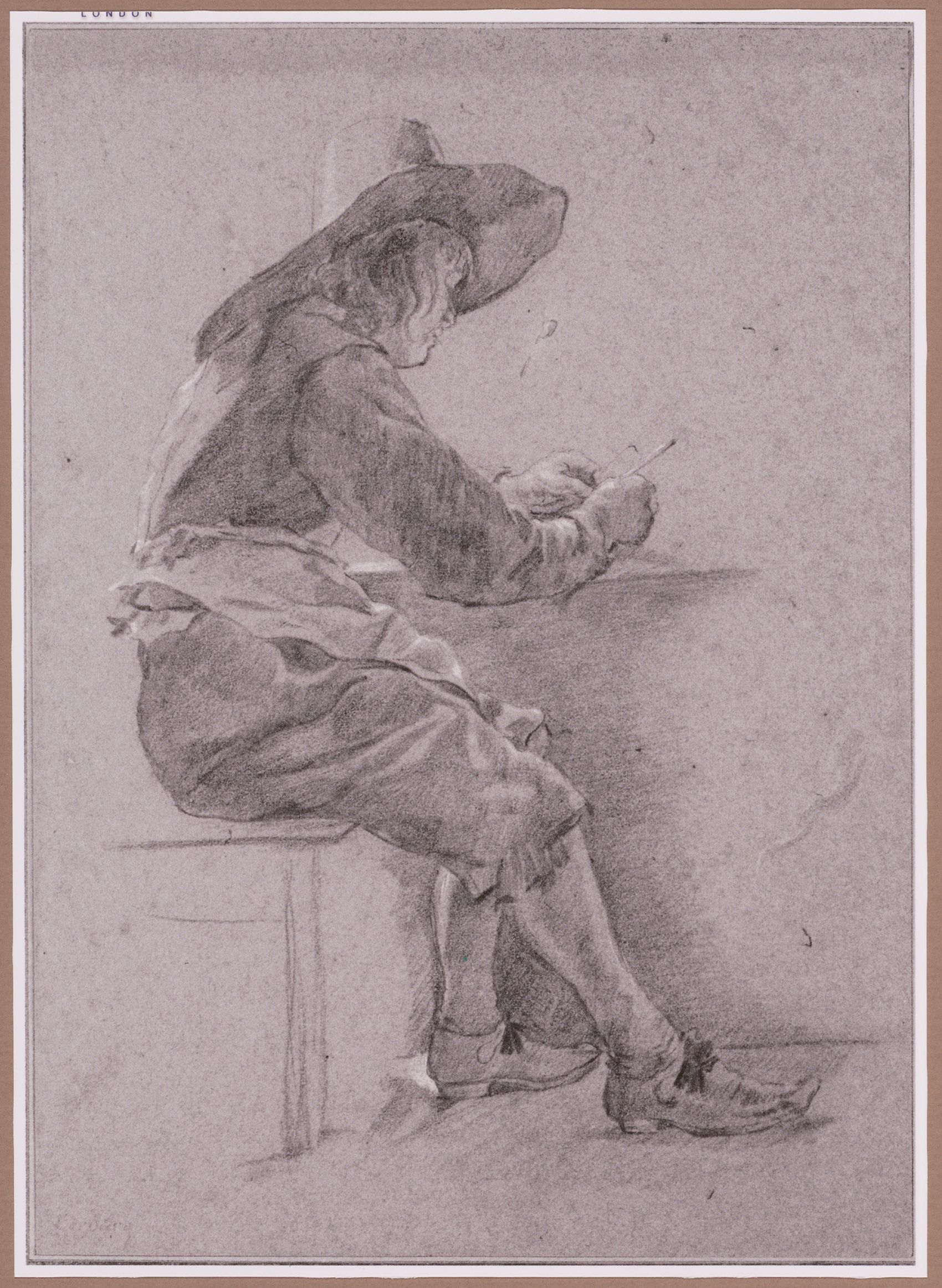

Submitted, not endorsed The appendix below reproduces the 22 presentation images received with the case, as documents of what was submitted. They are not ConfirmArt findings. Where an image asserts an attribution, a sitter, a provenance, a paper match or a named “modello”, that claim is not supported by the evidence on this page. The responses are in the notes on evidence status, paper and watermark, provenance and two-hands claims, and in section 06 of this page.

Documentary appendix: 22 supplied presentation images
  • RKD 116036, colour reproduction, as embeddedThe presentation’s copy of the RKD colour image. The source record is discussed in section 02.Supplied presentation; third-party artwork credits remain with the originating institution. Supplied presentation image, published at the dossier editor’s request; not endorsed.Download PNG (581 × 772 px, 662 KB)
  • Kunsthistorisches Museum Wien logo, as embeddedA credit graphic used in the presentation. It does not document any museum opinion on the drawing.Supplied presentation; third-party artwork credits remain with the originating institution. Supplied presentation image, published at the dossier editor’s request; not endorsed.Download PNG (403 × 221 px, 15 KB)
  • Submitted concordance table, second versionClaims a “Crowned Strasburg Lily + « WR » Countermark”, “206 mm × 153 mm (Fractional Quarto Cut)”, “Dual Hands: Student Draft + Master Revisions” and a provenance “Arthur Feldmann Cabinet (Sold via Switzerland 1934)”; for RKD 116036 it gives “Arthur Feldmann Cabinet (Seized 1939)”. None of these is supported by the evidence reviewed; see the correction record and the paper and provenance notes. The working name in the header is redacted.Supplied presentation; third-party artwork credits remain with the originating institution. Supplied presentation image, published at the dossier editor’s request; not endorsed.Download PNG (493 × 566 px, 84 KB)
  • RKD title block, as embeddedScreenshot of the RKD heading: anonymous; seated young man at a table, seventeenth century; blue paper, black and white chalk, 352 × 251 mm.Supplied presentation; third-party artwork credits remain with the originating institution. Supplied presentation image, published at the dossier editor’s request; not endorsed.Download PNG (470 × 203 px, 17 KB)
  • The present sheet, recto, reusedThe same custodian photograph used elsewhere on this page.Supplied presentation; third-party artwork credits remain with the originating institution. Supplied presentation image, published at the dossier editor’s request; not endorsed.Download PNG (620 × 795 px, 646 KB)
  • Dresden C 1421, reused reproductionA related subject, not the same design; see section 02b.Supplied presentation; third-party artwork credits remain with the originating institution. Supplied presentation image, published at the dossier editor’s request; not endorsed.Download PNG (1,819 × 2,299 px, 4.4 MB)
  • RKD 116036, monochrome reproduction, as embeddedThe presentation’s copy of the RKD monochrome image.Supplied presentation; third-party artwork credits remain with the originating institution. Supplied presentation image, published at the dossier editor’s request; not endorsed.Download PNG (1,700 × 2,324 px, 3.7 MB)
  • RKD attribution field, as embeddedCurrent attribution: anonymous, Northern Netherlands; date: seventeenth century.Supplied presentation; third-party artwork credits remain with the originating institution. Supplied presentation image, published at the dossier editor’s request; not endorsed.Download PNG (813 × 216 px, 16 KB)
  • RKD subject, object and provenance fields, as embeddedIncludes RKD’s provenance field: Sotheby’s, London, 6 July 2005, lot 141. Checked against the live record on 26 September 2026; the record supplies no earlier provenance.Supplied presentation; third-party artwork credits remain with the originating institution. Supplied presentation image, published at the dossier editor’s request; not endorsed.Download PNG (1,099 × 876 px, 62 KB)
  • Portrait labelled as Titus, Boijmans, as embeddedUsed in the presentation to propose Titus as the sitter. The sitter of the present sheet is not identified; see the sitter note.Supplied presentation; third-party artwork credits remain with the originating institution. Supplied presentation image, published at the dossier editor’s request; not endorsed.Download PNG (760 × 928 px, 925 KB)
  • Portrait labelled as Titus, Kunsthistorisches Museum, as embeddedUsed in the presentation to propose Titus as the sitter. Hair, view and medium differ; the sitter remains unidentified.Supplied presentation; third-party artwork credits remain with the originating institution. Supplied presentation image, published at the dossier editor’s request; not endorsed.Download PNG (515 × 536 px, 407 KB)
  • Submitted luminance maskA computation from a photograph. It does not measure ink, relief or infrared response.Supplied presentation; third-party artwork credits remain with the originating institution. Supplied presentation image, published at the dossier editor’s request; not endorsed.Download PNG (692 × 840 px, 422 KB)
  • Submitted normal-map viewA computation from a photograph. It does not measure physical relief.Supplied presentation; third-party artwork credits remain with the originating institution. Supplied presentation image, published at the dossier editor’s request; not endorsed.Download PNG (692 × 828 px, 918 KB)
  • Comparison labelled Eeckhout, as embeddedA comparison image labelled Eeckhout in the presentation. Its source record has not been audited for this dossier.Supplied presentation; third-party artwork credits remain with the originating institution. Supplied presentation image, published at the dossier editor’s request; not endorsed.Download PNG (407 × 548 px, 275 KB)
  • Comparison labelled Drost, as embeddedThe same image as the Drost control, British Museum Oo,9.96, in the comparison register.Supplied presentation; third-party artwork credits remain with the originating institution. Supplied presentation image, published at the dossier editor’s request; not endorsed.Download PNG (687 × 646 px, 824 KB)
  • Submitted concordance matrixTitled “Physical & Historical Concordance Matrix”, with the subject “Titus van Rijn at a Drawing Desk”. Lists a “Crowned Strasbourg Lily + « WR » Countermark”, “206 mm × 153 mm (Pristine Quarto Cut)”, “Fine Acidic Iron-Gall Ink & High-Carbon Wash” and “WZIS Type E.a. / Cleveland Control Standard”. None of these is supported by the evidence reviewed, and the sitter is not identified; see the correction record and the paper and sitter notes. The working name in the header is redacted.Supplied presentation; third-party artwork credits remain with the originating institution. Supplied presentation image, published at the dossier editor’s request; not endorsed.Download PNG (332 × 417 px, 52 KB)
  • Submitted concordance table, lower rowsClaims “Dual Hands: Student Draft + High-Velocity Master Revisions”, “Dr. Arthur Feldmann Portfolio (Sold In Serie via Switzerland, 1934)” and “School of Rembrandt (Carrying Rembrandt Autograph Corrections)”; for RKD 116036 it gives “Dr. Arthur Feldmann Cabinet (Seized by Gestapo 1939)”. Not supported by the evidence reviewed; neither Sotheby’s nor RKD records a Feldmann provenance for lot 141. See the correction record and the provenance note.Supplied presentation; third-party artwork credits remain with the originating institution. Supplied presentation image, published at the dossier editor’s request; not endorsed.Download PNG (731 × 503 px, 93 KB)
  • Transmitted-light photograph, uncropped, reusedThe watermark area as supplied. The mark remains unclassified.Supplied presentation; third-party artwork credits remain with the originating institution. Supplied presentation image, published at the dossier editor’s request; not endorsed.Download PNG (1,512 × 2,016 px, 3.6 MB)
  • Submitted overlay: the present sheet and RKD 116036An overlay with a grid, made for the presentation. The dossier’s own RKD comparison uses a separate, documented registration.Supplied presentation; third-party artwork credits remain with the originating institution. Supplied presentation image, published at the dossier editor’s request; not endorsed.Download PNG (544 × 722 px, 485 KB)
  • Submitted overlay: the present sheet and Dresden C 1421Dresden is a related subject, not the same design. An overlay does not show dependence.Supplied presentation; third-party artwork credits remain with the originating institution. Supplied presentation image, published at the dossier editor’s request; not endorsed.Download PNG (410 × 497 px, 330 KB)
  • Submitted difference viewA computation from photographs. Differences in colour and alignment are not measurements of the drawings.Supplied presentation; third-party artwork credits remain with the originating institution. Supplied presentation image, published at the dossier editor’s request; not endorsed.Download PNG (413 × 499 px, 294 KB)
  • Submitted emboss viewAn emboss filter applied to a photograph. It does not show physical relief.Supplied presentation; third-party artwork credits remain with the originating institution. Supplied presentation image, published at the dossier editor’s request; not endorsed.Download PNG (764 × 853 px, 929 KB)

Evidence-led drawing research

Research of this kind is ConfirmArt's work

ConfirmArt investigates drawings, paintings, and their documents for collectors who require evidence before opinions: museum records, paper and watermark analysis, catalogue and provenance research, laboratory coordination, and reporting that includes the evidence against as well as for.

  • Qualified object record
  • Claim-to-source audit
  • Institutional comparators
  • Ranked next examinations
  • Human review by Roy S.