
Step by step overview of our methodology for assessing the authenticity of a drawing.
Description and history of the artwork
Unaccurate geology and perspective, but what about the drawing style?
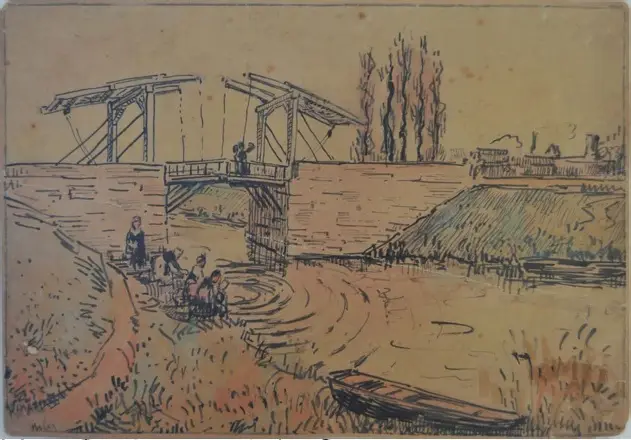

One month ago, the final version of paper “Did Van Gogh draw it?” (Yardeni, 2022) was published about the artwork titled Langlois Bridge in Arles. It is made on pencil, with blue and red watercolors. The paper goes in detail through the provenance of the drawing, obtained from a scholar acquaintance of himself, who found it Haifa (Israel) flea market. In the paper, the author mentions the story behind the artwork, which involves a Holocaust refugee escaping France with it.
At first inspection, I found the colors of the drawing to be similar to some artworks found on Van Gogh letters from 1882, but this contrasts with the reported date of 1888. Personally, if the drawing style looks like Van Gogh to any extent, it would be more similar to the drawings made 6 years prior to the dates Van Gogh lived in Arles. Secondly, after observing photos, maps and other artworks showing the Langlois bridge, I observe inconsistencies in geometry, perspective and geologic similarities to the actual surroundings of the place in 1888.
The image on the top shows the front of the artwork, and the image on the bottom, the back of the drawing.
Rejections from Van Gogh Museum: The drawing was rejected as a forgery by the museum in 2008 for the first time, citing that De la Faille attributed the drawing to Leon Giran-Max. The author of the manuscript contacted the museum again in 2019, but to receive a short note from them informing that “the work cannot be attributed to Van Gogh”, followed by an enumeration of the reasons, some of which I had observed as evident at first sight, including the geometry and geographic proofs. In this response letter from the VGM, I miss evidences regarding the drawing style and the use of colors. Indeed, somebody may say that the author could be experimenting with the geometry in favor of the composition, in order to prepare material for another artwork.
Goal of the study and approach: The author of the paper asks for an unbiased investigation. For this, I will train my model using only artworks which are proven to be made by Van Gogh. The artificial networks will not use any other image, in order to preserve the bias-free classification. We will see what the model says about the artwork.
PREPARING THE DATASETS
Selected artworks: van Gogh spent fifteen month living in Arles, from February 1888 to May 1889. In order to train our model on a sample of artworks which closely represents the drawing style of the artist during the mentioned period, we selected the artworks from his 4 latter years of life (1887-1890). For the testing artworks, in addition to the one featured in the referred paper, we reserved some authentic ones, and added some forged drawings introduced by Otto Wacker and The Lost Arles Sketchbook (deemed as forgeries by our model and also by the VGM).
We trained with 184 high resolution images of drawings made by Van Gogh during his time in Arles. We used the De La Faille catalog raisonne to verify the authenticity and provenance of the drawings used for training.
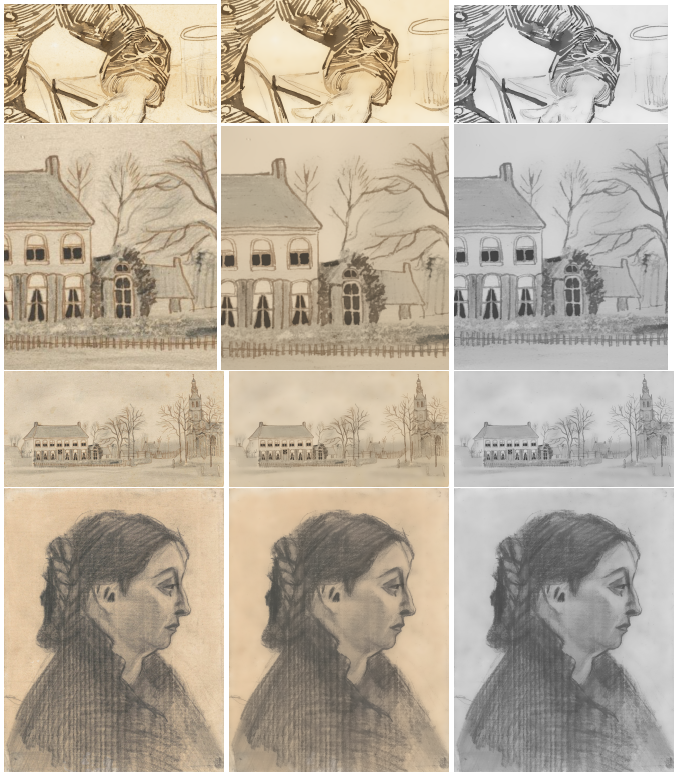
Image preparation: We used our own algorithm to filter the texture and tint of the paper of the drawings. This prevents the network to learn the paper, or even the camera, and to focus the learning on the drawing style. Next, in order to remove the influence of fading or degradation of the colors, we converted the photos of signatures into squared grayscale images.

Narrowing it around the Arles period
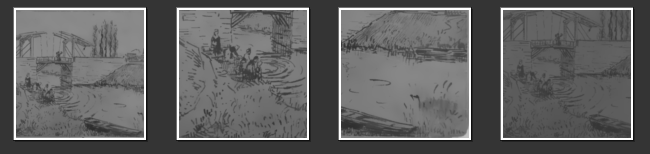
After the image preparation, we chopped the images to use as input for our neural network tuned for drawings, which works with sub-images of 256×256 pixels.
In order to chop the drawings, we used our algorithm which selects the most relevant regions and groups them to improve the performance of the model. The datasets are split as follows: 70% of the authentic signatures were randomly separated for training, 10% for validation, and the remaining 20% were reserved for testing.
On the left hand image, you can see the image with the squared regions selected. Every region will be tested for authenticity and studied separately. Additionally, the same is done with the image containing the whole drawing.
Training our neural network
Our neural networks are trained on the images of authentic Van Gogh drawings

The number of available authentic drawings is finite, so we performed data augmentation with the images: This means randomly translating and rotating the patches in the squared images. This procedure increments the variety of inputs to the network, free of biases, and results in an improvement in the accuracy of the classification. Additionally, it is also zoomed in and out a bit.
- We trained our model using only the authentic samples. For this task, we used two networks, an encoder and a decoder, which is able to reconstruct the signatures. After obtaining training convergence, we saved the trained model and tried it with the test signatures to evaluate the performance.
the veredict of our model
Authenticity of Langlois Bridge in Arles
The algorithm classifies the drawing Langlois Bridge in Arles, 1888?, Watercolor, 30×19.5 cm as Non Authentic.
Testing accuracy: Using our trained model we obtained a prediction accuracy of 89% for the authenticity of 220 drawings. We consider this confidence enough to issue a certificate with the detailed description of the experiment.
Final remarks: Our model indeed confirms the suspicions we raised about the authenticity of the artwork, based solely on geological and geometrical evidences. Furthermore I observed that the usage of colors, was not consistent with the drawings made by Van Gogh during the period he lived in Arles. Our model was able to corroborate the non-authenticity of the artwork, using as evidence solely a comparision of the style of the drawing with the style of drawings from Van Gogh.
Need help to authenticate or value an item?
We offer a personalized service to our customers.

