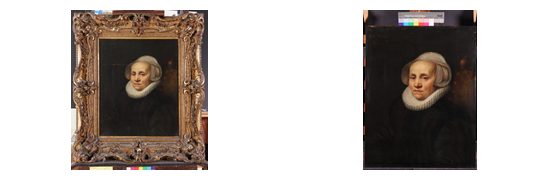
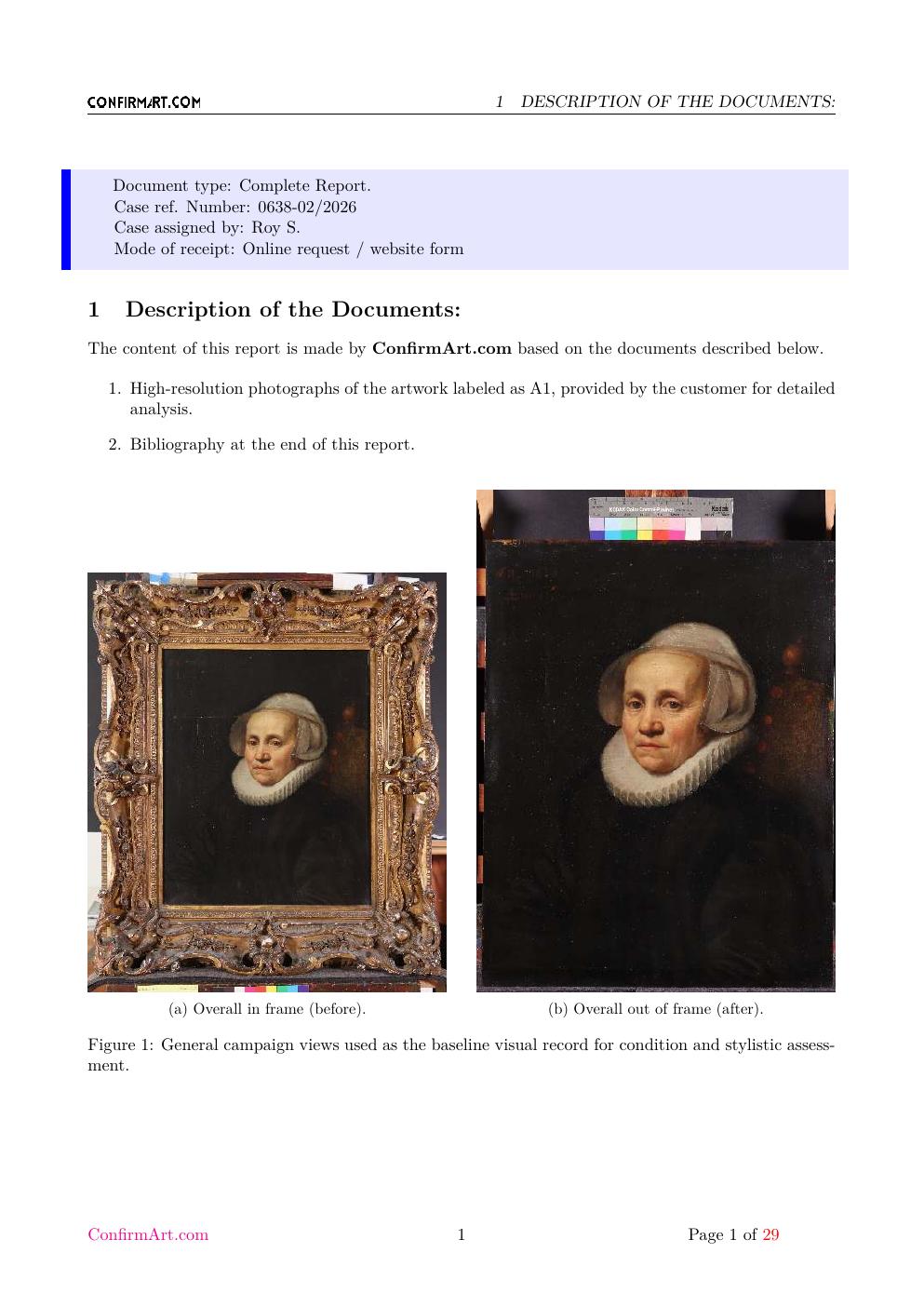
Portrait attributed to Jan Anthonisz. van Ravesteyn
Real client case reviewed by ConfirmArt for Portrait attributed to Jan Anthonisz. van Ravesteyn, attributed or related to Jan Anthonisz. van Ravesteyn. The public page presents selected visual evidence and a rendered report viewer without exposing the private commissioned PDF.
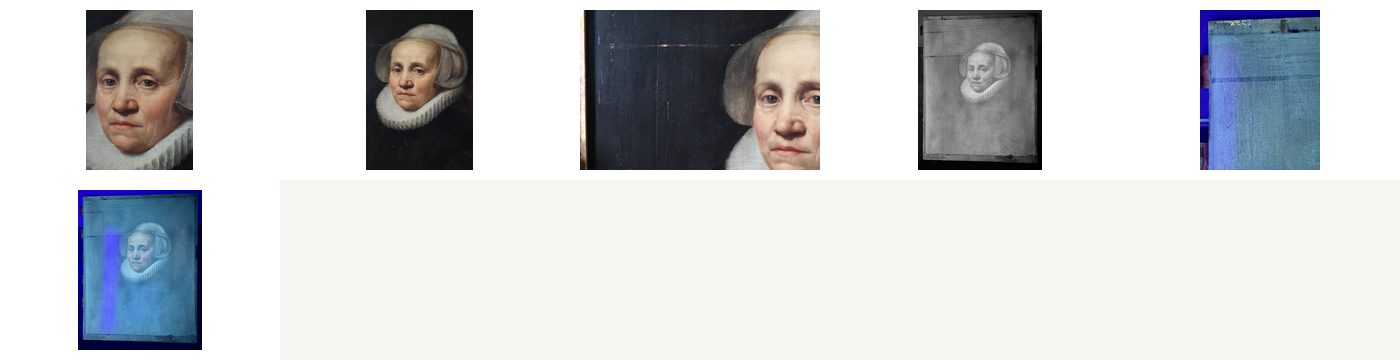
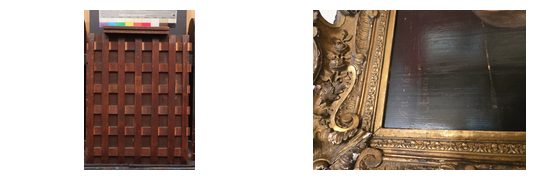
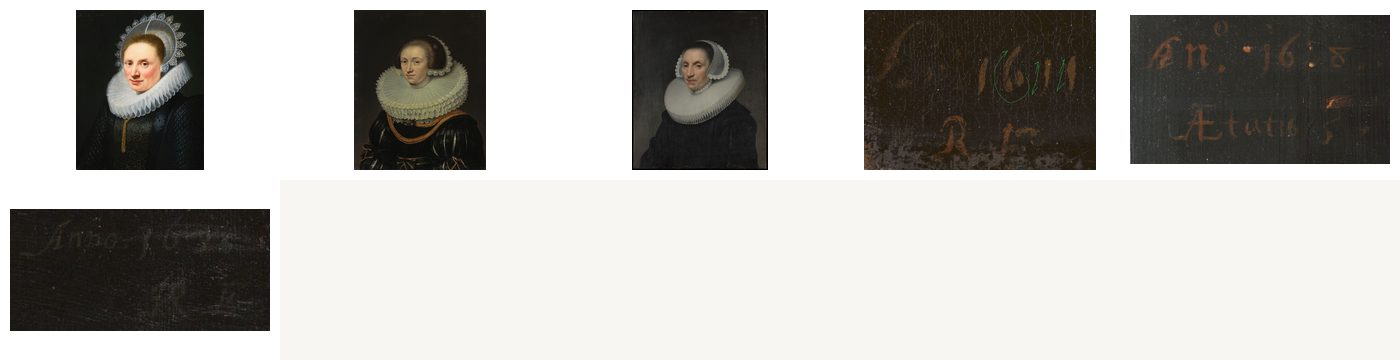
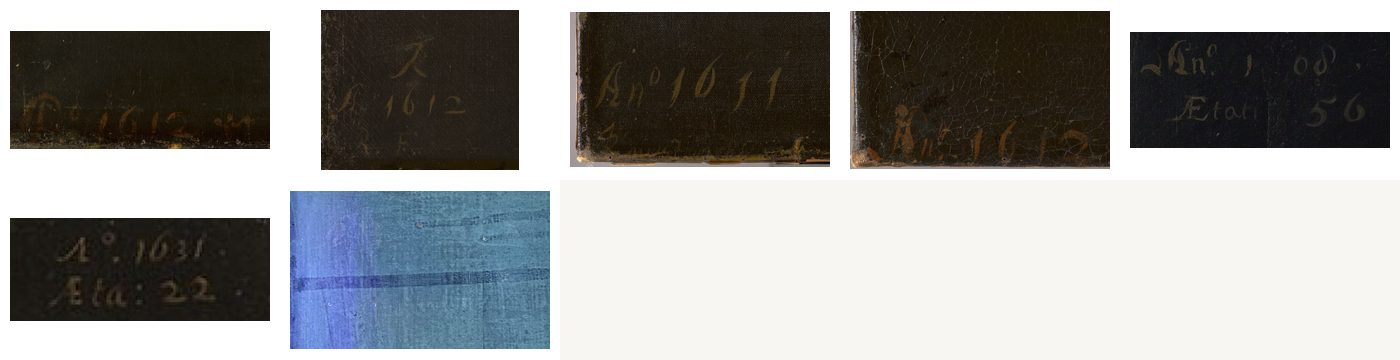
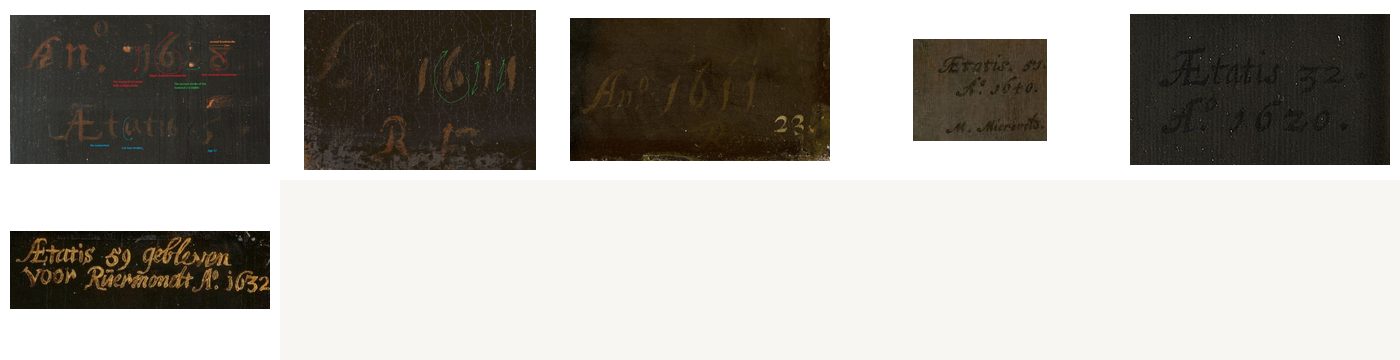
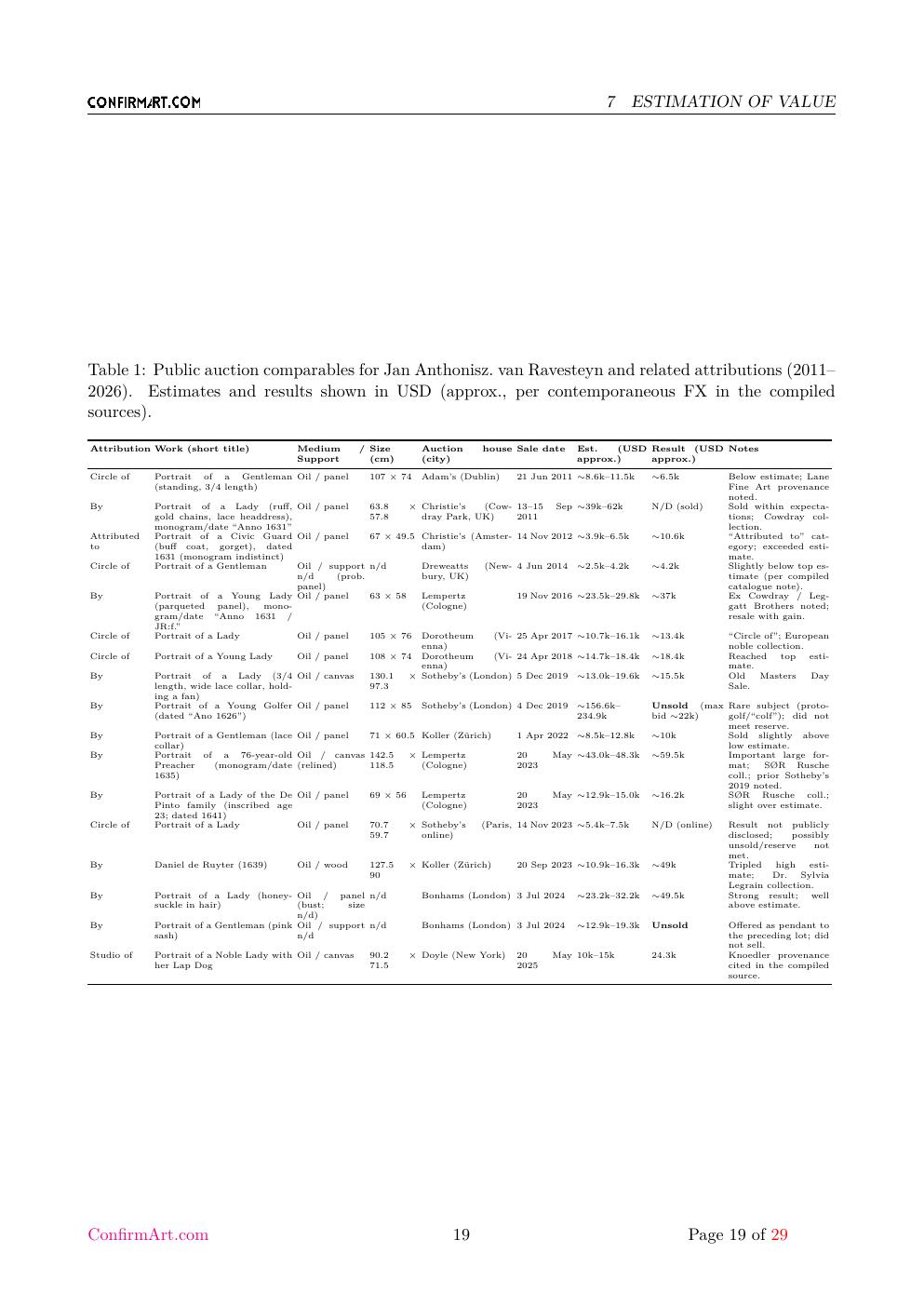
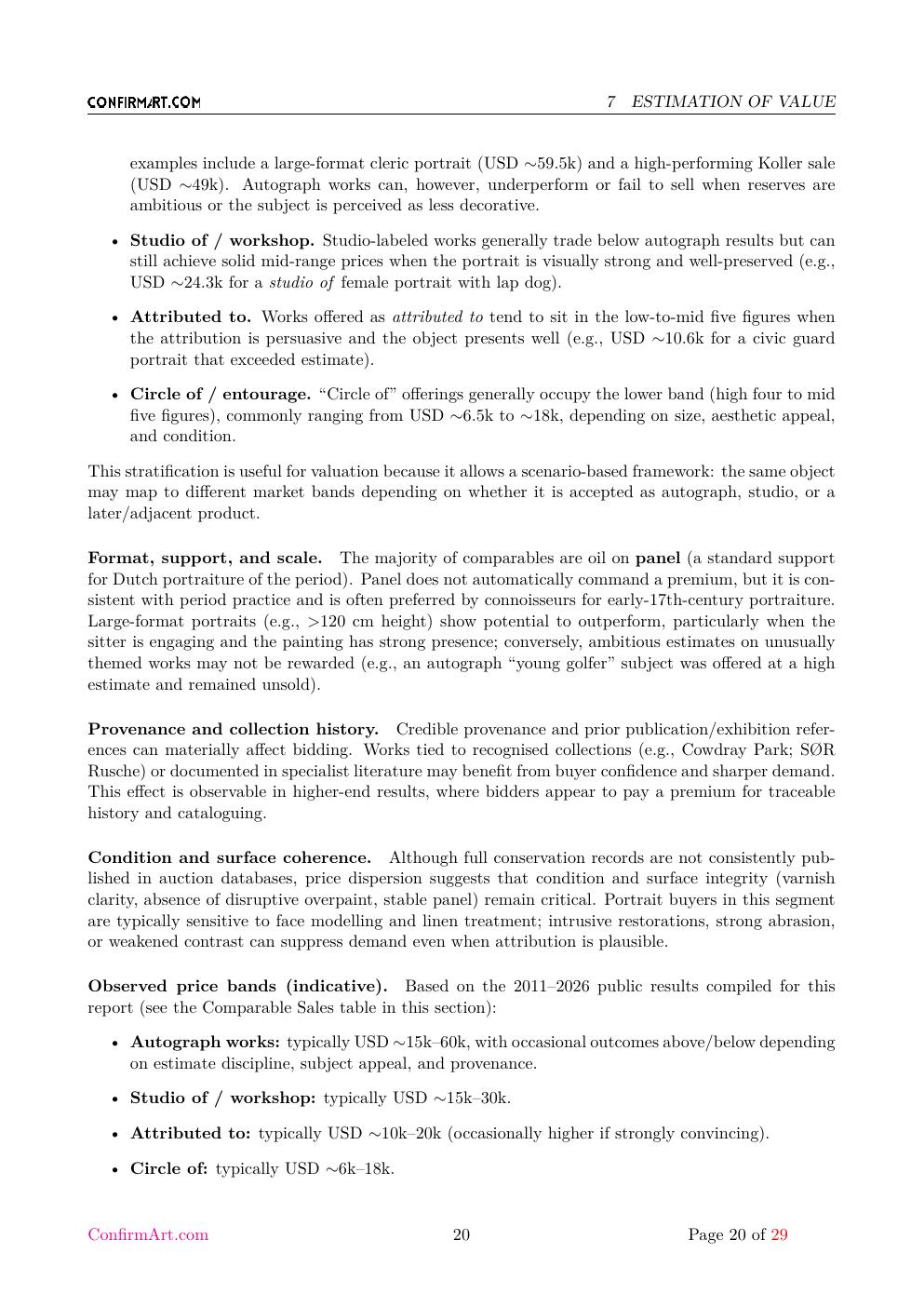
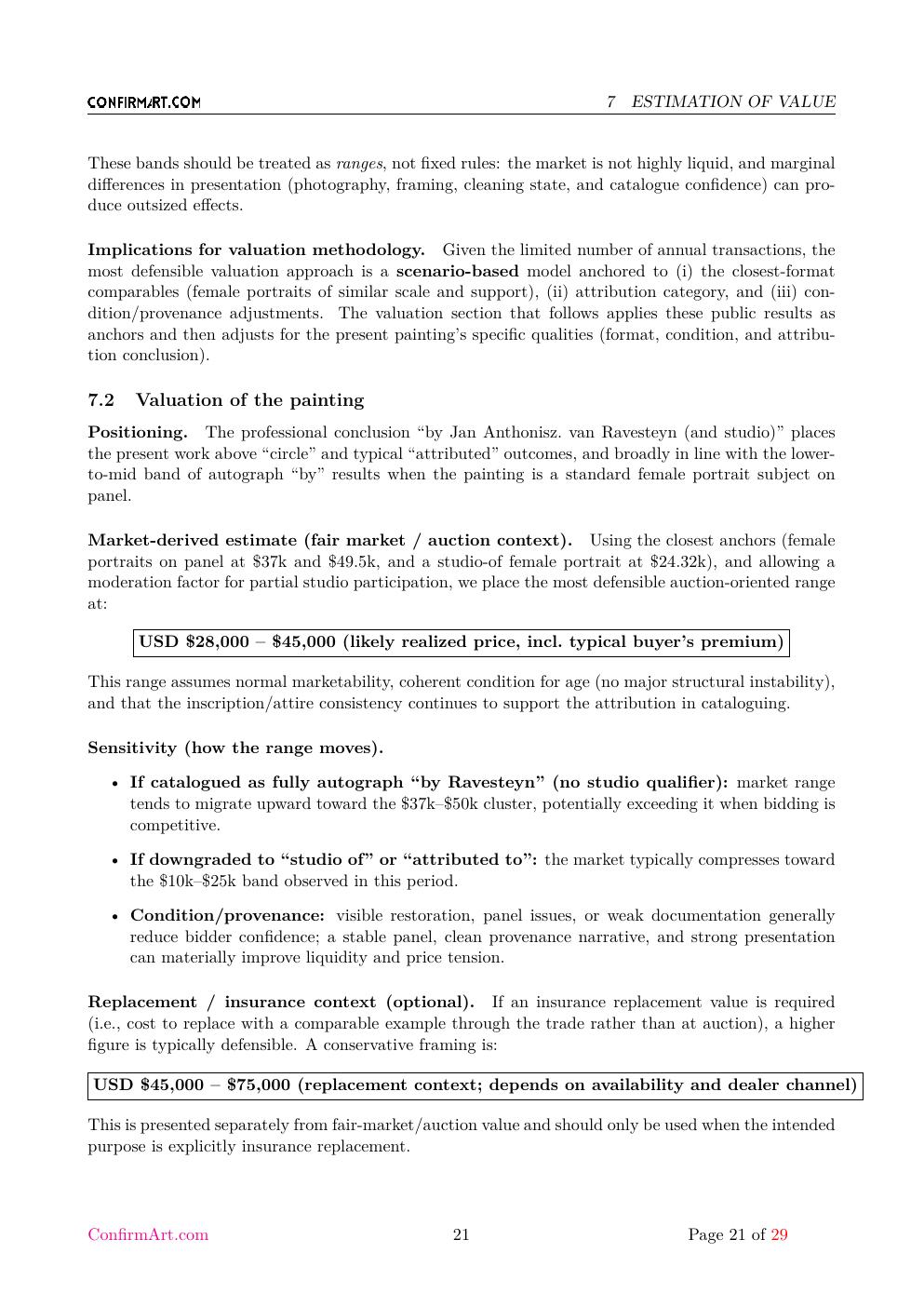
Jan Anthonisz. van Ravesteyn authentication evidence image 1: Portrait attributed to Jan Anthonisz. van RavesteynJan Anthonisz. van Ravesteyn authentication evidence image 2: Portrait attributed to Jan Anthonisz. van RavesteynJan Anthonisz. van Ravesteyn authentication evidence image 3: Portrait attributed to Jan Anthonisz. van RavesteynJan Anthonisz. van Ravesteyn authentication evidence image 4: Portrait attributed to Jan Anthonisz. van RavesteynJan Anthonisz. van Ravesteyn authentication evidence image 5: Portrait attributed to Jan Anthonisz. van RavesteynJan Anthonisz. van Ravesteyn authentication evidence image 6: Portrait attributed to Jan Anthonisz. van RavesteynJan Anthonisz. van Ravesteyn authentication evidence image 7: Portrait attributed to Jan Anthonisz. van RavesteynJan Anthonisz. van Ravesteyn authentication evidence image 8: Portrait attributed to Jan Anthonisz. van Ravesteyn
Report structure
Section summaries
01
Pictorial composition and depicted elements
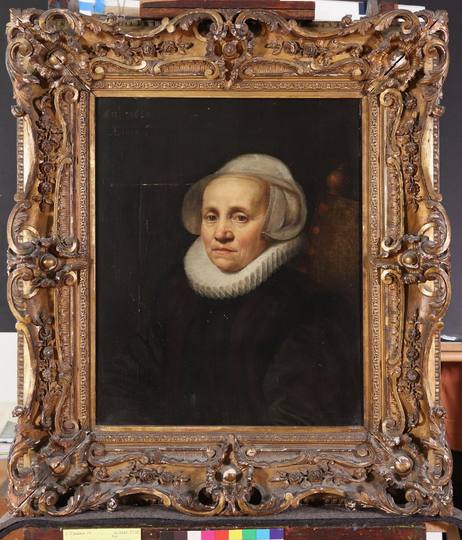
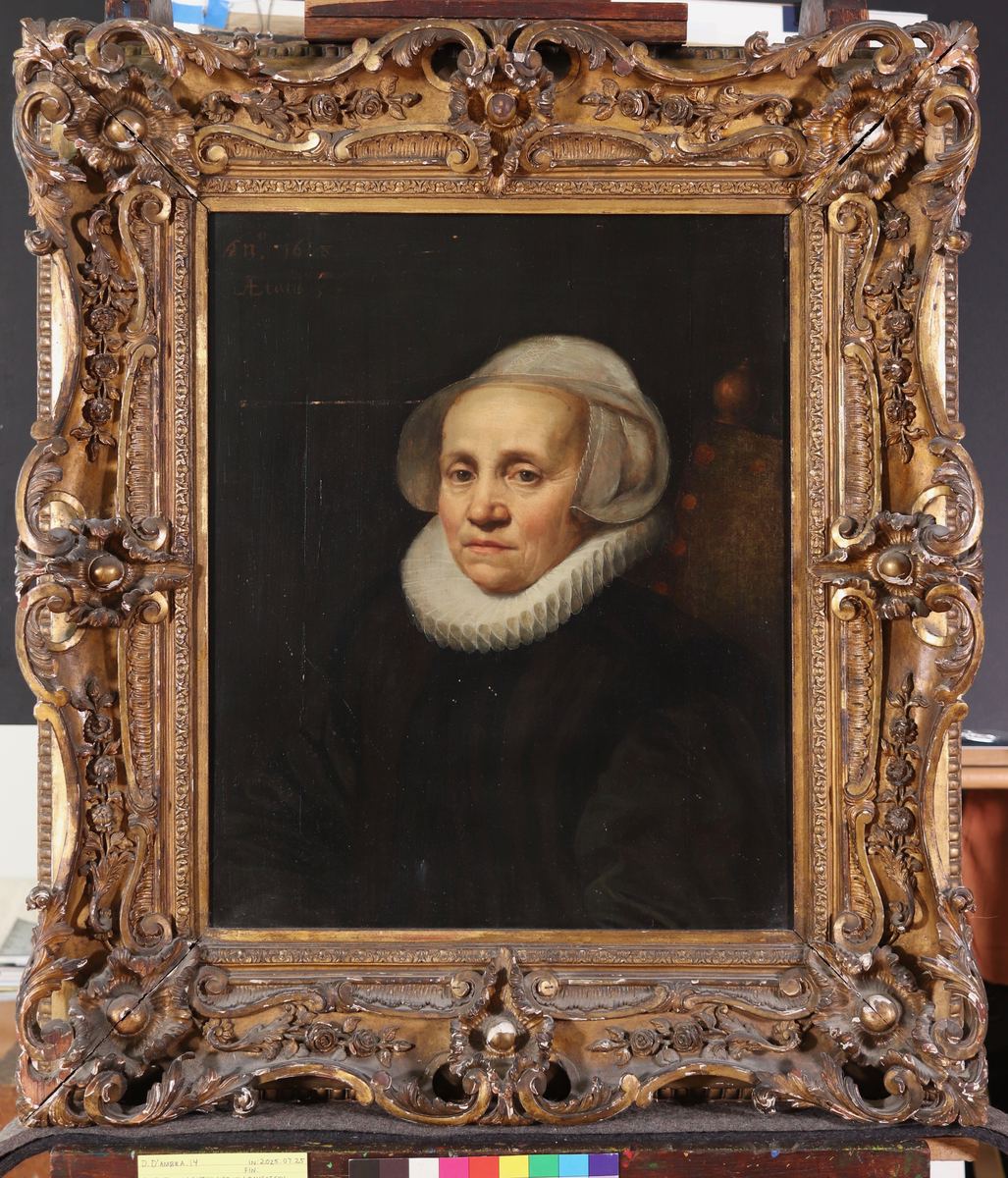
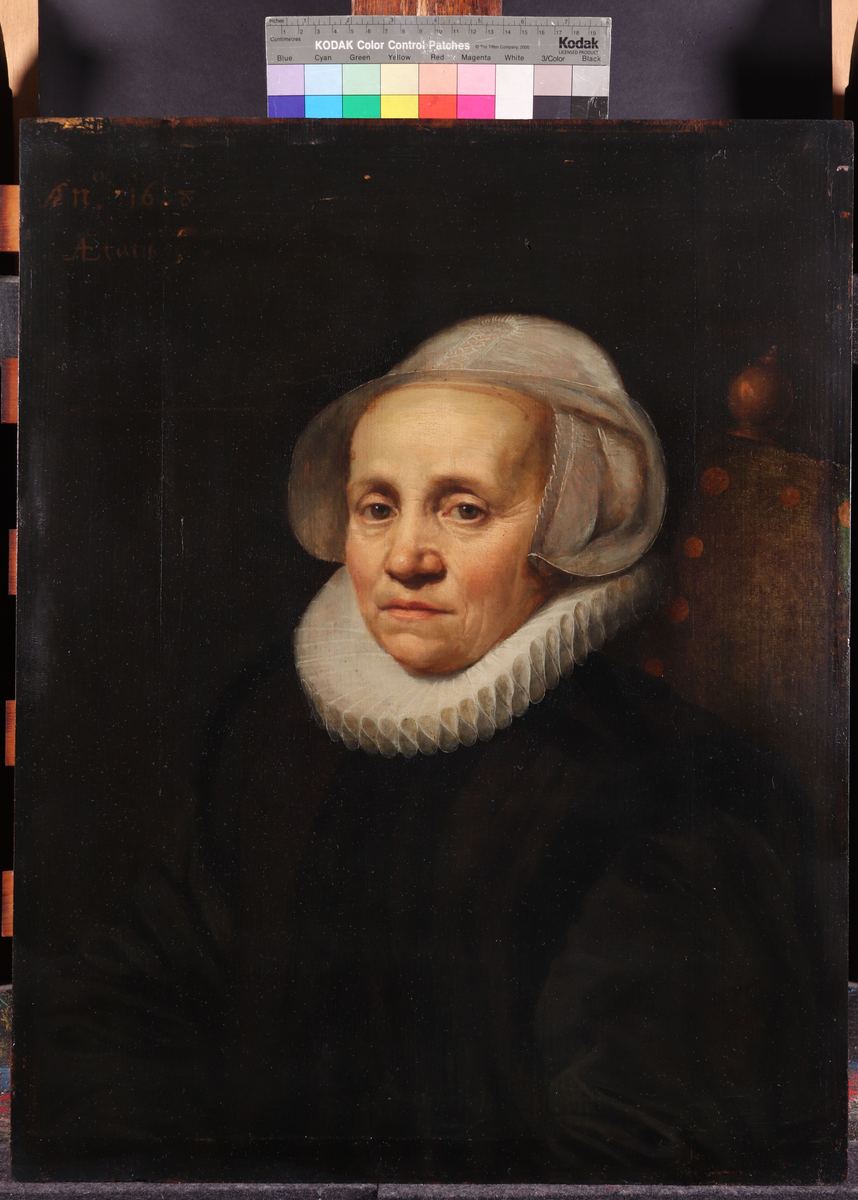
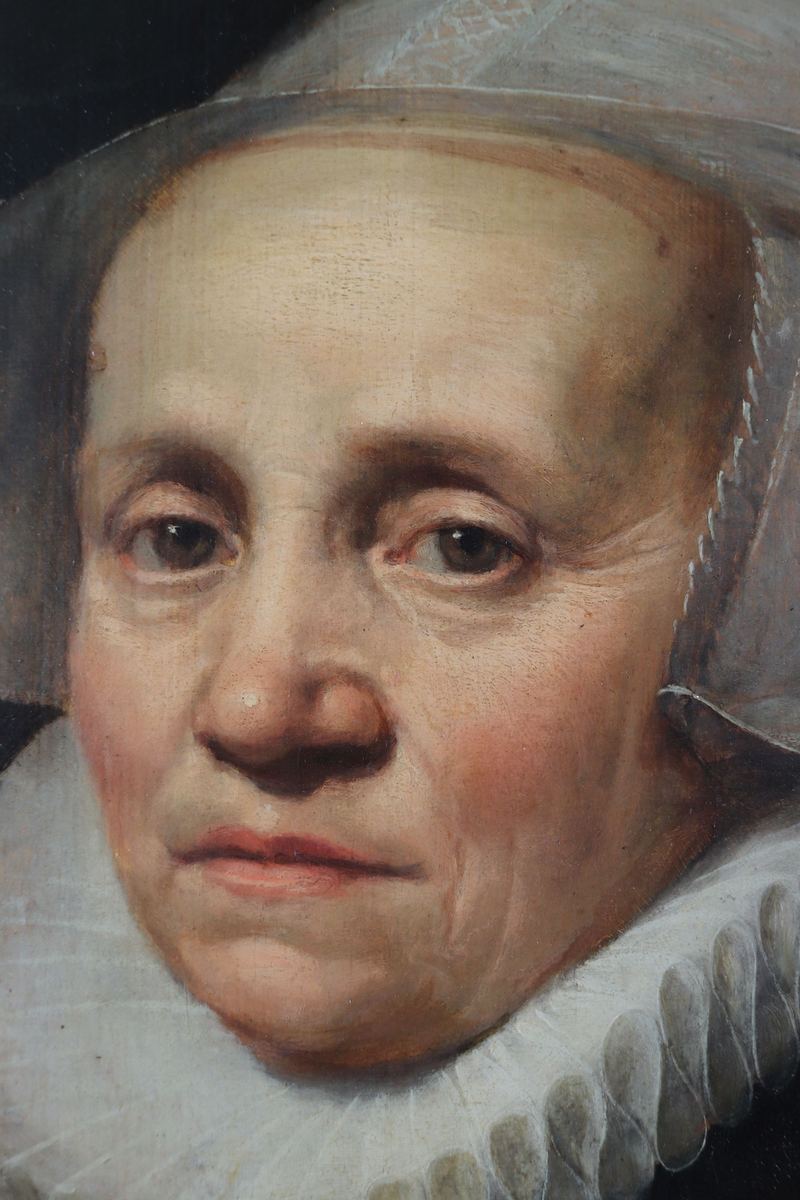
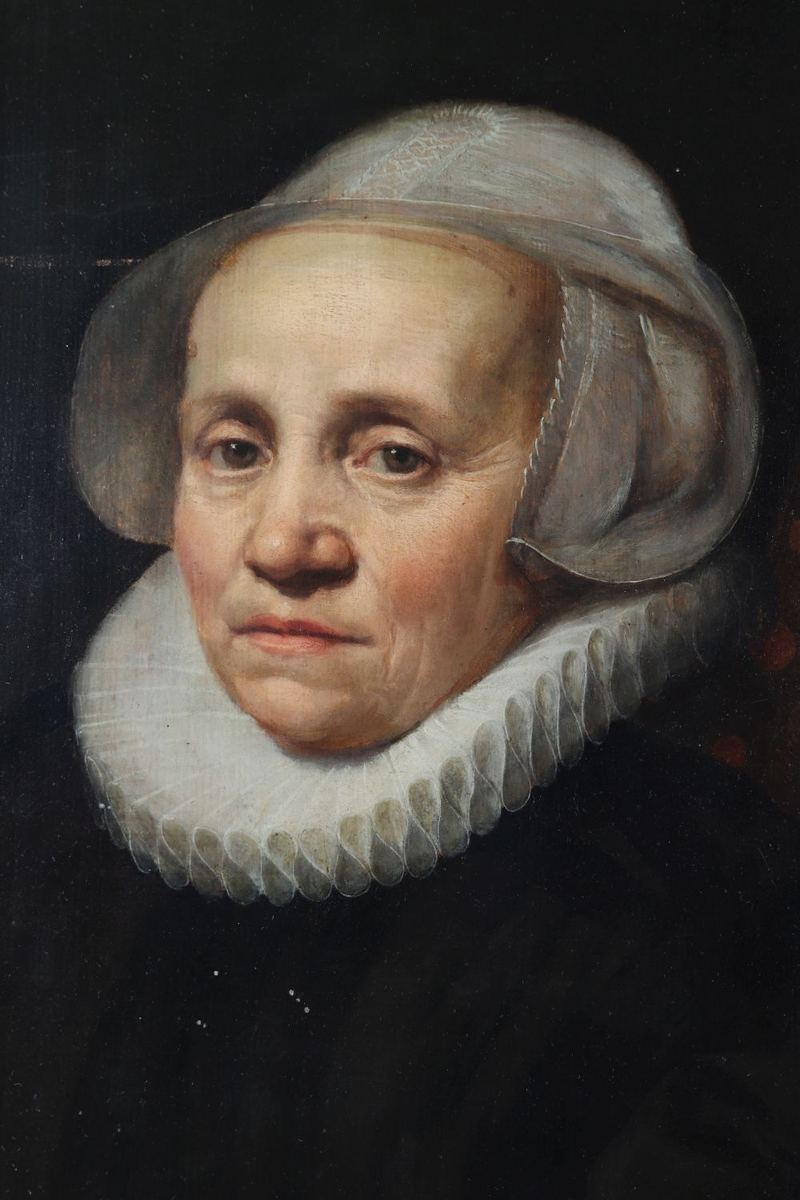
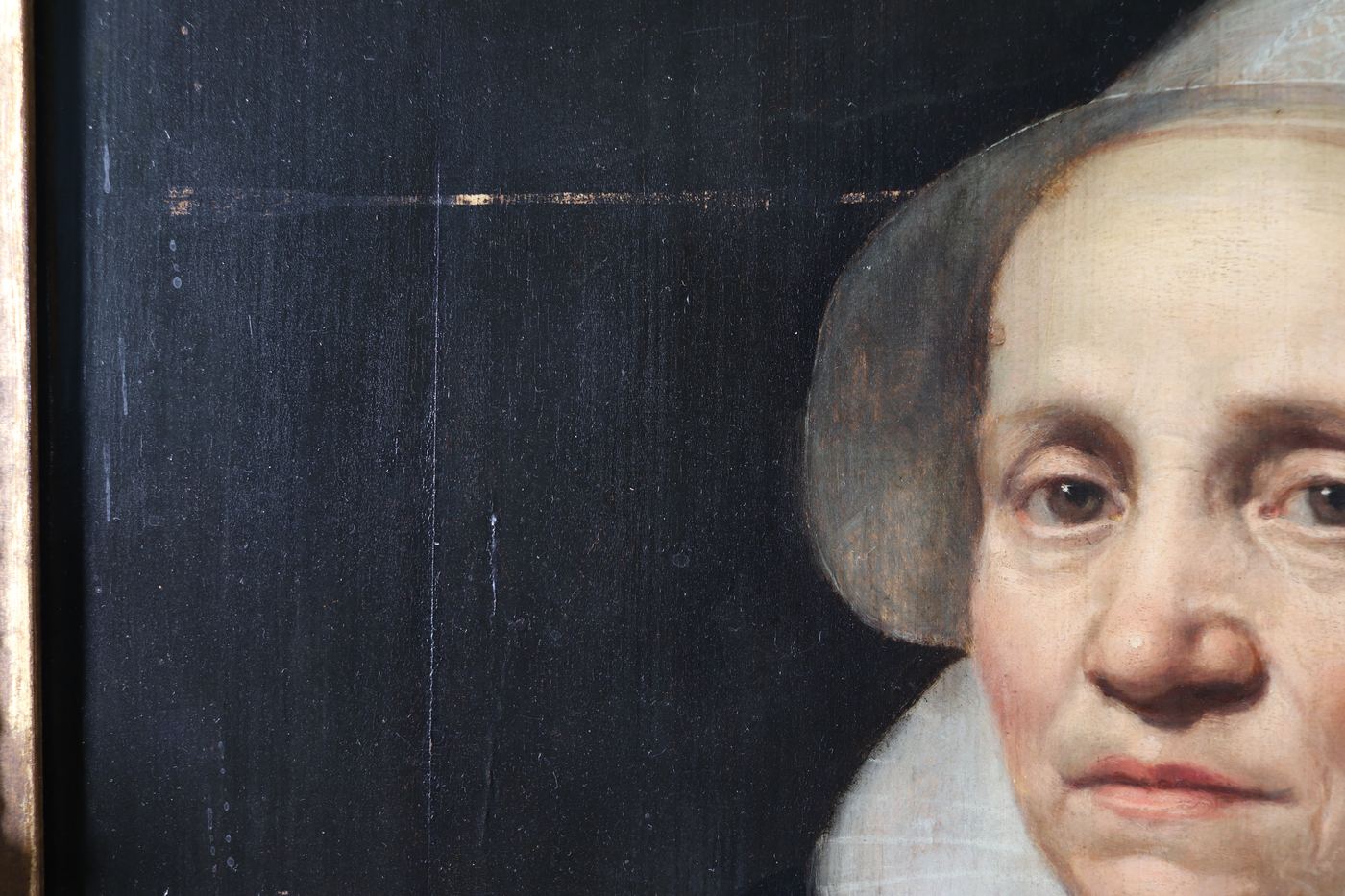
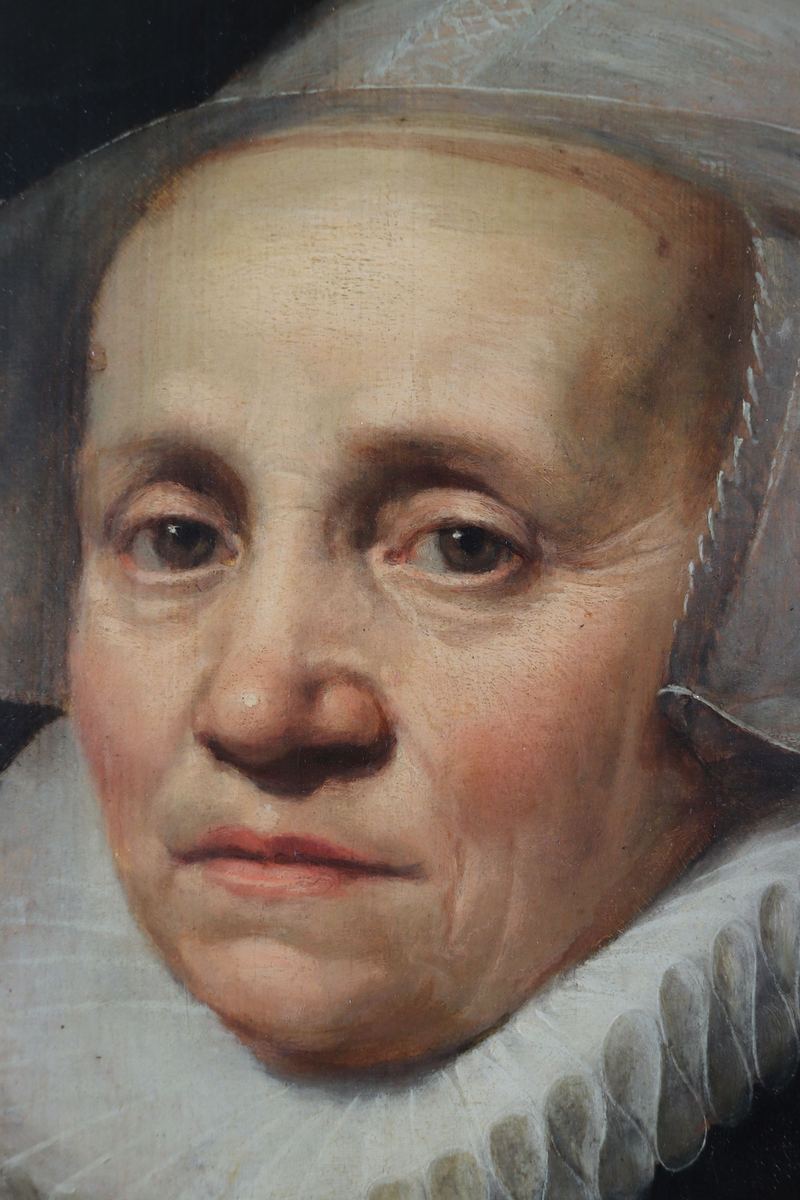
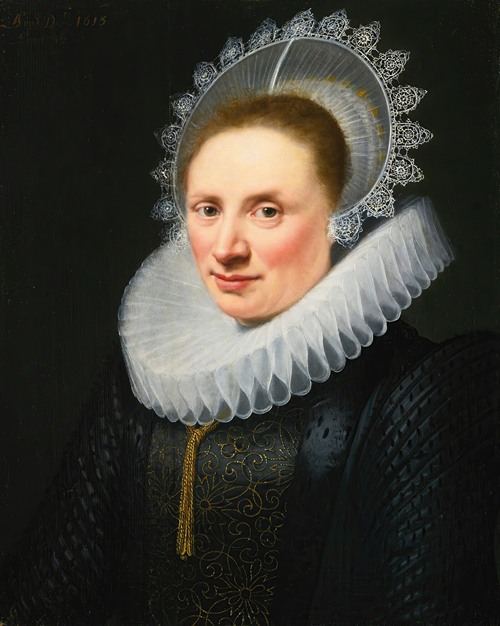
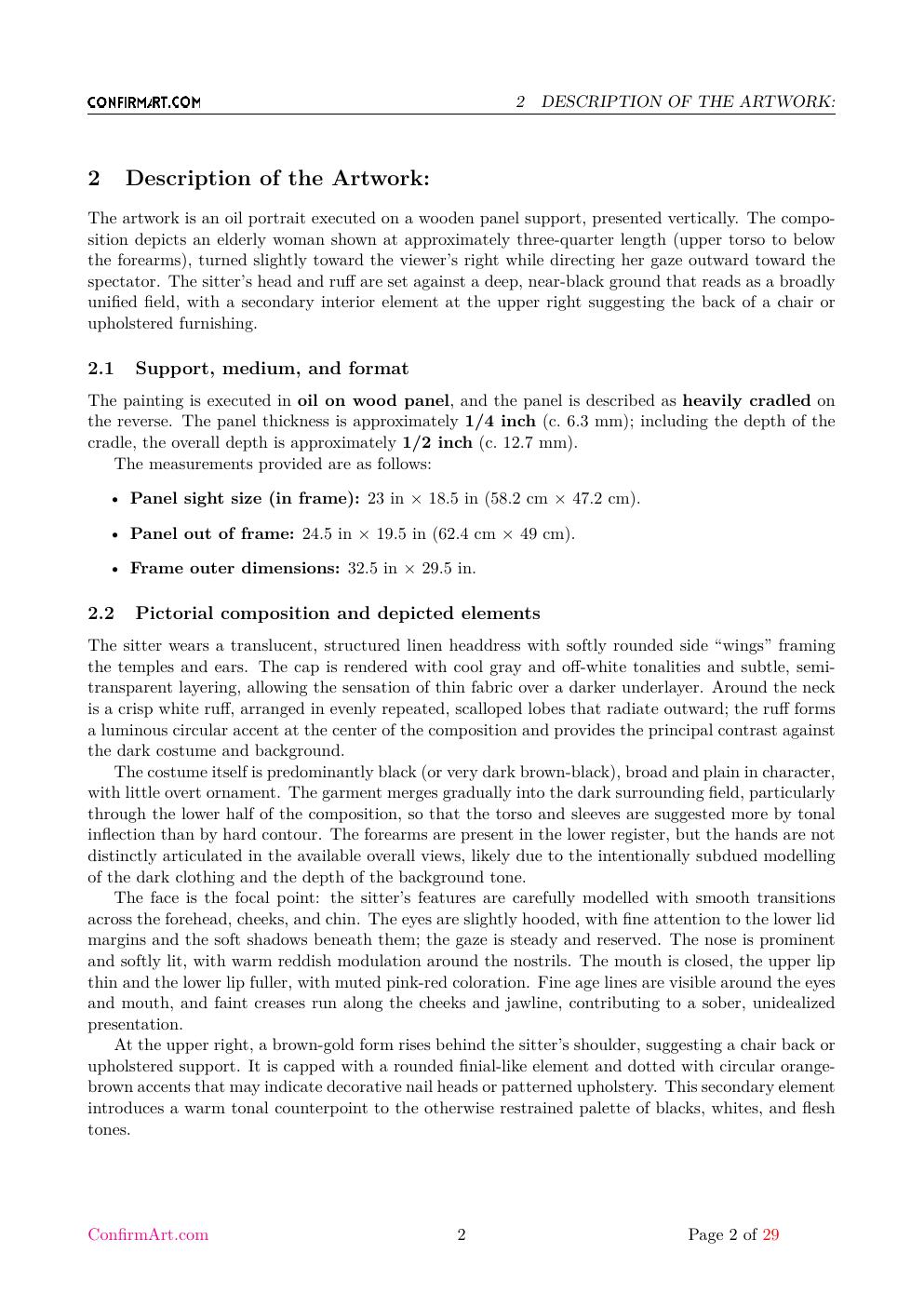
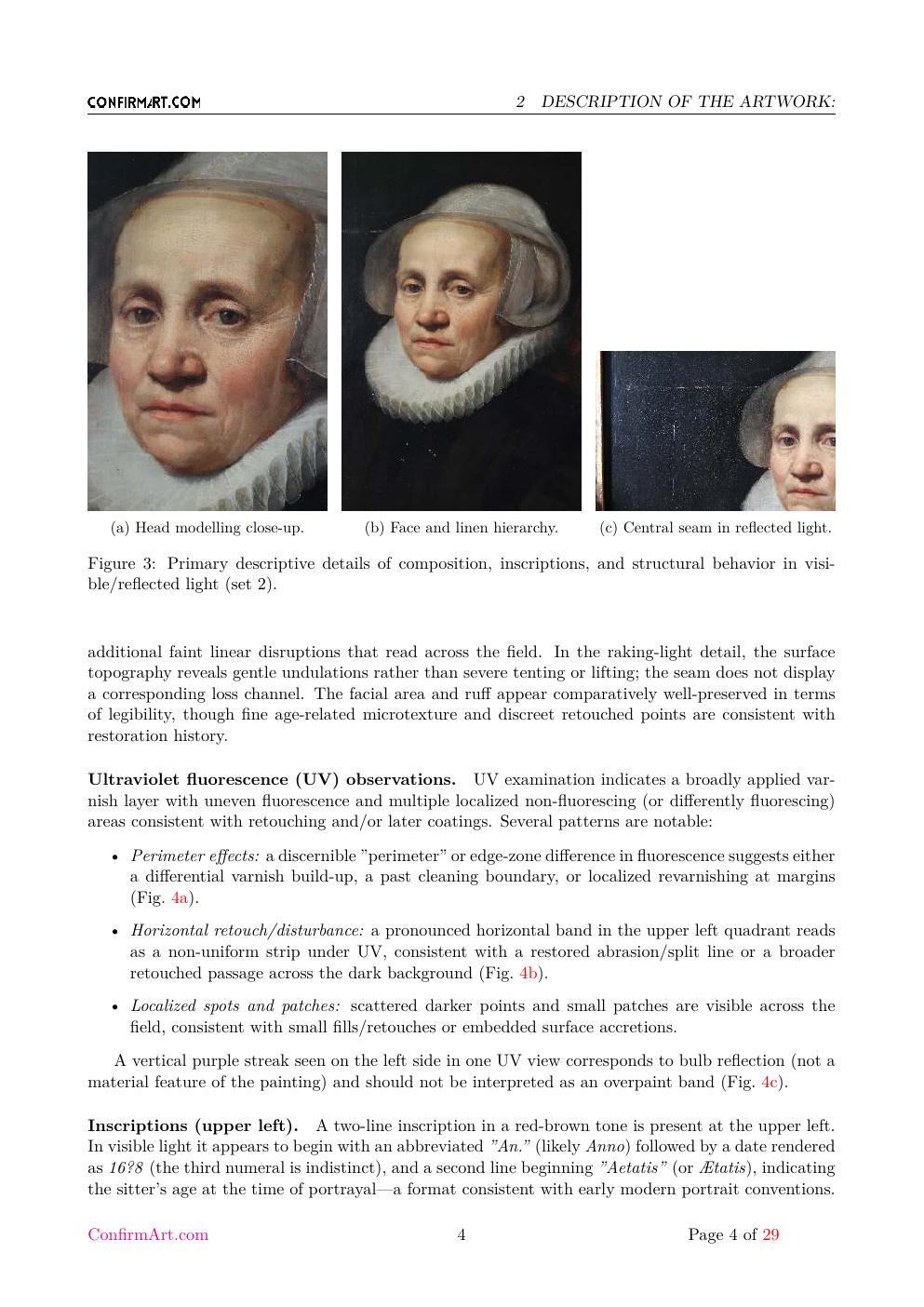
The sitter wears a translucent, structured linen headdress with softly rounded side "wings" framing the temples and ears. The cap is rendered with cool gray and off-white tonalities and subtle, semi-transparent layering, allowing the sensation of thin fabric over a darker underlayer. Around the neck is a crisp white ruff, arranged in evenly repeated, scalloped lobes that radiate outward; the ruff forms a luminous circular accent at the of the composition and provides the principal contrast against the dark costume
02
Technical Observations
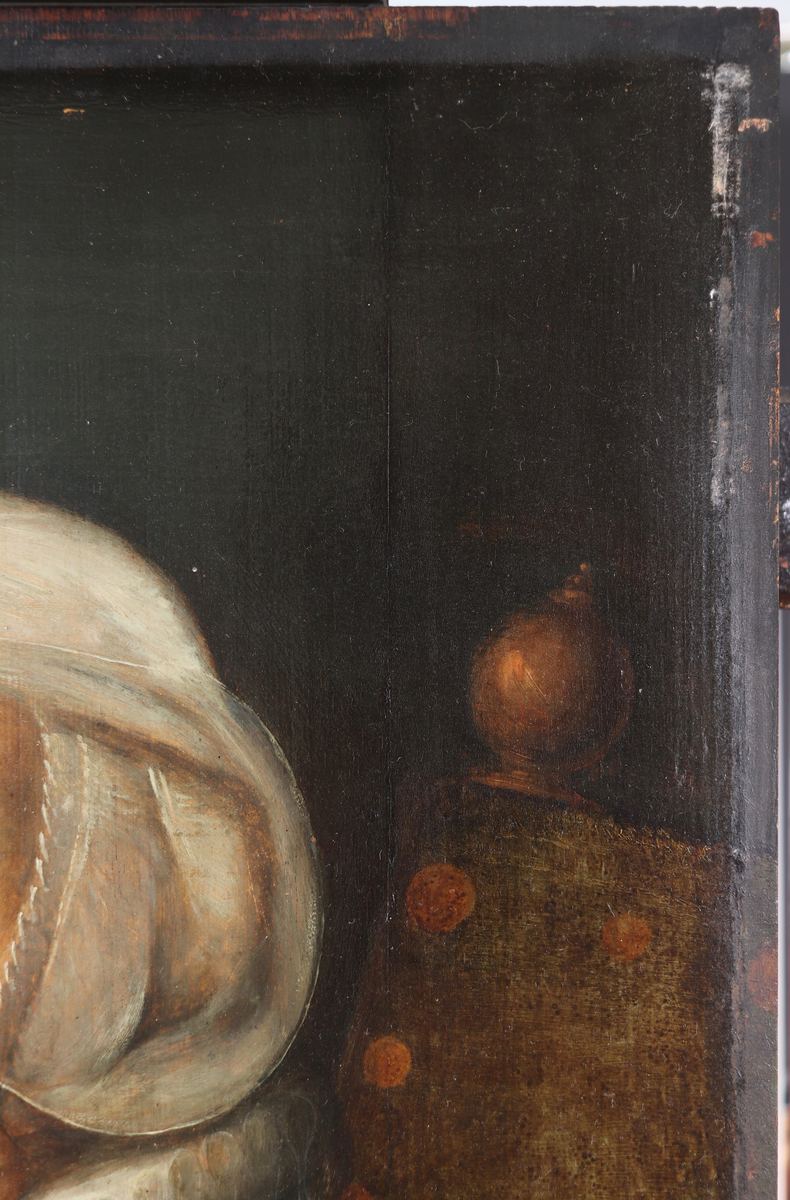
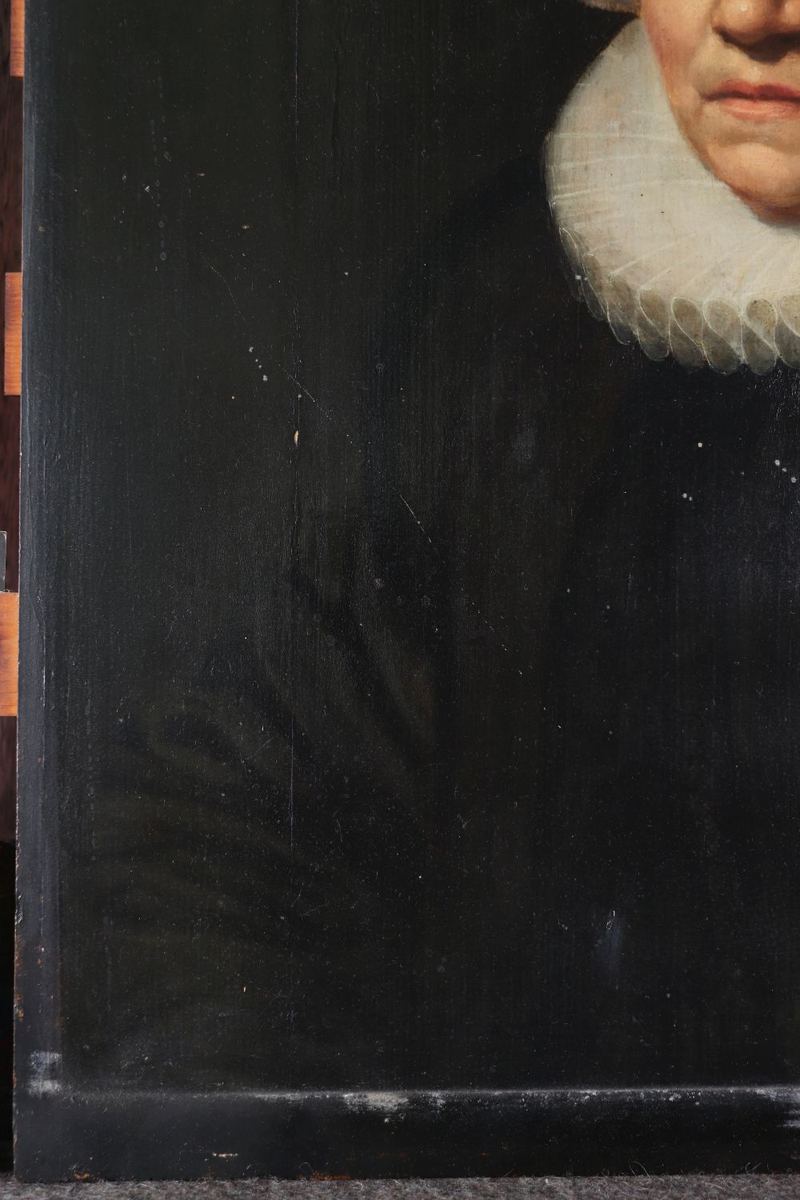
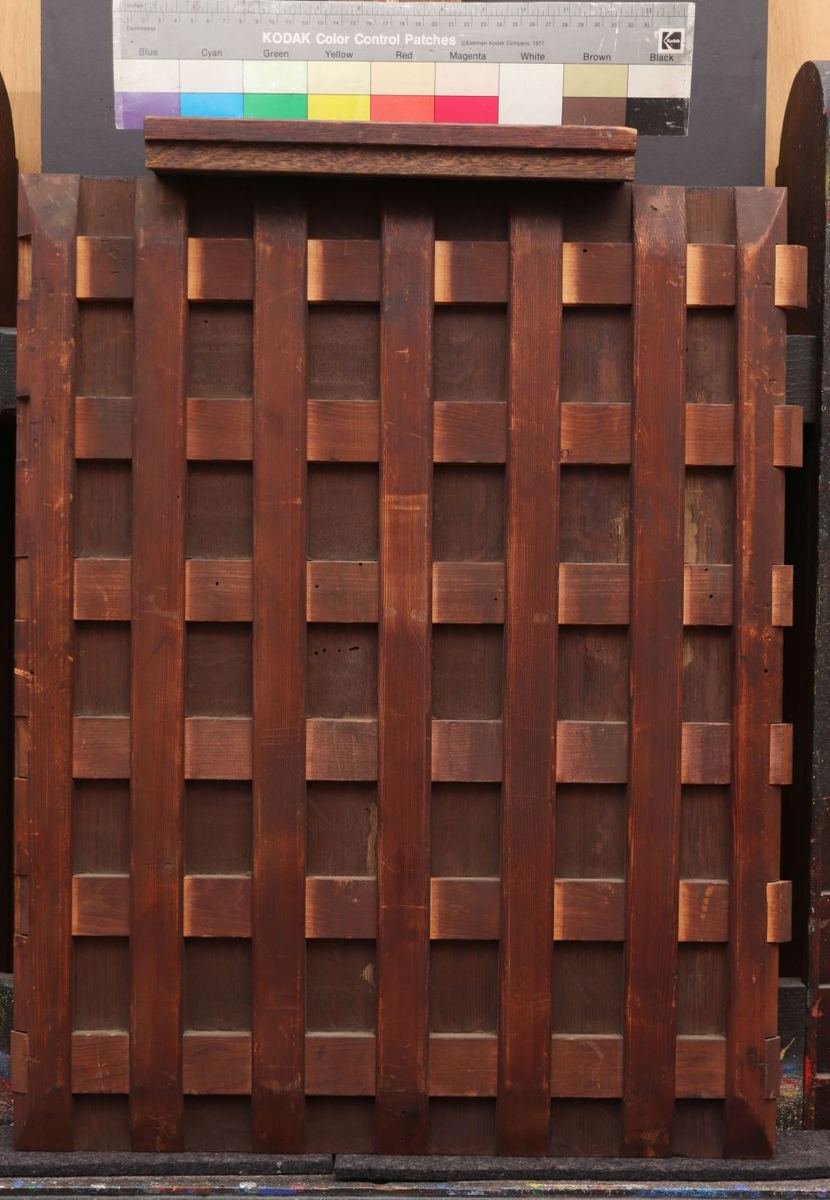
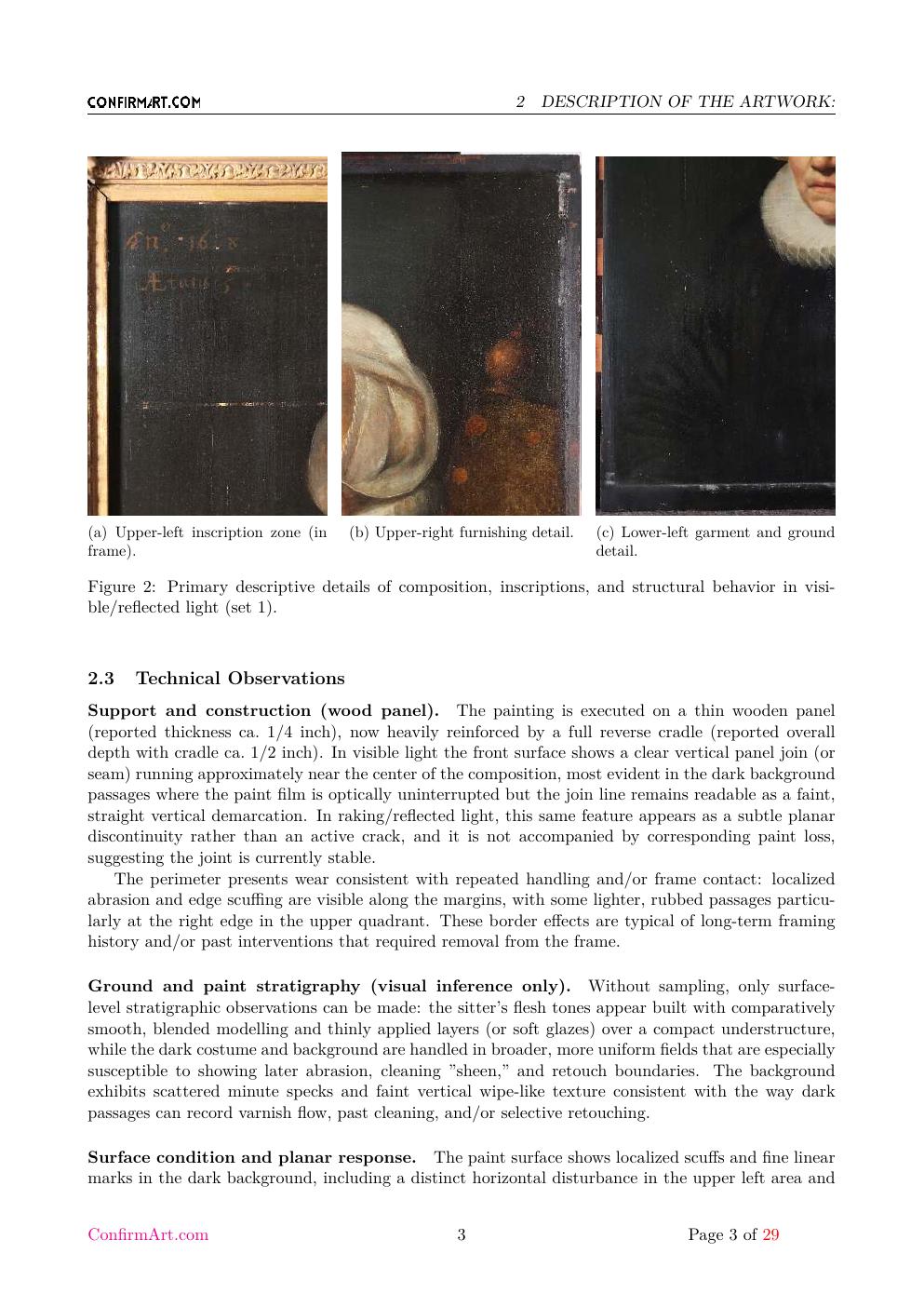
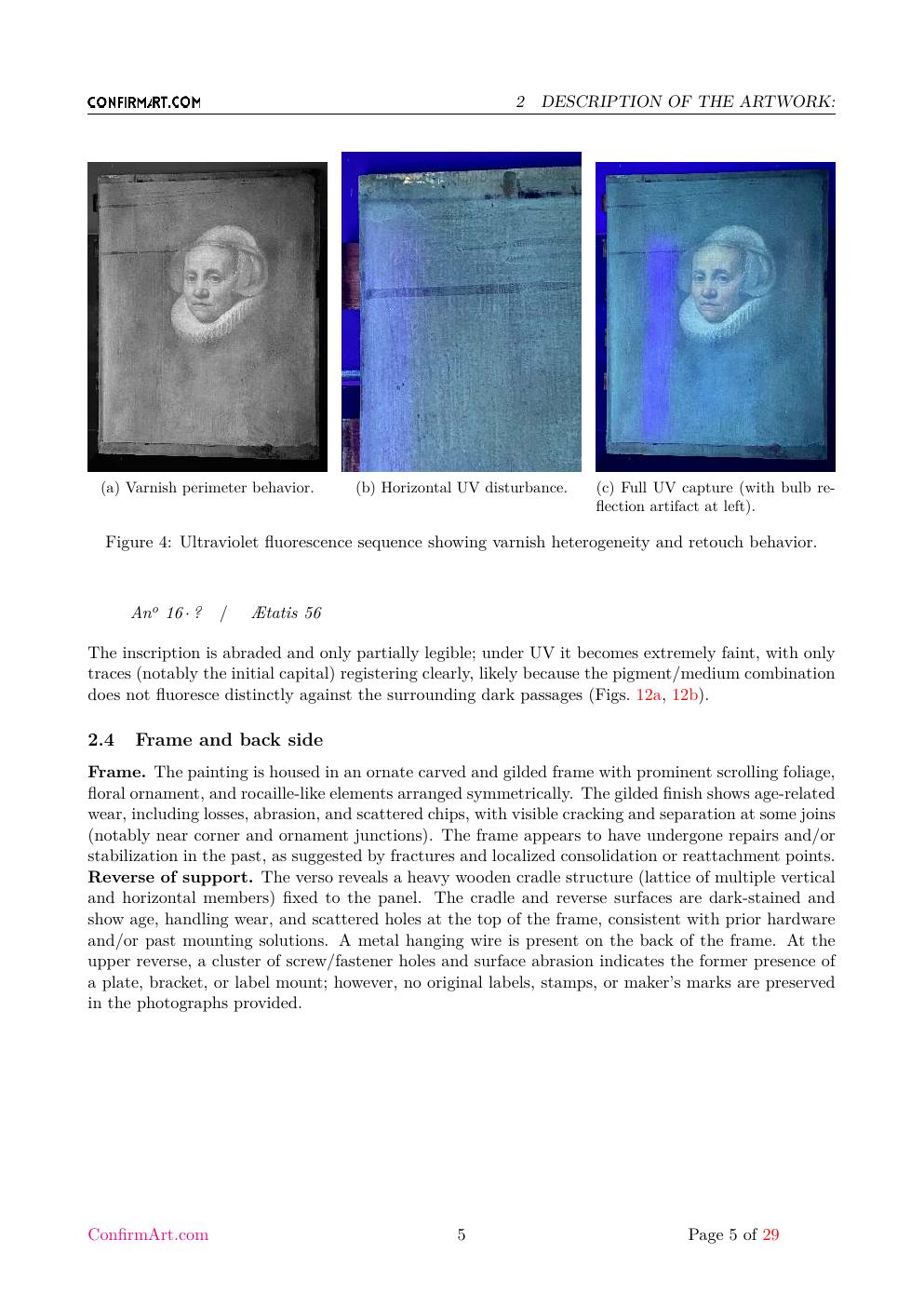
Support and construction (wood panel). The painting is executed on a thin wooden panel (reported thickness ca.\ 1/4 inch), now heavily reinforced by a full reverse cradle (reported overall depth with cradle ca.\ 1/2 inch). In visible light the front surface shows a clear vertical panel join (or seam) running approximately near the of the composition, most evident in the dark background passages where the paint film is optically uninterrupted but the join line remains readable as a faint, straight vertical demarcati
03
Frame and back side
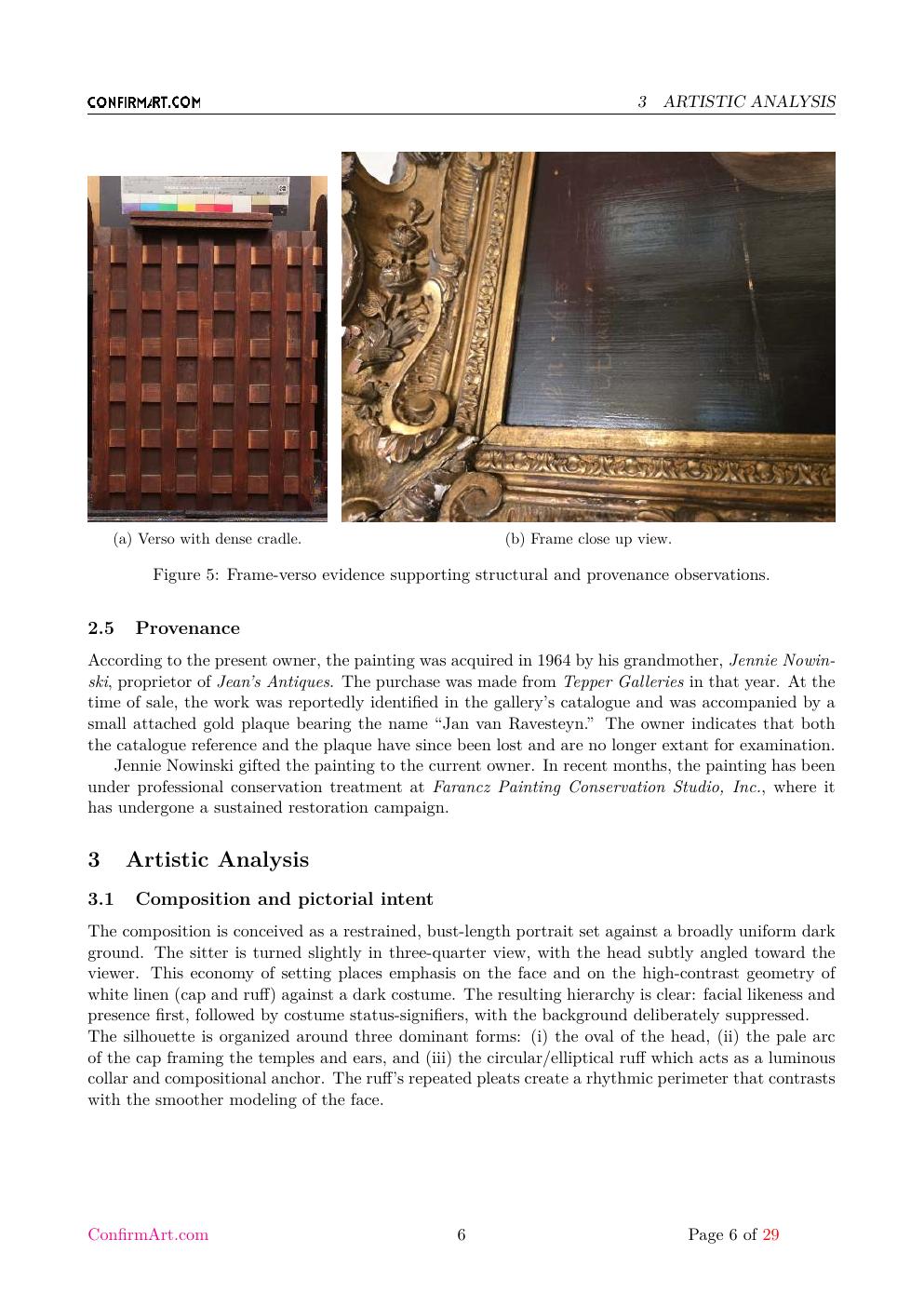
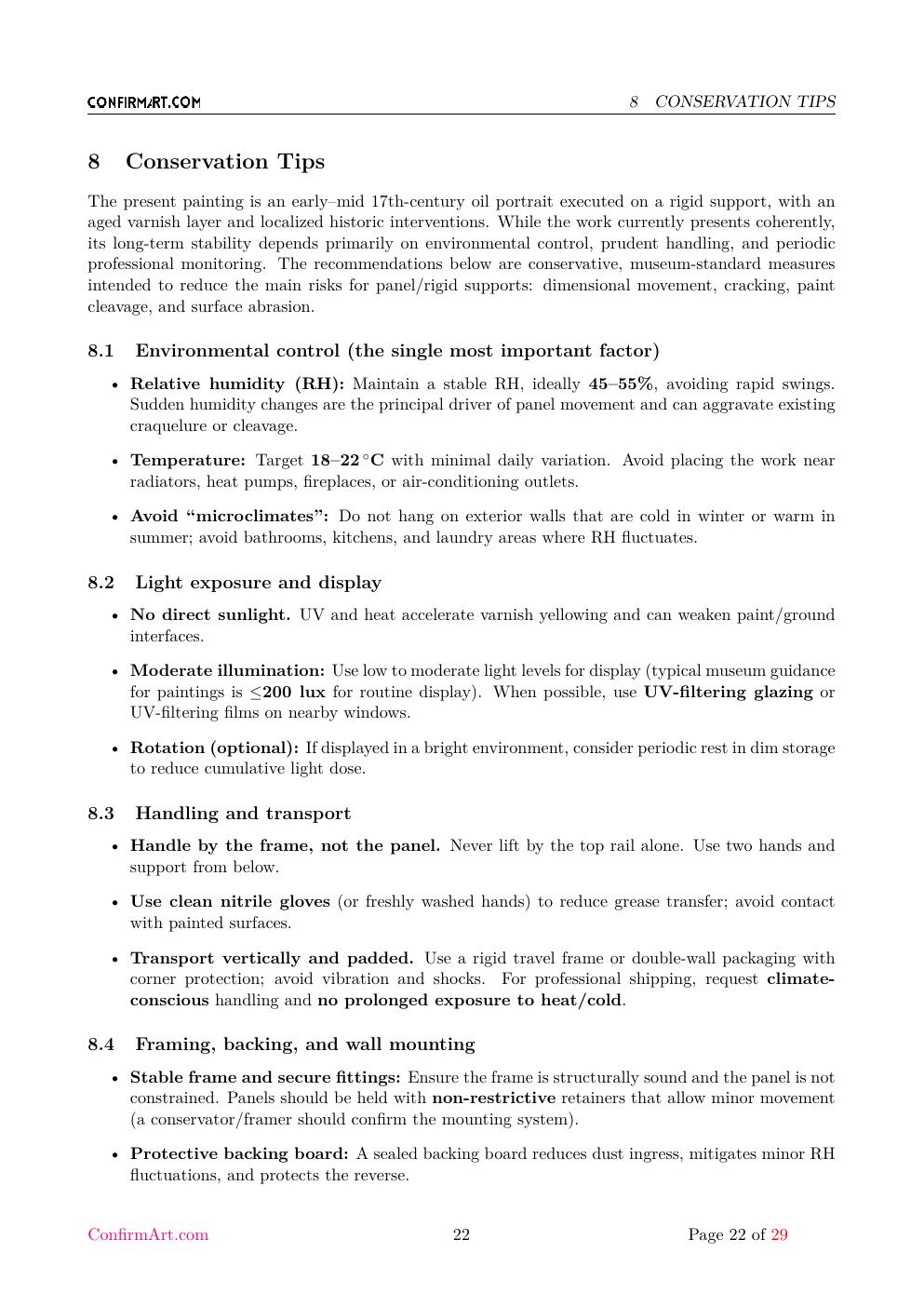
The painting is housed in an ornate carved and gilded frame with prominent scrolling foliage, floral ornament, and rocaille-like elements arranged symmetrically. The gilded finish shows age-related wear, including losses, abrasion, and scattered chips, with visible cracking and separation at some joins (notably near corner and ornament junctions). The frame appears to have undergone repairs and/or stabilization in the past, as suggested by fractures and localized consolidation or reattachment points.
04
Dating Statement (Working Estimate)
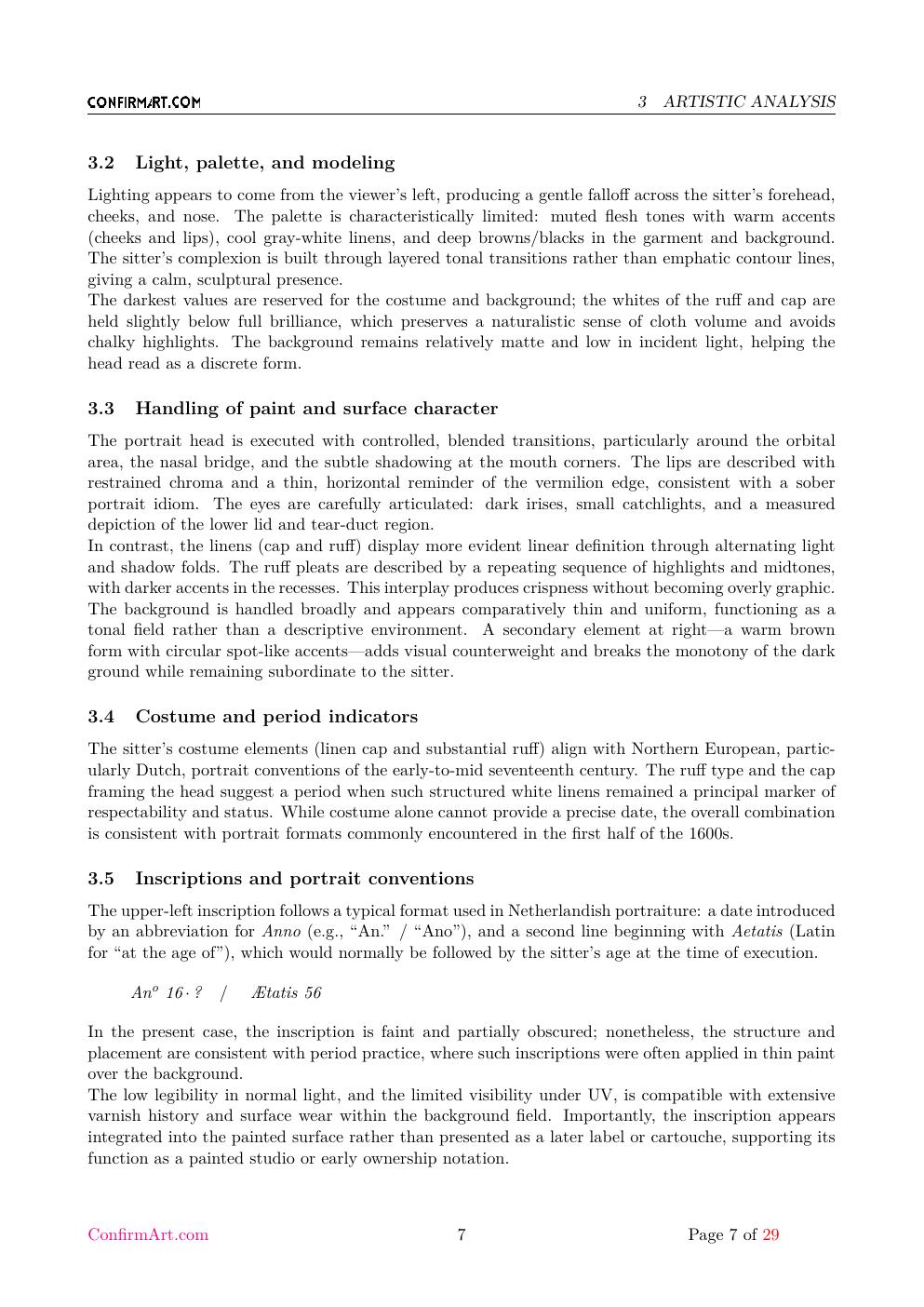
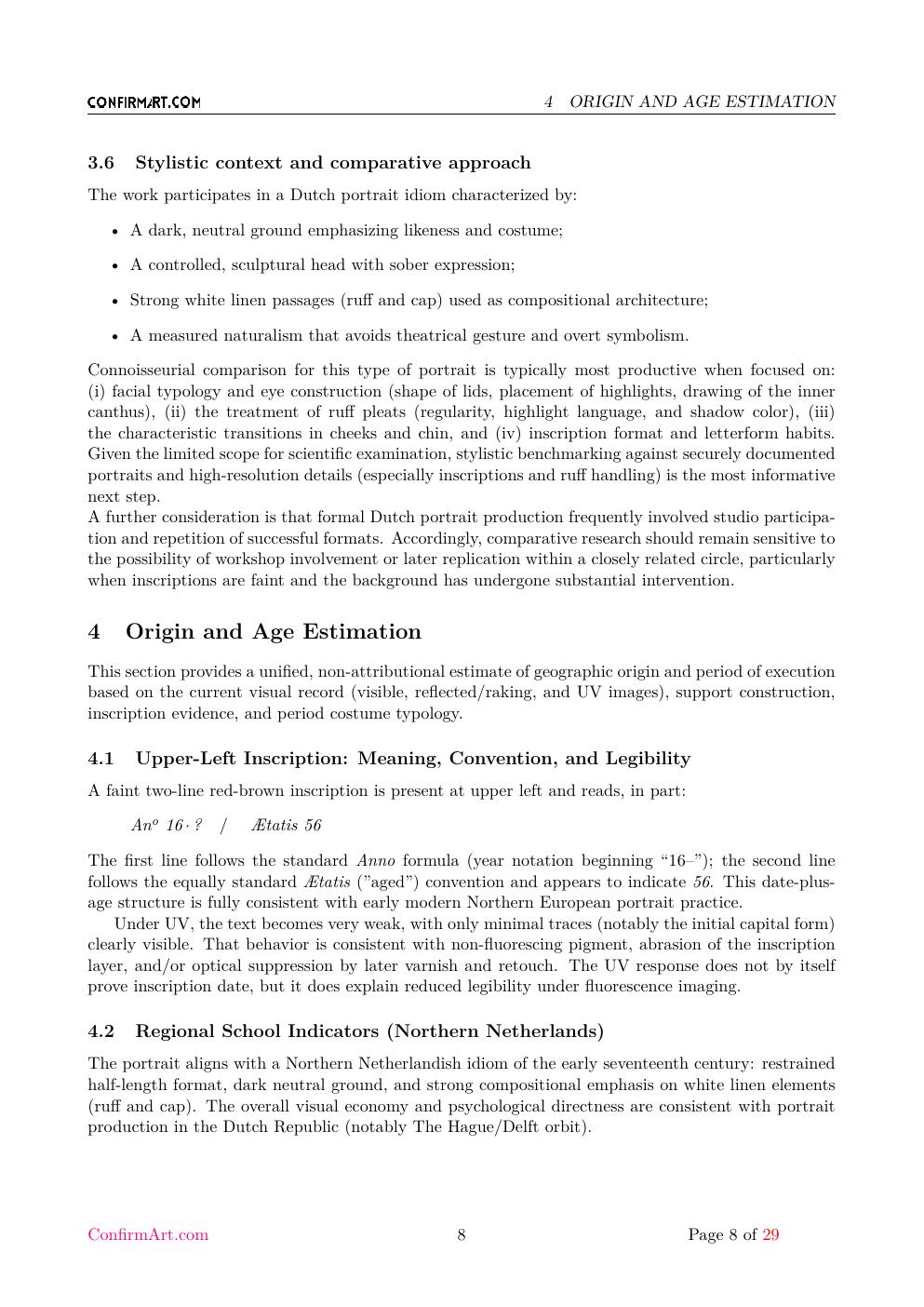
On current evidence, the work is most plausibly situated in: The Dutch Republic / Northern Netherlands, first half of the 17th century (approx.\ 1620s--1640s). This remains a provisional, non-attributional chronology pending any additional technical corroboration (for example, dendrochronology where feasible, stratigraphic study, and expanded comparative analysis). 0.32 Female type with lace ruff/cap (1613).
05
Differentiation from Michiel Jansz.\ van Mierevelt
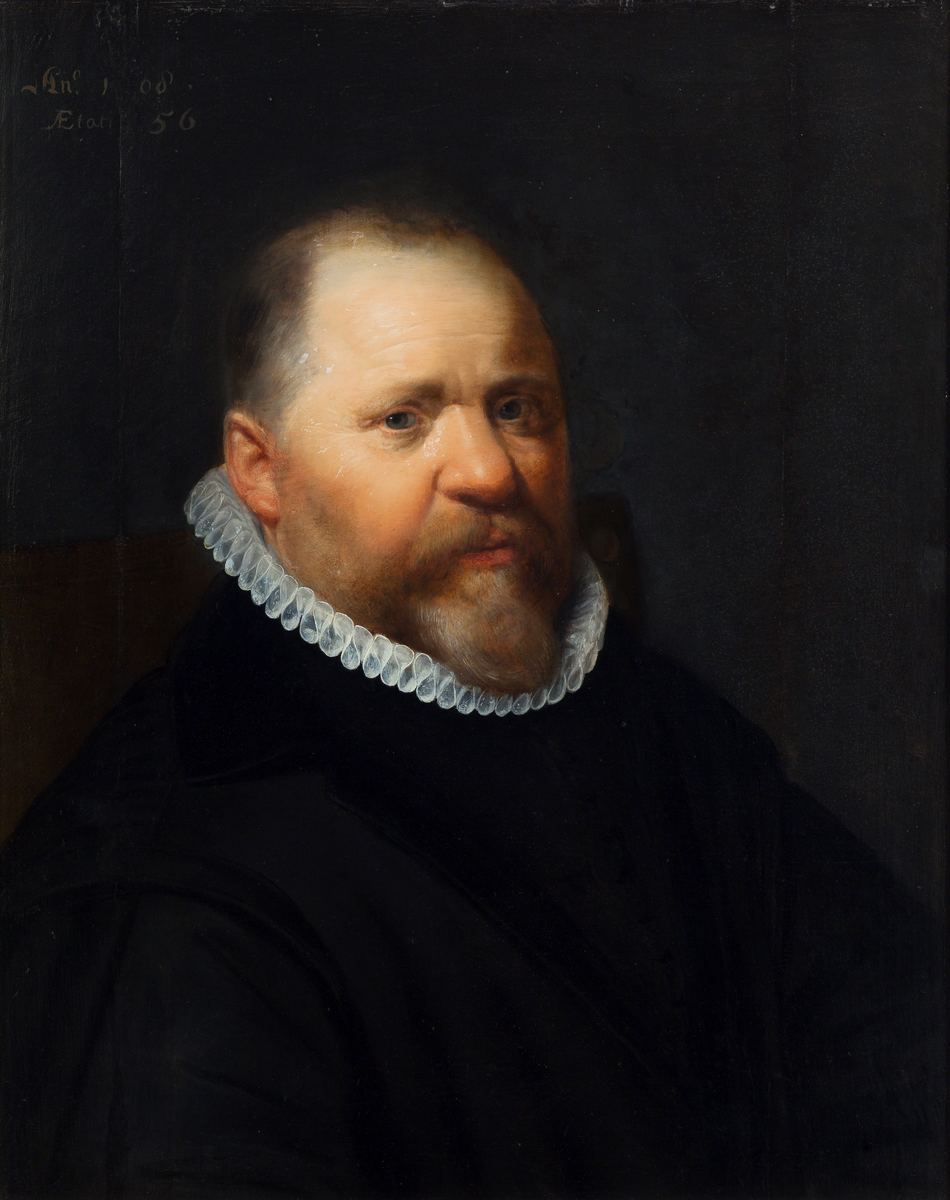
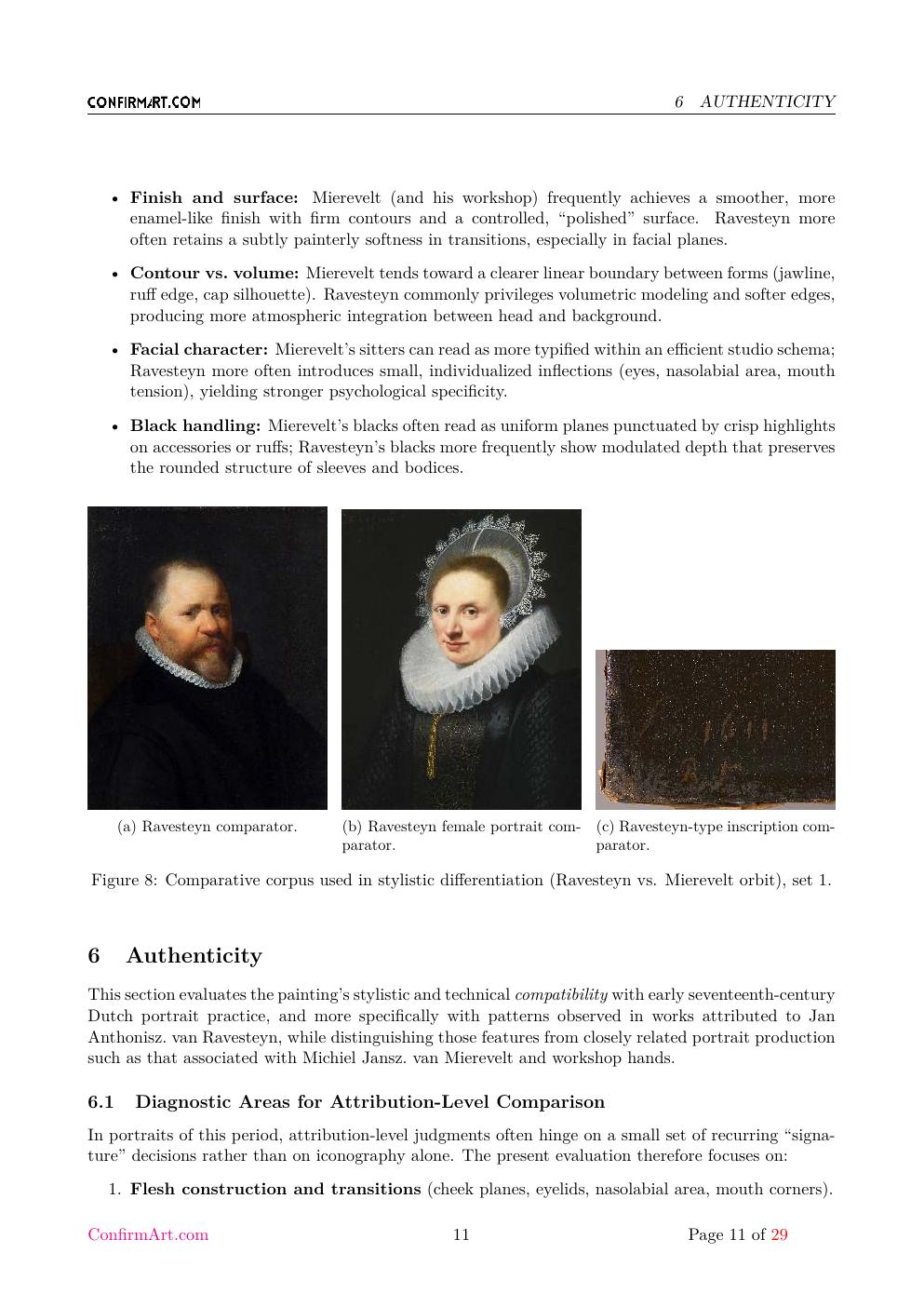
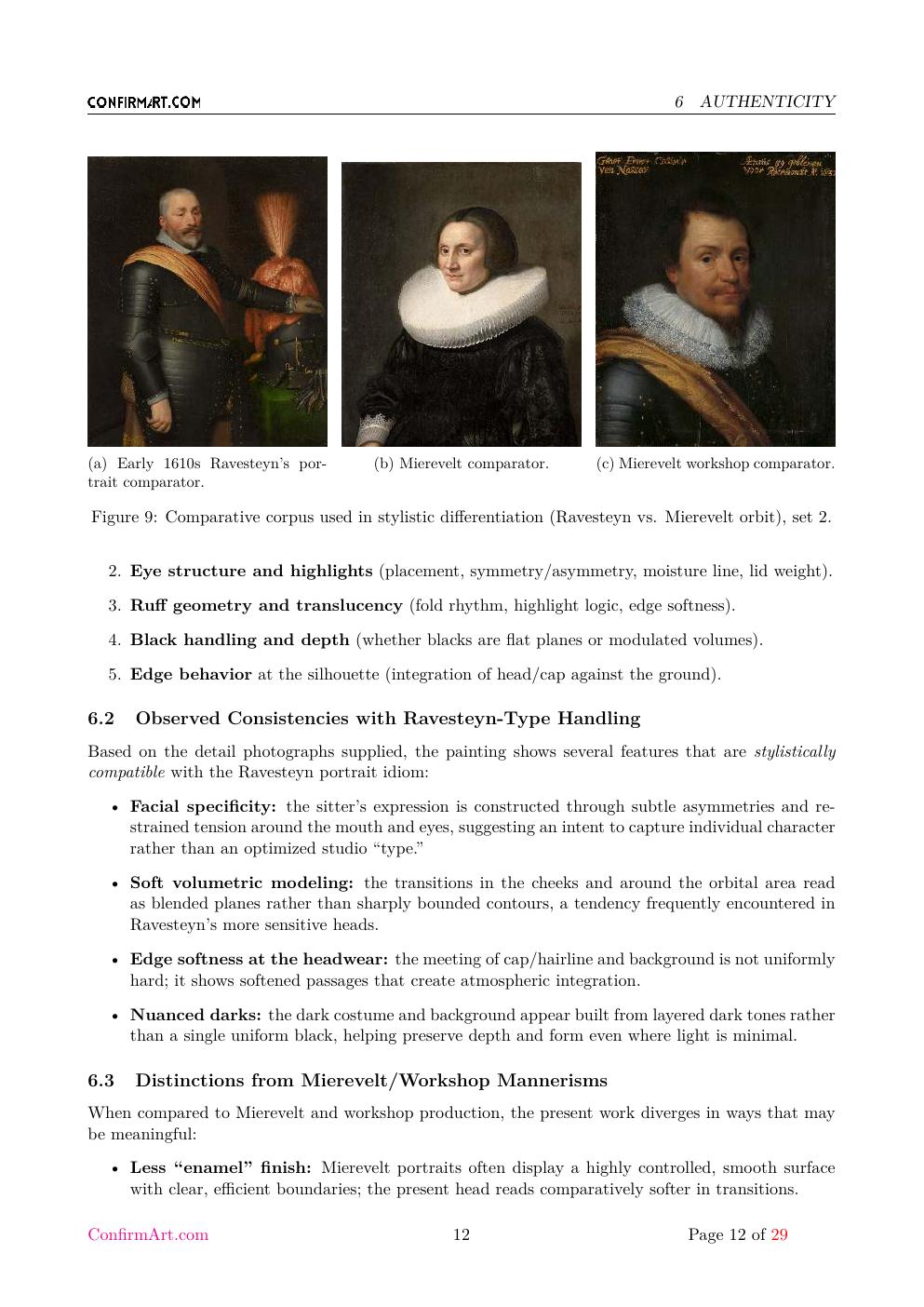
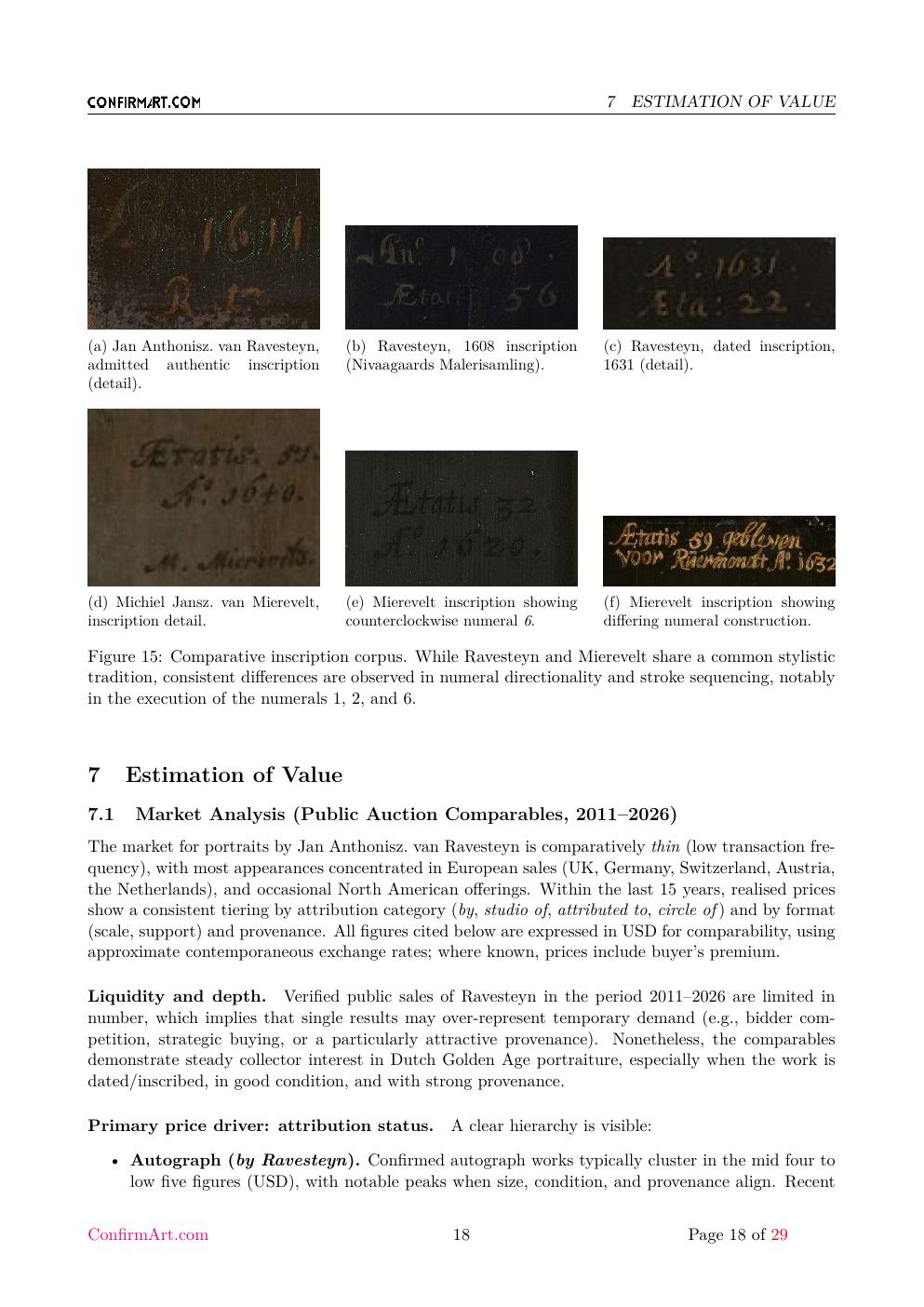
Michiel Jansz.\ van Mierevelt (Delft, 1566–1641) provides a useful comparator because his studio output established a highly influential, standardized portrait language that circulated widely. While the two painters share the same broader cultural and stylistic ecosystem, their typical emphases differ: Finish and surface: Mierevelt (and his workshop) frequently achieves a smoother, more enamel-like finish with firm contours and a controlled, "polished" surface. Ravesteyn more often retains a subtly painterly softne
06
Interim Statement (Prior to Inscription Analysis)
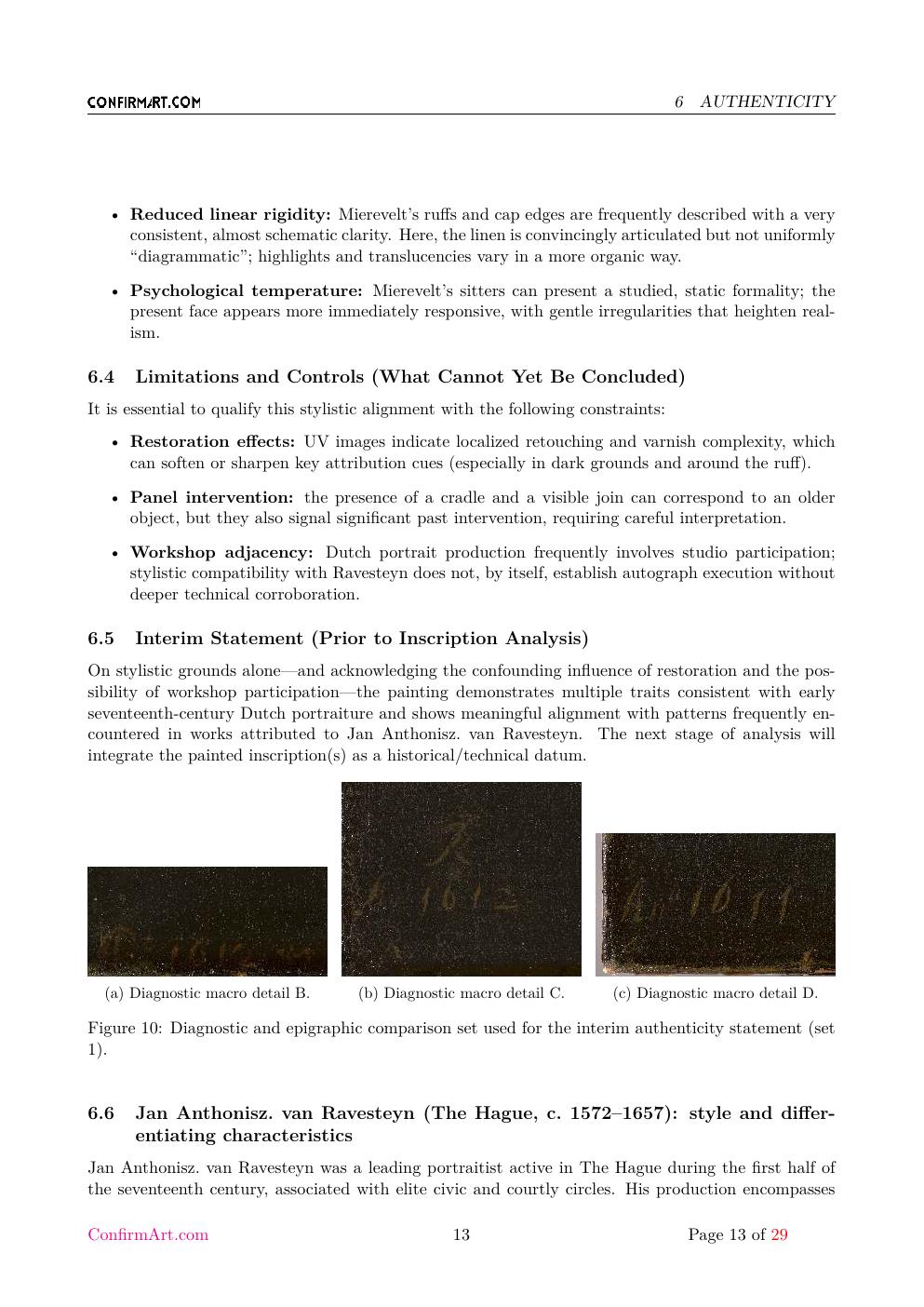
On stylistic grounds alone—and acknowledging the confounding influence of restoration and the possibility of workshop participation—the painting demonstrates multiple traits consistent with early seventeenth-century Dutch portraiture and shows meaningful alignment with patterns frequently encountered in works attributed to Jan Anthonisz.\ van Ravesteyn. The next stage of analysis will integrate the painted inscription(s) as a historical/technical datum. Diagnostic and epigraphic comparison set used for the interim
07
Inscription Analysis and Attribution Consistency
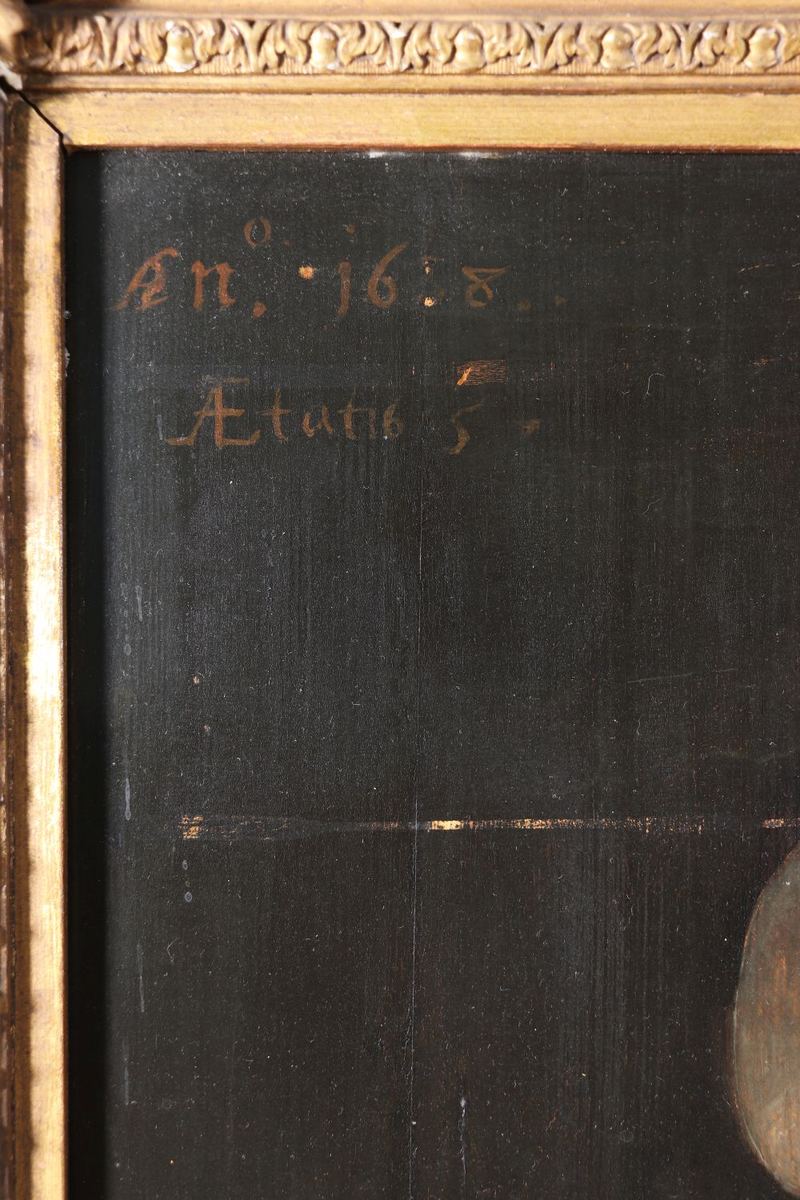
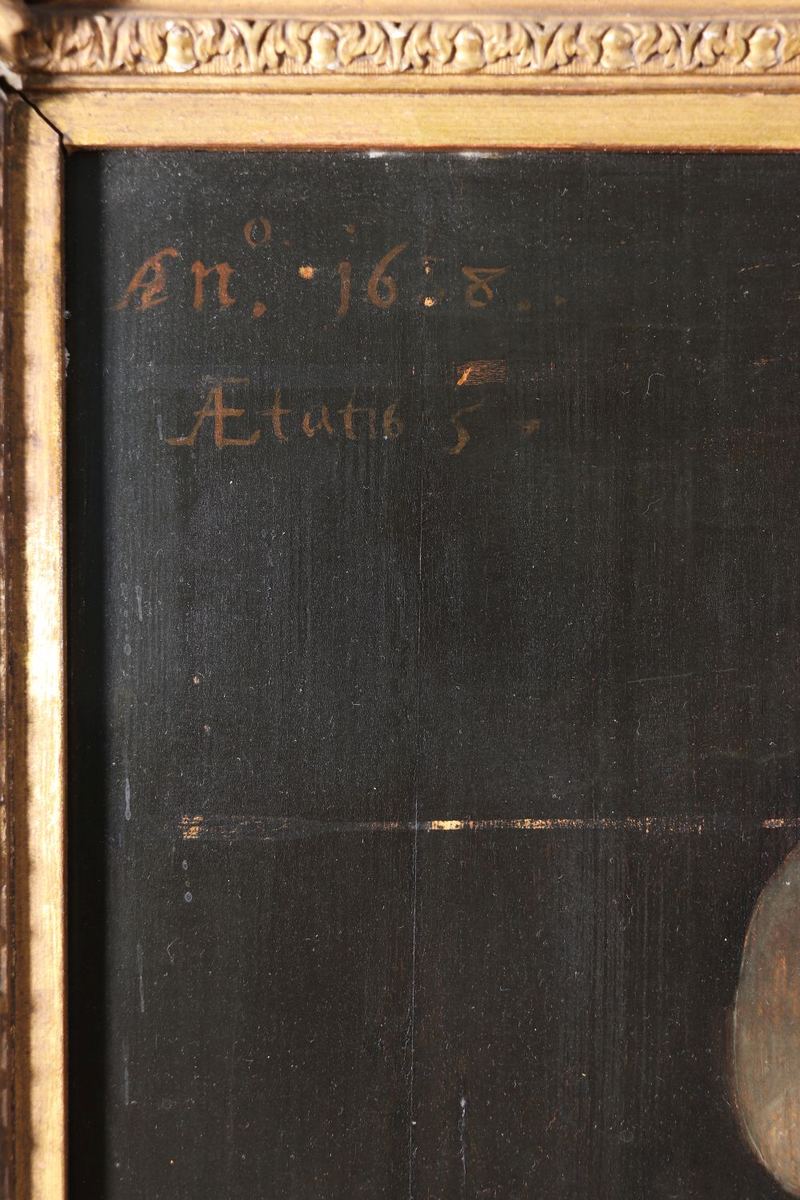
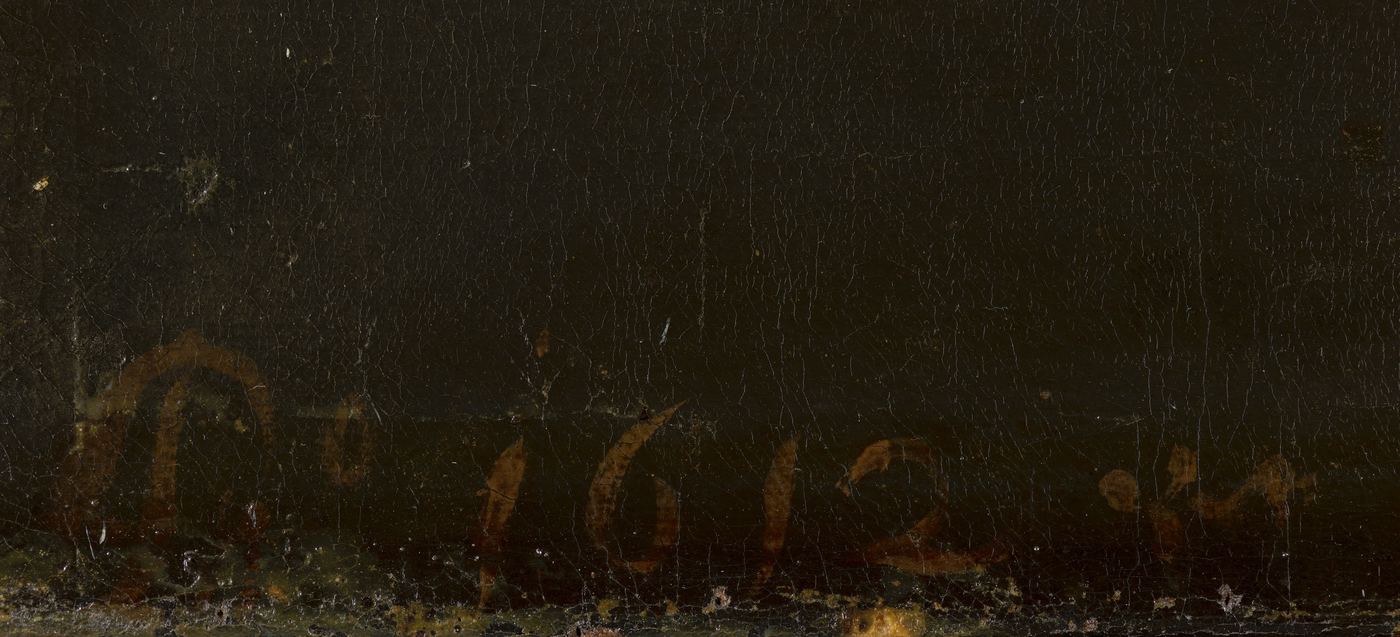
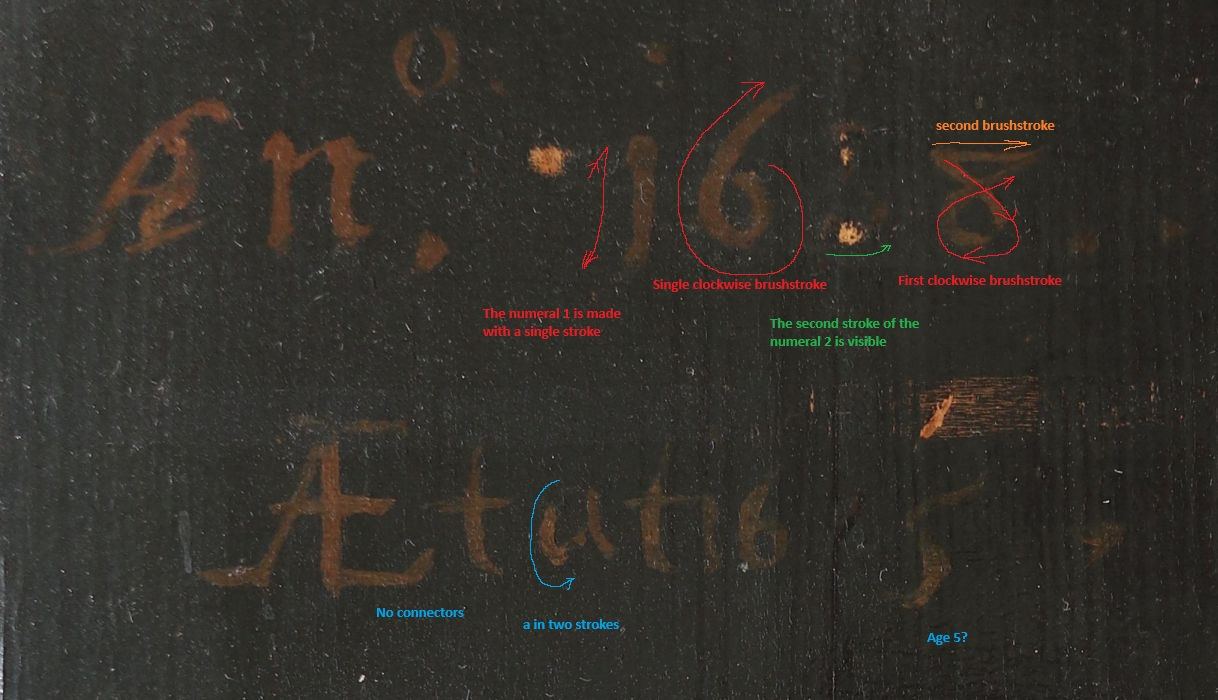
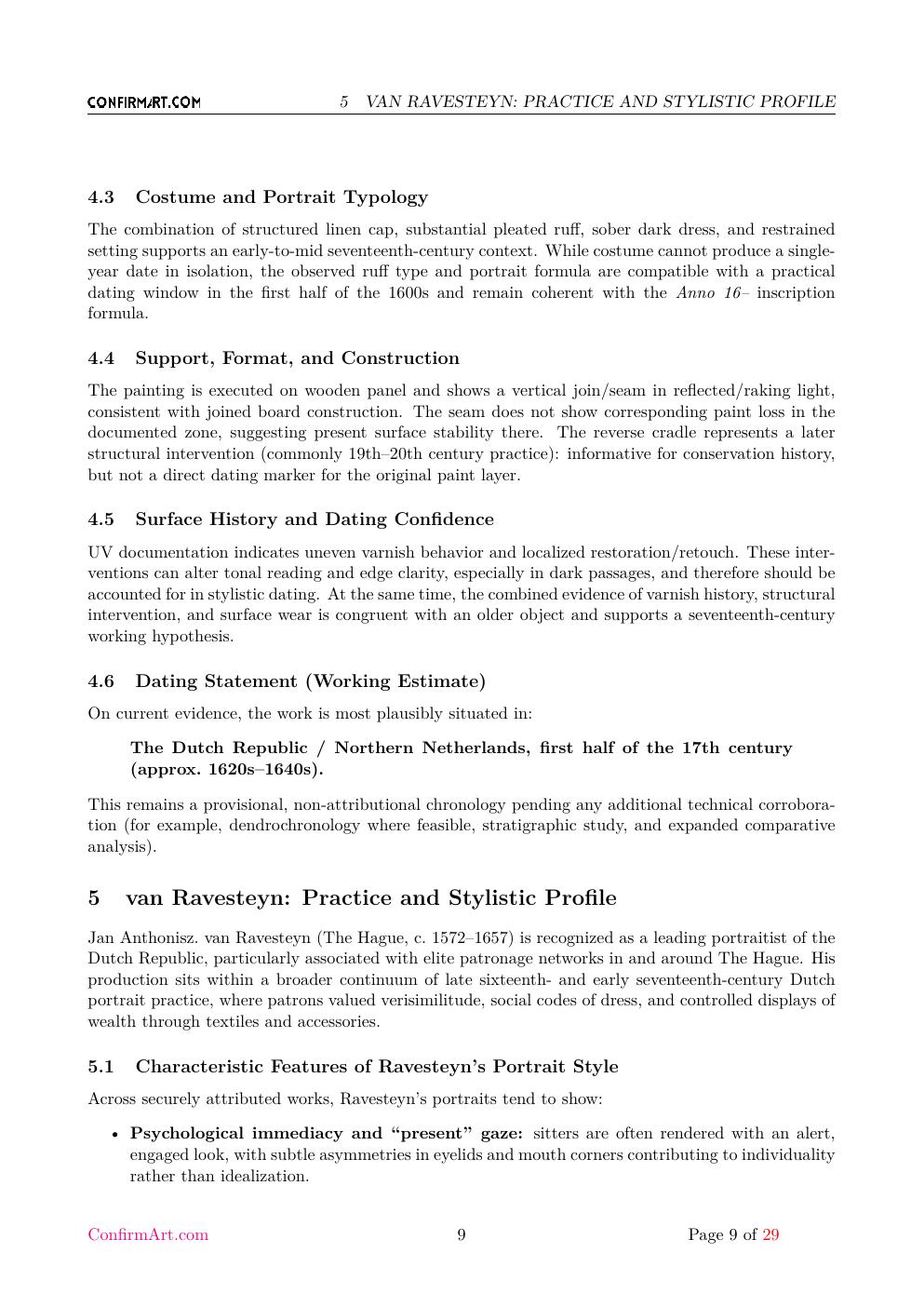
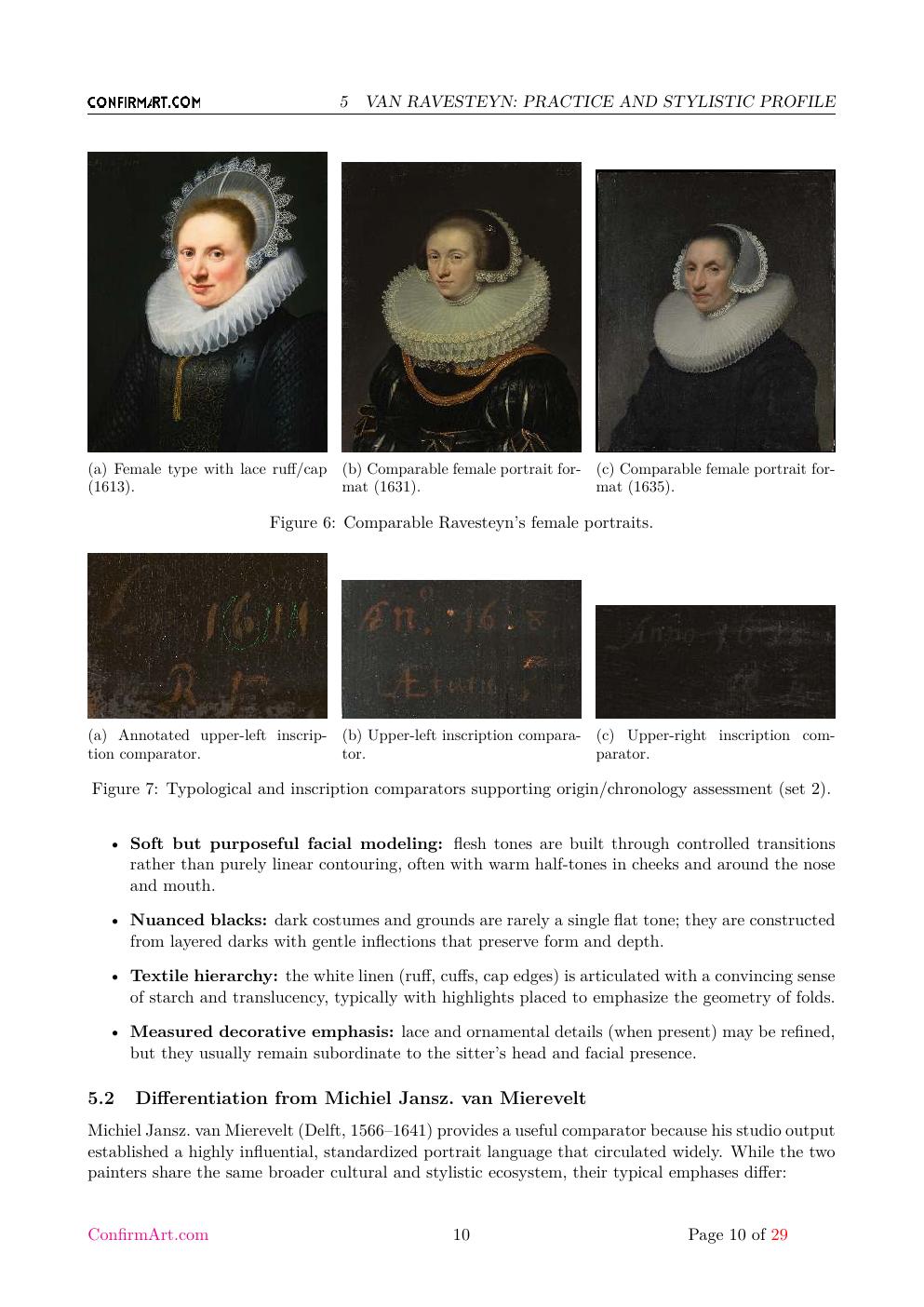
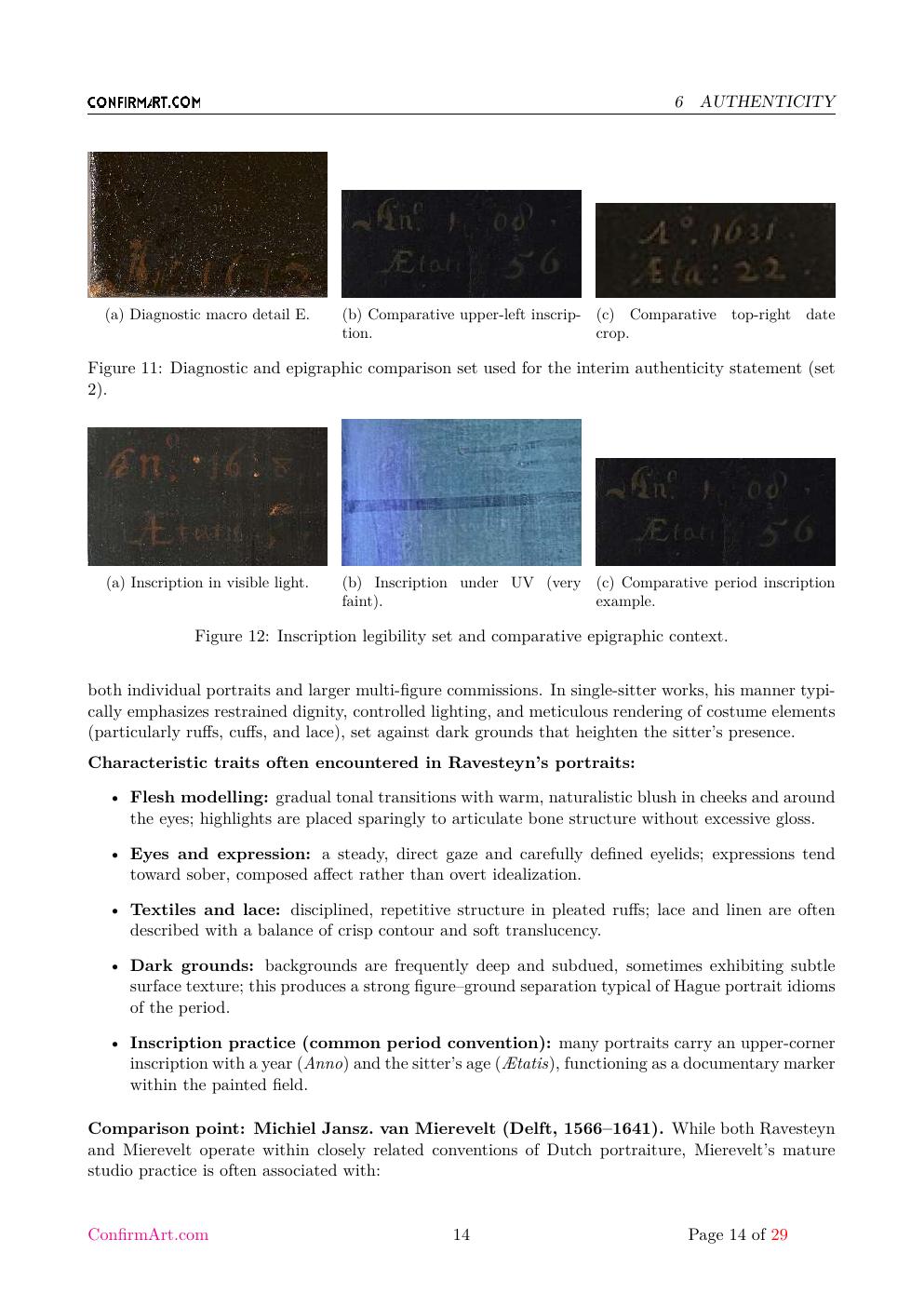
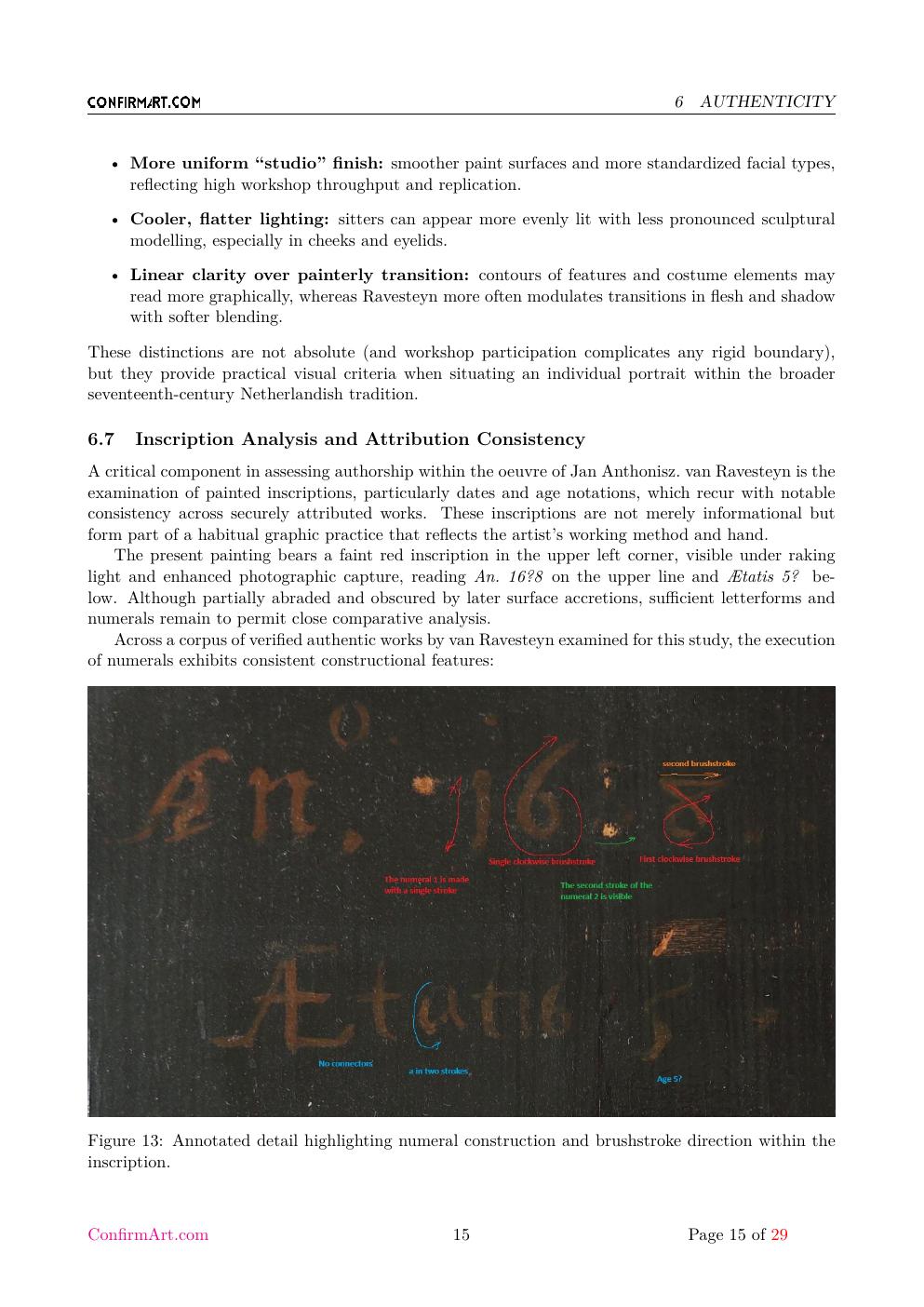
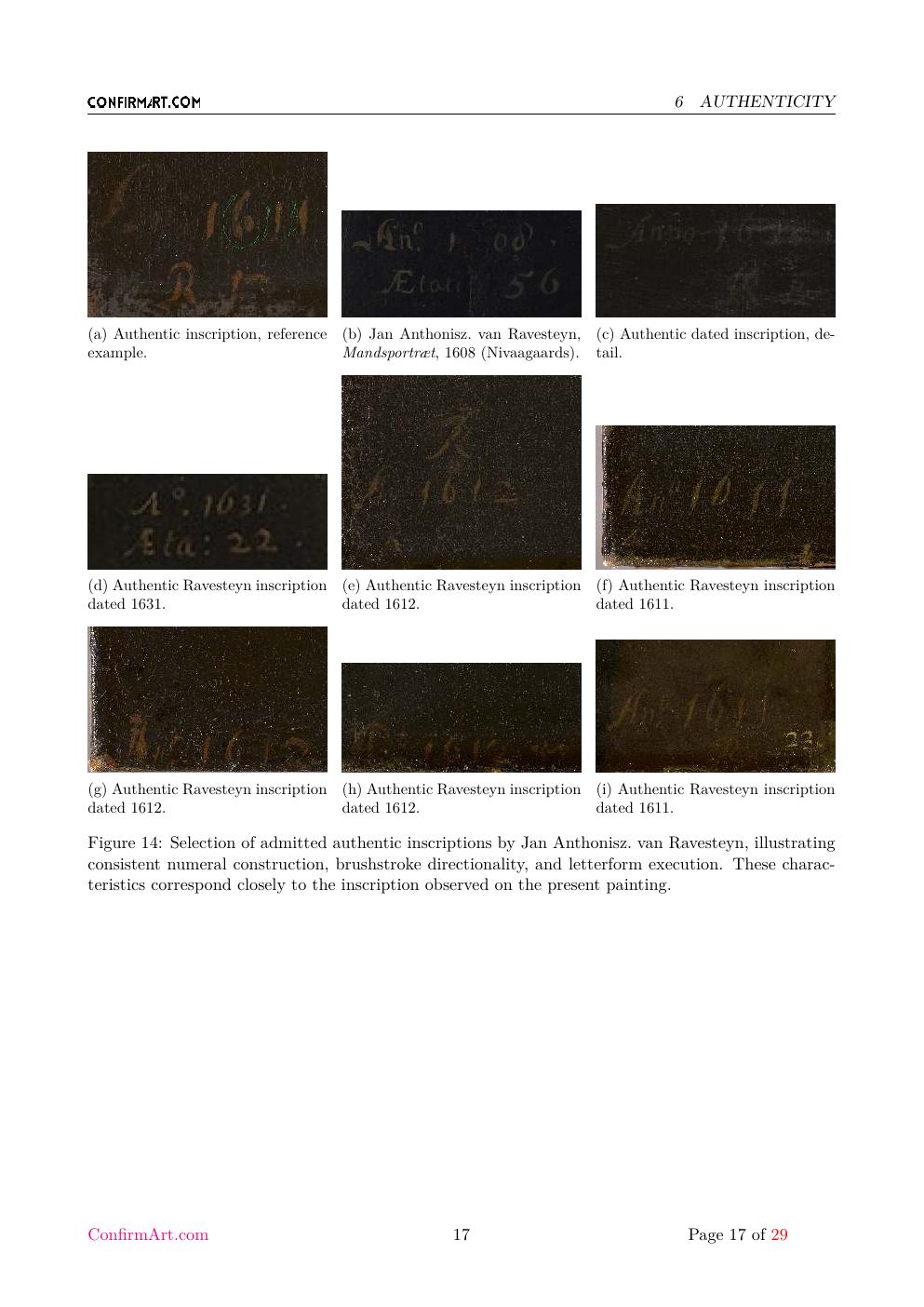
A critical component in assessing authorship within the oeuvre of Jan Anthonisz.\ van Ravesteyn is the examination of painted inscriptions, particularly dates and age notations, which recur with notable consistency across securely attributed works. These inscriptions are not merely informational but form part of a habitual graphic practice that reflects the artist's working method and hand. The present painting bears a faint red inscription in the upper left corner, visible under raking light and enhanced photograp
Authentication evidence
Selected close details from the human review
Description of the DocumentsThe section organizes the available documentation and provenance signals so the artwork can be reviewed as a traceable object, not only as an image.Technical ObservationsSupport and construction (wood panel). The painting is executed on a thin wooden panel (reported thickness ca.\ 1/4 inch), now heavily reinforced by a full reverse cradle (reported overall depth with cradle ca.\ 1/2 inch).Frame and back sideThe painting is housed in an ornate carved and gilded frame with prominent scrolling foliage, floral ornament, and rocaille-like elements arranged symmetrically. The gilded finish shows age-related wear, including losses, abrasion, and scattered chips, with visible cracking and separation at some joins (notably near corner and ornament junctions).Dating Statement (Working Estimate)On current evidence, the work is most plausibly situated in: The Dutch Republic / Northern Netherlands, first half of the 17th century (approx.\ 1620s--1640s). This remains a provisional, non-attributional chronology pending any additional technical corroboration (for example, dendrochronology where feasible, stratigraphic study, and expanded comparative analysis).Interim Statement (Prior to Inscription Analysis)On stylistic grounds alone—and acknowledging the confounding influence of restoration and the possibility of workshop participation—the painting demonstrates multiple traits consistent with early seventeenth-century Dutch portraiture and shows meaningful alignment with patterns frequently encountered in works attributed to Jan Anthonisz.\ van Ravesteyn. The next stage of analysInscription Analysis and Attribution ConsistencyA critical component in assessing authorship within the oeuvre of Jan Anthonisz.\ van Ravesteyn is the examination of painted inscriptions, particularly dates and age notations, which recur with notable consistency across securely attributed works. These inscriptions are not merely informational but form part of a habitual graphic practice that reflects the artist's working met
Private authentication
Submit your artwork for a ConfirmArt review
Use this real case as a reference for the kind of evidence that can be organized in a private authentication report.
The public browser receives rendered pages, not a native PDF viewer or direct PDF URL. Public pixels can still be screen-captured; private commissioned reports remain controlled client deliverables.
QR verification
Traceable real case
This real case has a stable verification URL and source fingerprints. The QR code resolves to the public verification record for this case.
Only your email and service selection are needed to submit the request. Optional images, dimensions and notes can be added now or later.
Payment is requested only for the Authentication report. Catalogue search, advisory, restoration and local inspection requests are reviewed first so the scope can be confirmed.
Authentication is a human expert review. ConfirmArt may use AI for bounded research support such as database, image, book or provenance searches, but not as a classifier verdict.
Complete front image
Reverse, support, frame and condition details
Signature, inscriptions, labels or seals
Invoices, certificates, provenance or catalogues
Comparative images, references or previous opinions, if available